Choose an upright if your home has substantial carpet, several rugs, pets, or one main vacuum must handle deep cleaning. Choose a stick vacuum if you mostly have hard floors, live in a smaller space, want something easy to grab, or have limited closet space; a cordless stick may be especially convenient, but its runtime and battery aging are trade-offs.
What Matters Most
Start With the Job: Deep Cleaning or Frequent Pickup?
An upright vacuum is generally the better fit when your main job is removing embedded dirt from wall-to-wall carpet or thick area rugs. Its motorized cleaning head and upright body put much of the machine’s weight over the brush, helping it work down into carpet fibers. Consumer Reports describes full-sized uprights as stronger performers for deep cleaning, particularly on carpet, although individual models vary. ([consumerreports.org](https://www.consumerreports.org/appliances/vacuum-cleaners/buying-guide/?utm_source=openai))
A stick vacuum is built around convenience. It is slimmer, easier to carry, and usually faster to bring out for crumbs, tracked-in grit, pet hair near a food bowl, or a quick pass through the kitchen. Modern stick models have improved, but Consumer Reports still notes that they generally do not match full-sized uprights for deep carpet cleaning. ([consumerreports.org](https://www.consumerreports.org/appliances/vacuum-cleaners/choose-the-right-vacuum-for-the-job-a8862503418/?utm_source=openai))
That difference matters most when you are choosing one vacuum for the whole home. If you already own a capable upright, a stick can be an excellent companion for daily messes. If you want only one machine, ask whether you are willing to trade some deep-cleaning ability for easier handling and more frequent use.
- Best starting point for an upright: carpet, rugs, pet hair, and larger homes.
- Best starting point for a stick: hard floors, small spaces, stairs, and quick cleanups.
How Each Type Handles Different Floors
For carpet, an upright usually has the advantage. The full-sized floor head, brush roll, and stronger overall design are suited to lifting debris that has settled below the surface. If your rooms are mostly carpeted or you have dense rugs, prioritize cleaning performance over the lightest possible weight.
For hardwood, tile, vinyl, and laminate, either type can work well when the floor head is designed for bare floors. A stick vacuum can feel more natural for these surfaces because it is light and easy to steer around chair legs and kitchen islands. Consumer Reports also advises using a soft-roller attachment, turning off the brush roll, or selecting a bare-floor setting when appropriate to help reduce the chance of scratching. ([consumerreports.org](https://www.consumerreports.org/home-garden/flooring/ways-to-clean-and-protect-your-floors-a6046705974/?utm_source=openai))
Look beyond the vacuum category and check the controls. A useful model should let you reduce or disable brush-roll action on delicate bare floors, adjust suction when needed, and reach close to baseboards. If you have a mix of floors, a versatile upright may be the safer one-machine choice; a strong stick can work well in a smaller, mostly hard-floor home.
- Mixed flooring: look for a height adjustment, floor-type setting, or brush-roll control.
- Hard floors: prioritize edge cleaning, a gentle floor head, and easy maneuverability.
- Thick rugs: check whether the head can be adjusted rather than simply relying on maximum suction.
Weight, Stairs, and Everyday Handling
Stick vacuums are typically much lighter than uprights. Consumer Reports lists stick vacuums at roughly 3 to 10 pounds and uprights at about 8 to 21 pounds across the category, though actual models vary. That difference is noticeable when you are cleaning stairs, carrying a vacuum between floors, or reaching under furniture. ([consumerreports.org](https://www.consumerreports.org/appliances/vacuum-cleaners/buying-guide/?utm_source=openai))
An upright can still be comfortable to push, especially on one level, but lifting it is a separate question. A heavier model may feel stable and capable on carpet yet become tiring if you need to carry it up stairs or over thresholds. Some uprights offer lift-away or detachable-pod designs that distribute the weight more easily, but inspect how the detached parts are carried and where the hose and tools go.
A stick is usually easier to grab with one hand and may convert into a handheld for upholstery, stairs, shelves, or a car. The trade-off is that a lightweight body can mean a smaller dustbin, narrower cleaning path, or less capacity between emptying sessions. If you dislike bending, compare the bin-release design and whether emptying requires your hand to get near the collected debris.
Storage: The Upright Is Not Always the Bulky Choice
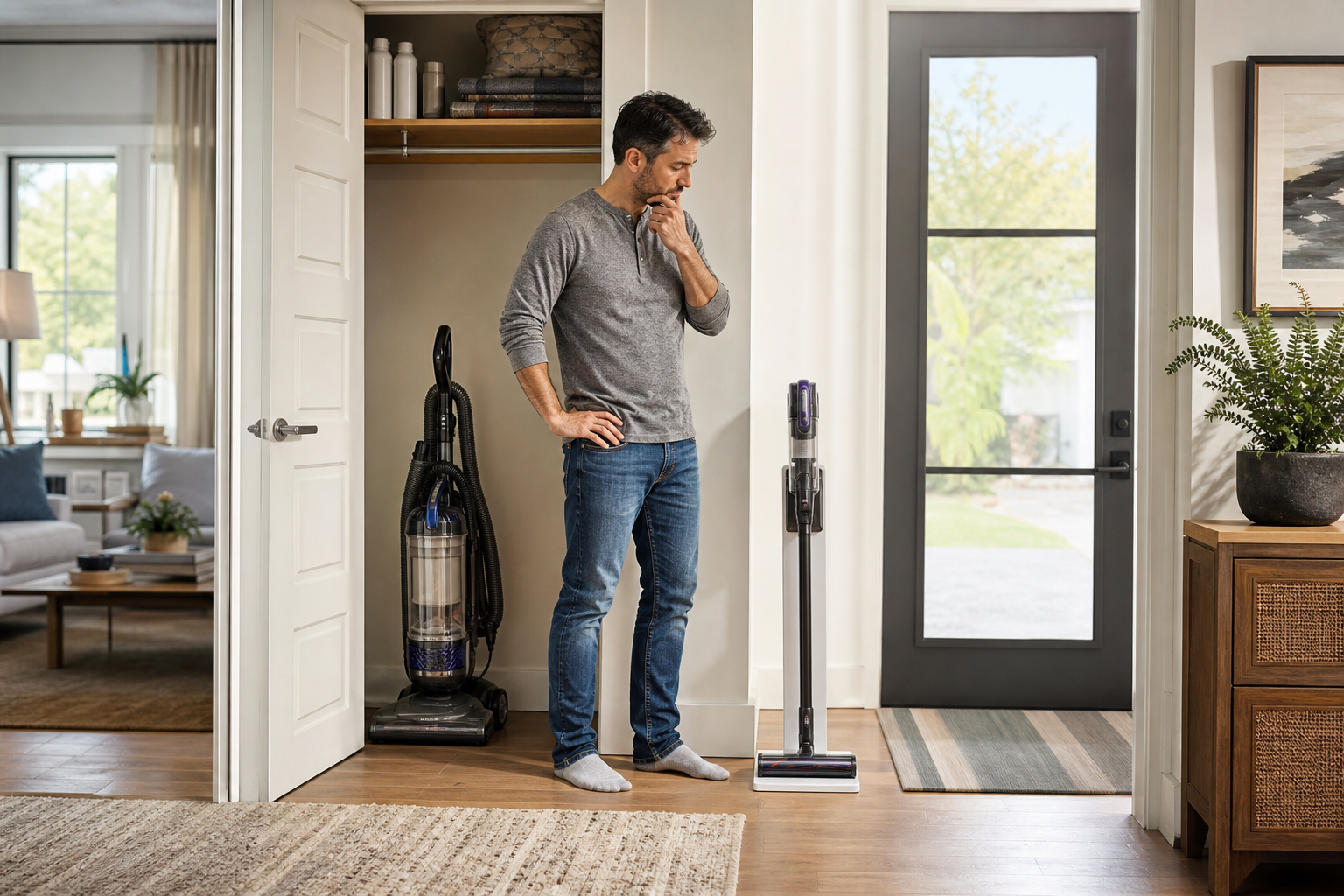
Storage is one of the clearest reasons to consider a stick vacuum. Many sticks have a narrow profile and can stand on a wall dock, floor stand, or compact charging mount. That can make them easier to keep near the kitchen or entryway instead of hiding them in a deep closet.
An upright takes more visual space, but its vertical shape can be efficient in a closet. Consumer Reports specifically notes that uprights can be easier to store than canister vacuums because they have a smaller footprint. ([consumerreports.org](https://www.consumerreports.org/appliances/vacuum-cleaners/buying-guide/?utm_source=openai)) A stick may be slimmer overall but still need room for a charging dock, accessories, and a battery charger.
Measure the storage location before buying. Check the machine’s full height, whether the handle folds, whether the dock must be wall-mounted, and how much room the hose and attachments require. If you rent, have limited wall space, or prefer not to install a dock, a freestanding stick or compact upright may be more practical than a wall-mounted system.
- Best for a shallow closet: a compact upright or slim stick with onboard tools.
- Best for visible everyday storage: a stick with a stable floor stand or tidy wall dock.
- Do not forget accessory storage; a vacuum body that fits does not guarantee its tools will.
Corded vs. Cordless: The Decision Inside the Decision
A corded upright is ready whenever you are and does not depend on battery capacity. That makes it appealing for larger homes, long cleaning sessions, and anyone who wants consistent power without planning around a charge. The downside is managing the cord, changing outlets, and working around a cable on stairs or between rooms.
Most stick vacuums are cordless, though corded sticks still exist. Cordless models remove the outlet problem and are often the easiest option for quick pickups, but runtime depends on the power setting, floor head, battery condition, and model design. Consumer Reports reports that high-power cleaning on cordless sticks may provide only about 10 to 15 minutes on one charge in many cases, while manufacturer maximum-runtime claims are usually measured under specific lower-demand conditions. ([consumerreports.org](https://www.consumerreports.org/appliances/vacuum-cleaners/choose-the-right-vacuum-for-the-job-a8862503418/?utm_source=openai))
For example, Dyson’s official Gen5 information lists up to 70 minutes of suction, while also specifying a particular machine configuration and operating conditions. That illustrates why runtime numbers should be treated as a ceiling rather than a promise for a full-home cleaning session. ([dyson.com](https://www.dyson.com/discover/innovation/new-machines/gen5detect-gen5outsize-launch?utm_source=openai)) Look for removable or replaceable batteries, the cost and availability of a spare, charging time, and whether the vacuum can remain stored on its charger.
Which One Fits Your Home?
Choose an upright when carpet and rugs dominate, you want one primary vacuum, or your cleaning routine includes larger weekly sessions. It is also the more reassuring choice when you regularly deal with embedded grit, substantial pet hair, or a large floor area. A bagged upright may appeal if you prefer less dust exposure when emptying; a bagless version avoids replacement bags but requires more attention to filters and bin cleaning.
Choose a stick vacuum when most of your floors are hard surfaces, your home is compact, or convenience is what determines whether cleaning actually happens. It is a strong fit for apartments, single-level homes, kitchens, entryways, and households that prefer several short cleaning sessions rather than one large one. A high-performing stick can serve as the only vacuum in a small mostly hard-floor home, but it may feel underpowered or require more passes on thick carpet. ([consumerreports.org](https://www.consumerreports.org/appliances/vacuum-cleaners/buying-guide/?utm_source=openai))
If your home has two levels, extensive carpet, or a mix of deep-cleaning and daily pickup needs, a two-vacuum setup can be sensible: an upright for primary cleaning and a stick for stairs and quick messes. If budget or storage allows only one, let your most demanding floor—not your easiest floor—make the decision.
- Pick upright first: mostly carpet, large home, pets, one-vacuum household, long cleaning sessions.
- Pick stick first: mostly hard floors, limited storage, stairs, small home, frequent quick pickups.
- Consider both: large or multilevel home where carrying the primary vacuum is inconvenient.
Buying Checklist Before You Compare Models
For an upright, compare the vacuum’s weight, turning feel, cleaning-head width, hose reach, brush-roll controls, height adjustment, cord length, bag or bin capacity, and tool storage. A model that cleans well but is difficult to steer or lift may stay in the closet, so handling deserves equal attention.
For a stick, compare measured weight in the configuration you will actually use, not just the handheld body. Check the high-power runtime, charging time, battery replacement policy, dustbin size, filter-washing instructions, stand or dock requirements, and whether the floor head lies flat enough to reach under furniture. If you have rugs, confirm that the model is intended for them rather than marketed only for bare floors.
Finally, confirm the manufacturer’s instructions for your flooring. Avoid assuming that a premium price guarantees the right brush roll, battery life, or storage arrangement. The best match is the vacuum whose limits fit your rooms, routine, and available space.
Sources & editorial note
This guide is research-based and does not claim hands-on testing unless explicitly stated.
- Consumer Reports — Choose the Right Vacuum for Your Home — Supports category-level comparisons for cleaning performance, weight, storage, floor types, corded and cordless trade-offs, and typical use cases.
- Consumer Reports — How to Choose the Right Vacuum for the Job — Supports guidance on uprights for carpet, sticks for targeted cleaning, battery-runtime limitations, and two-vacuum households.
- Consumer Reports — Best Way to Clean and Protect Your Floors — Supports recommendations about brush-roll settings, soft rollers, and selecting appropriate tools for bare floors.
- Dyson — Gen5detect and Gen5outsize Launch Information — Provides an official manufacturer example of cordless runtime claims and the conditions and configuration associated with them.