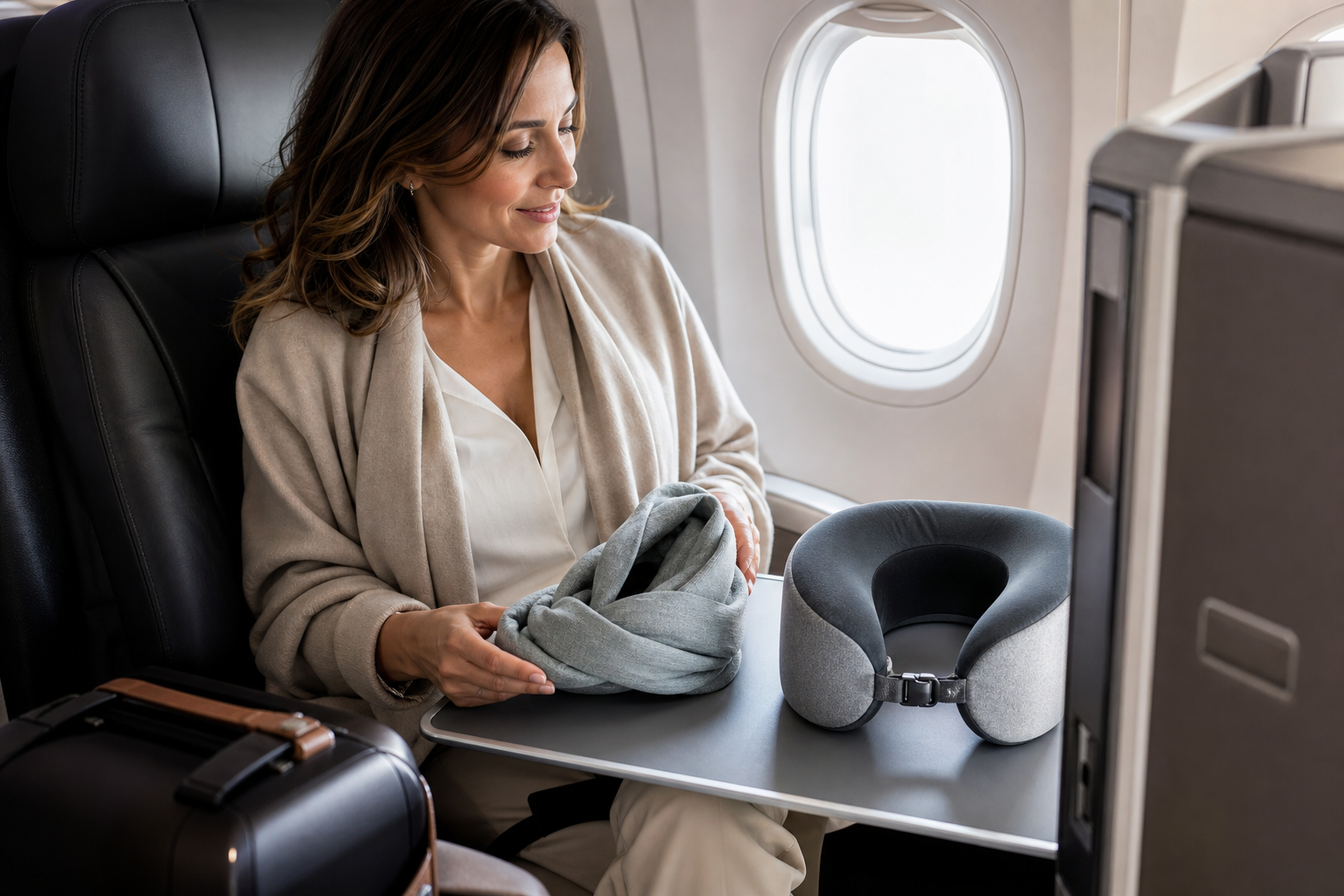
Choose a neck wrap if your priority is the smallest, least fussy option for planes, trains, car rides, and waiting areas. Choose a travel pillow if you want more substantial support for sleeping, especially on longer journeys or in seats where your head tends to fall sideways or forward. The most portable designs blur the line: some pillows wrap like scarves, while some neck wraps contain foam or internal support.
What Matters Most
The short answer: neck wraps are usually easier to carry, travel pillows are usually easier to sleep with
For pure portability, a neck wrap has the advantage. A scarf-like design can be worn around your neck between uses, tucked into a coat pocket, or compressed into a small pouch. It does not have the instantly recognizable bulk of a traditional U-shaped pillow, and it is less likely to snag on a bag or take up space in an already-full personal item.
For support, a travel pillow generally has the edge because it is designed to hold a shape around the neck. Memory foam, inflatable chambers, molded foam, raised side sections, chin closures, and seat straps can all provide more structure than a simple fabric wrap. Some wrap-style pillows, such as the Trtl Travel Pillow, combine a scarf-like shape with an internal support panel and weigh 4.7 ounces, according to the manufacturer. ([trtltravel.com](https://trtltravel.com/collections/all-products/products/trtl-travel-pillow?utm_source=openai))
That means the real choice is not simply pillow versus wrap. It is structured support versus flexible convenience. If you want something you can forget you are carrying, start with a neck wrap. If you want an aid for sleeping upright, start with a travel pillow and then look for a compact design.
- Easiest to carry: soft neck wrap
- Easiest to sleep with: structured travel pillow
- Best compromise: wrap-style pillow with internal support
Which one takes up less space?
A basic neck wrap is usually the simpler packing choice because it has little or no rigid structure. It can flatten against the back of a suitcase, fit in a jacket pocket, or stay around your neck while you move through an airport. If you already wear a scarf while traveling, a wrap can feel like one more layer rather than another accessory to manage.
Travel pillows vary widely. A classic inflatable pillow may pack very small but needs inflation and can feel less substantial. Foam pillows are more comfortable for some travelers but occupy more volume unless they include a compression bag. Cabeau says its Evolution S3 compresses to one-third of its original size in the included case, while Ostrichpillow says its Go Neck Pillow reduces in volume by up to 60%. ([cabeau.com](https://cabeau.com/products/evolution-s3-neck-pillow?utm_source=openai))
Pay attention to packed volume rather than the product’s uncompressed shape. A pillow that looks large in a product photo may be manageable if it comes with a useful case and luggage clip. Conversely, a supposedly compact item can become annoying if the storage pouch is easy to lose or the pillow cannot be compressed without a wrestling match.
- For the smallest personal item: choose a soft, flat wrap.
- For more support without full-size bulk: choose a compressible foam pillow.
- For occasional use: a pillow that clips to luggage may be easier than one packed inside your bag.
Which one is easier to put on and adjust?
A neck wrap usually wins on first-use simplicity. You place it around your neck, pull or fasten the closure, and adjust the tension. Some designs use hook-and-loop closures, toggles, or an internal elastic system. Ostrichpillow’s Go Neck Pillow, for example, uses a broad hook-and-loop closure and is designed to be wrapped around the neck and adjusted for fit. ([help.ostrichpillow.com](https://help.ostrichpillow.com/en-US/go-neck-pillow-product-details-894093?utm_source=openai))
A structured travel pillow may take a little more trial and error. You may need to position the highest section under your jaw, rotate the pillow to one side, tighten a front clasp, or attach straps to the seat. Cabeau’s Evolution S3 includes a seat-strap system and adjustable front clasp, which can improve stability but adds steps before you can settle in. ([cabeau.com](https://cabeau.com/products/evolution-s3-neck-pillow?utm_source=openai))
The extra adjustment can be worthwhile if you tend to fall asleep quickly or dislike your head dropping forward. It can be less appealing if you are getting on and off trains, switching seats, or using the item for short periods. For stop-and-go travel, the design that takes 10 seconds to position may be more useful than the one with the most support on paper.
- Fastest setup: simple wrap with one closure
- Most adjustable: structured pillow with clasp, toggle, or seat strap
- Least fuss during a journey: a wrap that stays comfortable without repeated repositioning
Where each option makes the most sense
A neck wrap is a strong fit for travelers who want light support, warmth, and flexibility. It works well for airport lounges, commuter trains, road trips, waiting rooms, and flights where you expect to stay awake for part of the journey. It can also be more discreet than a bulky pillow when you need to walk through a terminal or go directly to a meeting.
A travel pillow makes more sense when the journey is long and sleep is the main goal. It can be useful in an upright airplane seat, on a coach or train, or in a car when you are a passenger. Some designs support the sides of the head, while others focus on preventing the chin from dropping. A seat strap can make a difference when the seat has a headrest and you want the pillow to stay in place.
Neither option replaces choosing a comfortable seat or taking regular movement breaks on longer trips. The CDC advises travelers to follow current airline and travel guidance, and notes that travel lasting more than four hours may increase blood-clot risk for some people; a neck accessory is a comfort item, not a substitute for general travel-health precautions. ([wwwnc.cdc.gov](https://wwwnc.cdc.gov/travel/page/before-travel?utm_source=openai))
- Choose a wrap for mixed-use travel and frequent movement.
- Choose a pillow for dedicated rest in a fixed seat.
- Choose structured support if your head commonly tips forward or sideways.
Comfort trade-offs: soft and flexible versus supportive and secure
Neck wraps tend to feel less restrictive because they leave more freedom around the jaw and shoulders. That can matter if you dislike a snug collar or tend to get warm while resting. The trade-off is that a soft wrap may shift during sleep and may not stop your head from moving as effectively as a shaped pillow.
Travel pillows offer more ways to control movement, but that structure can feel bulky or confining. Raised side sections, foam cores, and front closures may be welcome during a long nap but irritating when you are reading, eating, or turning toward the window. A pillow that feels supportive in a showroom can feel too warm or tight after several hours.
Material and cleaning details also matter. Look for a removable, washable cover or a fabric that can be cleaned according to the manufacturer’s instructions. Trtl says its travel pillow is machine washable, while Cabeau specifies that its cover is washable but the memory-foam insert should not be machine washed. ([trtltravel.com](https://trtltravel.com/collections/all-products/products/trtl-travel-pillow?utm_source=openai))
- For warmth and softness: look for fleece, jersey, or breathable stretch fabric.
- For firm support: consider molded or memory foam.
- For humid cabins or warm sleepers: prioritize ventilation and a washable cover.
What to look for before buying
Start with your actual travel pattern rather than the product’s feature list. If you mostly take short flights, commute by train, or carry only a small personal item, the lightest wrap may get more use. If you take overnight flights or long road trips, a structured pillow may earn its space by offering more reliable support.
Check the packed dimensions, weight, closure style, and cleaning instructions. A luggage clip is useful only if you are comfortable carrying the item outside your bag. A compression case is useful only if it is quick to use and does not require storing the pillow tightly for long periods; Cabeau specifically cautions against leaving some of its pillows compressed for more than a month. ([cabeau.com](https://cabeau.com/products/evolution-s3-neck-pillow?utm_source=openai))
Finally, consider whether you want a neck accessory or a sleep tool. A neck wrap is the better everyday carry choice when comfort needs change throughout the day. A travel pillow is the better targeted choice when you want to settle into one seat and reduce head movement. If you are undecided, a scarf-style pillow with internal support offers the most balanced starting point.
- Best for minimalists: soft neck wrap
- Best for long-haul sleepers: structured travel pillow
- Best all-around compromise: compact wrap-style travel pillow
- Best for frequent flyers: washable cover, compression case, and luggage clip
Sources & editorial note
This guide is research-based and does not claim hands-on testing unless explicitly stated.
- Trtl Travel Pillow product documentation — Supports the wrap-style design, setup method, 4.7-ounce weight, compact format, adjustable tightness, and cleaning claims.
- Cabeau Evolution S3 product documentation — Supports compression-case details, seat straps, front clasp, side support, and cleaning instructions.
- Ostrichpillow Go Neck Pillow product details — Supports the wrap-around closure, memory-foam construction, packed-volume reduction, weight, and dimensions.
- CDC Travelers' Health: Before You Travel — Supports the general travel-health note about trips longer than four hours and blood-clot risk.
- CDC Yellow Book: Air Travel — Provides institutional context about aircraft travel conditions, including dry cabin air.