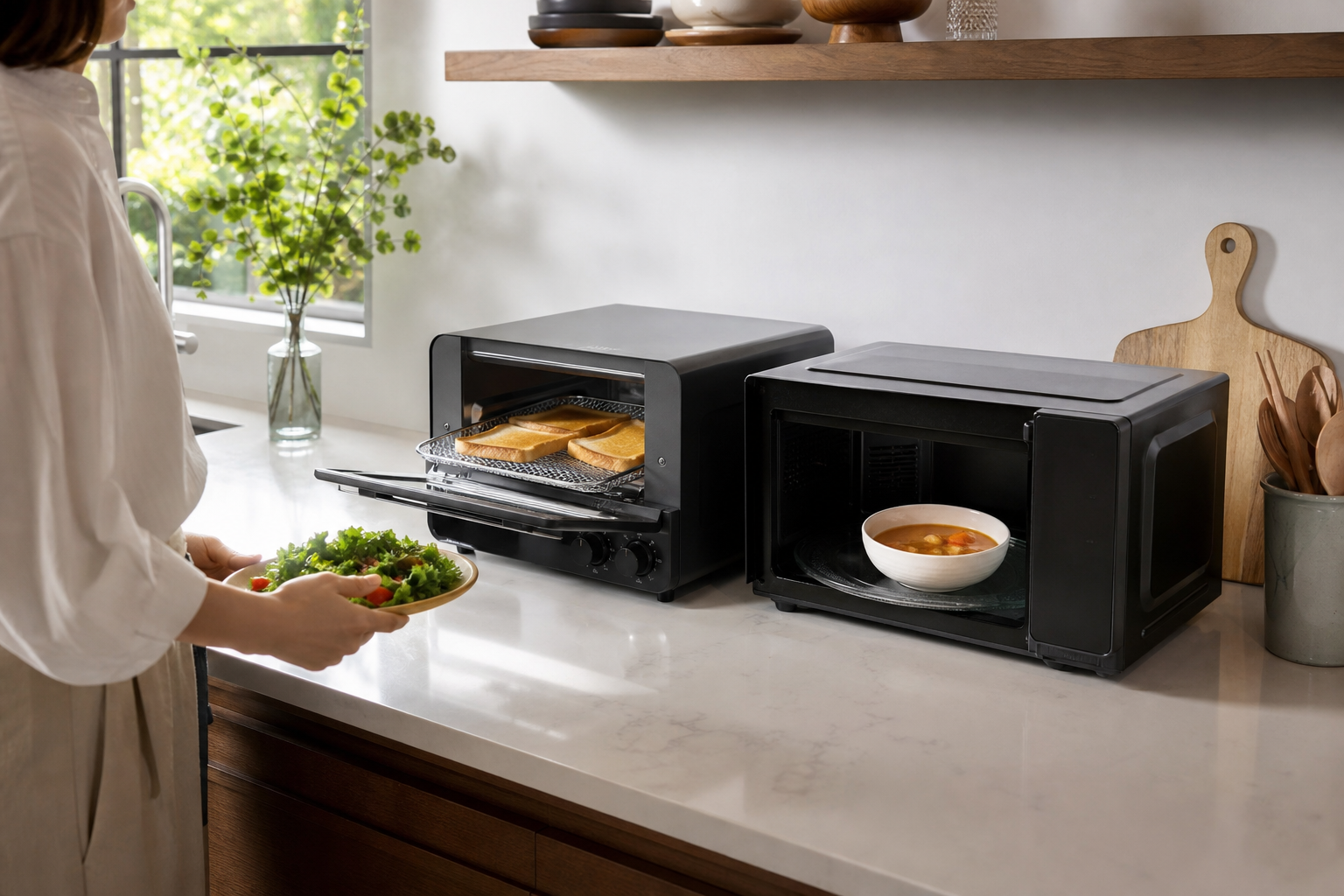
If your main job is reheating leftovers, defrosting food, softening ingredients, or making quick oatmeal, a countertop microwave is usually the more useful compact appliance. If you want toast, crisp pizza, roasted vegetables, baked dishes, broiled toppings, or an alternative to turning on the full-size oven, a toaster oven earns its space more easily. If you regularly do both, the two appliances solve different problems rather than truly replacing one another.
What Matters Most
Start with the job, not the appliance
A compact microwave and a toaster oven apply heat in fundamentally different ways. A microwave uses microwave energy to heat food, while a toaster oven uses heated elements and, on some models, convection airflow. That difference determines the texture you get, the cookware you can use, and whether food comes out soft, crisp, browned, or toasted. ([fda.gov](https://www.fda.gov/radiation-emitting-products/resources-you-radiation-emitting-products/microwave-ovens?utm_source=openai))
For many households, the decision comes down to a simple weekly pattern: Are you mostly trying to get food hot, or are you trying to make food crisp and browned? A microwave is built around speed and convenience for reheating and cooking foods with moisture. A toaster oven is closer to a small conventional oven, making it better suited to dry heat and surface browning.
Think through your actual routine before comparing wattage, presets, or smart features. The appliance that handles your three most common jobs well will be more useful than one with the longest feature list.
- Choose microwave-first for reheating, defrosting, steaming, and quick single-portion meals.
- Choose toaster-oven-first for toast, crisping, baking, roasting, broiling, and small casseroles.
- Choose both only if you have distinct, frequent jobs for each and enough counter space.
When a countertop microwave makes more sense
A countertop microwave is the practical choice when speed and moisture matter most. It is especially useful for reheating soup, rice, pasta, vegetables, sauces, coffee, and plated leftovers. Microwave cooking heats food directly and can be faster than heating a larger oven, particularly for small portions. The FDA also notes that microwave cooking can use less energy than conventional cooking because it heats the food rather than warming the entire oven compartment. ([fda.gov](https://www.fda.gov/radiation-emitting-products/resources-you-radiation-emitting-products/microwave-ovens?utm_source=openai))
It is also the easier tool for defrosting frozen food, softening butter, melting chocolate, warming tortillas, and preparing quick breakfasts. Sensor-reheat and sensor-cook features can reduce guesswork by adjusting time or power based on detected steam or temperature, although performance depends on the specific design and the food inside. Panasonic, for example, describes sensor and inverter features on current countertop models as tools for more automatic and even heating. ([shop.panasonic.com](https://shop.panasonic.com/products/1-2-cu-ft-inverter-microwave-oven-1200w-magic-pot?utm_source=openai))
The trade-off is texture. A microwave generally will not restore crisp breading, toast a slice of bread, or brown the top of a casserole in the same way as dry radiant heat. It can also heat unevenly, so stirring, rotating, standing time, and following the food or appliance instructions matter. For meat, poultry, seafood, and egg dishes, use a food thermometer when the cooking method requires a verified internal temperature. ([fda.gov](https://www.fda.gov/food/buy-store-serve-safe-food/refrigerator-thermometers-cold-facts-about-food-safety?utm_source=openai))
- Best jobs: leftovers, soups, oatmeal, frozen meals, defrosting, melting, steaming, and quick reheating.
- Look for: sensor reheat, multiple power levels, a usable interior shape, easy-clean surfaces, and controls you can read.
- Remember: microwave-safe cookware is required, and metal or aluminum foil is generally not appropriate unless the appliance instructions specifically allow it. ([fda.gov](https://www.fda.gov/radiation-emitting-products/resources-you-radiation-emitting-products/microwave-ovens?utm_source=openai))
When a toaster oven earns the counter space
A toaster oven makes more sense when the finished texture matters as much as the temperature. Toast, bagels, English muffins, open-faced sandwiches, crisp pizza, roasted vegetables, baked potatoes, and small portions of breaded food are all jobs that benefit from dry heat. Many current models add bake, broil, roast, warm, air-fry, reheat, and dehydrate settings, but the exact capabilities vary widely by model. ([breville.com](https://www.breville.com/en-us/shop/ovens?utm_source=openai))
For small meals, a toaster oven can stand in for the full-size oven. That may be useful when you are cooking one or two portions, want to avoid heating the whole kitchen, or need a baking tray or oven-safe dish rather than a microwave-safe container. Convection models circulate hot air, which can improve browning and cooking consistency, but they may also need adjustments to temperature, rack position, or cooking time.
The trade-offs are preheating, heat, and cleanup. A toaster oven usually takes longer to deliver a hot meal than a microwave, and its exterior, rack, tray, and nearby counter area can become hot. It also needs more attention to clearance and placement than many people expect. Read the manual for required space around the appliance, especially if it includes high-heat broil or air-fry functions.
- Best jobs: toast, bagels, crisping, baking, roasting, broiling, pizza, and small oven meals.
- Look for: interior dimensions, temperature range, rack positions, removable crumb tray, timer behavior, and whether convection or air-fry modes are included.
- Remember: a toaster oven is not automatically an air fryer; airflow, basket design, capacity, and performance differ by model.
The jobs where the choice is less obvious
Reheating pizza is a useful tie-breaker. A microwave is faster and keeps the topping soft, but the crust may become chewy. A toaster oven takes longer but is more likely to restore a crisp crust and browned cheese. The same pattern applies to fries, breaded chicken, roasted vegetables, quesadillas, and toasted sandwiches.
For frozen meals, check the package directions rather than assuming one appliance is always better. Microwave directions are usually designed for speed and may produce a softer result. Oven directions often take longer but can deliver better browning. Some meals are designed for one method only, and transferring food to a different container can change the result.
For baking, a toaster oven is the more natural fit, but capacity is the limiting factor. A compact model may handle cookies, muffins, toast, or a small baking dish while rejecting a standard nine-by-thirteen-inch pan. Measure the usable interior, not just the exterior dimensions, and account for handles, rack clearance, and the direction the door opens.
- Want speed and softness? Pick the microwave.
- Want crispness and browning? Pick the toaster oven.
- Want small-batch baking? Check the toaster oven's actual interior dimensions before buying.
- Want one appliance to do both? Consider a combination microwave-convection model, but expect compromises in capacity, controls, and price.
Space, safety, and everyday usability
Counter space is only part of the calculation. Measure width, depth, height, plug location, door swing, and the space needed to place hot dishes. A toaster oven may need more open clearance because it produces substantial heat during baking, broiling, or air frying. A microwave needs enough room for ventilation and a door that can open fully without hitting a wall or cabinet.
Microwave safety is largely about following the manual and using an undamaged appliance. The FDA advises against using a microwave with a bent or damaged door, latch, or seal, and recommends stopping use if the oven continues operating with the door open. It also warns that overheated water can erupt unexpectedly, so heating instructions and handling precautions matter. ([fda.gov](https://www.fda.gov/radiation-emitting-products/resources-you-radiation-emitting-products/microwave-ovens?utm_source=openai))
Toaster oven usability is more physical: hot racks, trays, crumb buildup, and awkward access can matter more than a glossy control panel. Look for a door and handle that feel easy to operate, a crumb tray that removes without a struggle, controls you can see clearly, and a cooking chamber large enough for the dishes you already own.
- Measure the installation area before shopping, including overhead and side clearance.
- Check whether your preferred dishes fit: mugs and bowls for microwaves; pans, trays, and racks for toaster ovens.
- Prioritize easy cleaning and readable controls over decorative extras.
- Do not assume a compact footprint means low heat or low power.
How to choose if you can buy only one
Choose a countertop microwave if your kitchen routine is built around leftovers, quick breakfasts, frozen food, defrosting, and reheating drinks or ingredients. It is the stronger single-appliance choice for speed, convenience, and foods where a soft or moist texture is acceptable. A model with useful power controls, sensor functions, and an interior that fits your everyday bowls may serve you better than a larger unit with complicated presets.
Choose a toaster oven if you regularly make toast, crisp pizza, roast vegetables, bake small dishes, broil toppings, or cook foods that are disappointing when microwaved. It is the better single-appliance choice for texture and small-portion oven work. Focus on usable capacity, rack placement, heat controls, cleanup, and safe counter placement.
If your routine genuinely splits down the middle, owning both may be reasonable because they are complementary tools. The microwave handles the fast, moist, low-fuss jobs; the toaster oven handles the crisp, browned, oven-style jobs. If counter space is tight, write down the five foods you prepare most often and choose the appliance that handles the majority without special workarounds.
- Microwave-first household: reheating and speed dominate.
- Toaster-oven-first household: crisping, baking, and browning dominate.
- Combination-model shopper: useful when one footprint matters most, but compare capacity and cooking modes carefully.
- Best final test: picture an ordinary weekday, not an occasional special meal.
Sources & editorial note
This guide is research-based and does not claim hands-on testing unless explicitly stated.
- U.S. Food and Drug Administration: Microwave Ovens — Supports how microwave ovens heat food, cookware guidance, energy-efficiency context, and safety considerations.
- U.S. Department of Energy: Microwave Ovens — Supports current federal definitions and energy-conservation context for microwave ovens.
- Breville: Countertop Toaster Ovens — Supports the range of functions available on current toaster-oven models, including bake, broil, roast, air fry, warm, and dehydrate.
- Panasonic: Countertop Microwave with Inverter Technology — Supports examples of current microwave features such as inverter cooking and sensor reheat.
- U.S. Food and Drug Administration: Cold Facts About Food Safety — Supports stirring, rotating, and using a food thermometer where appropriate.