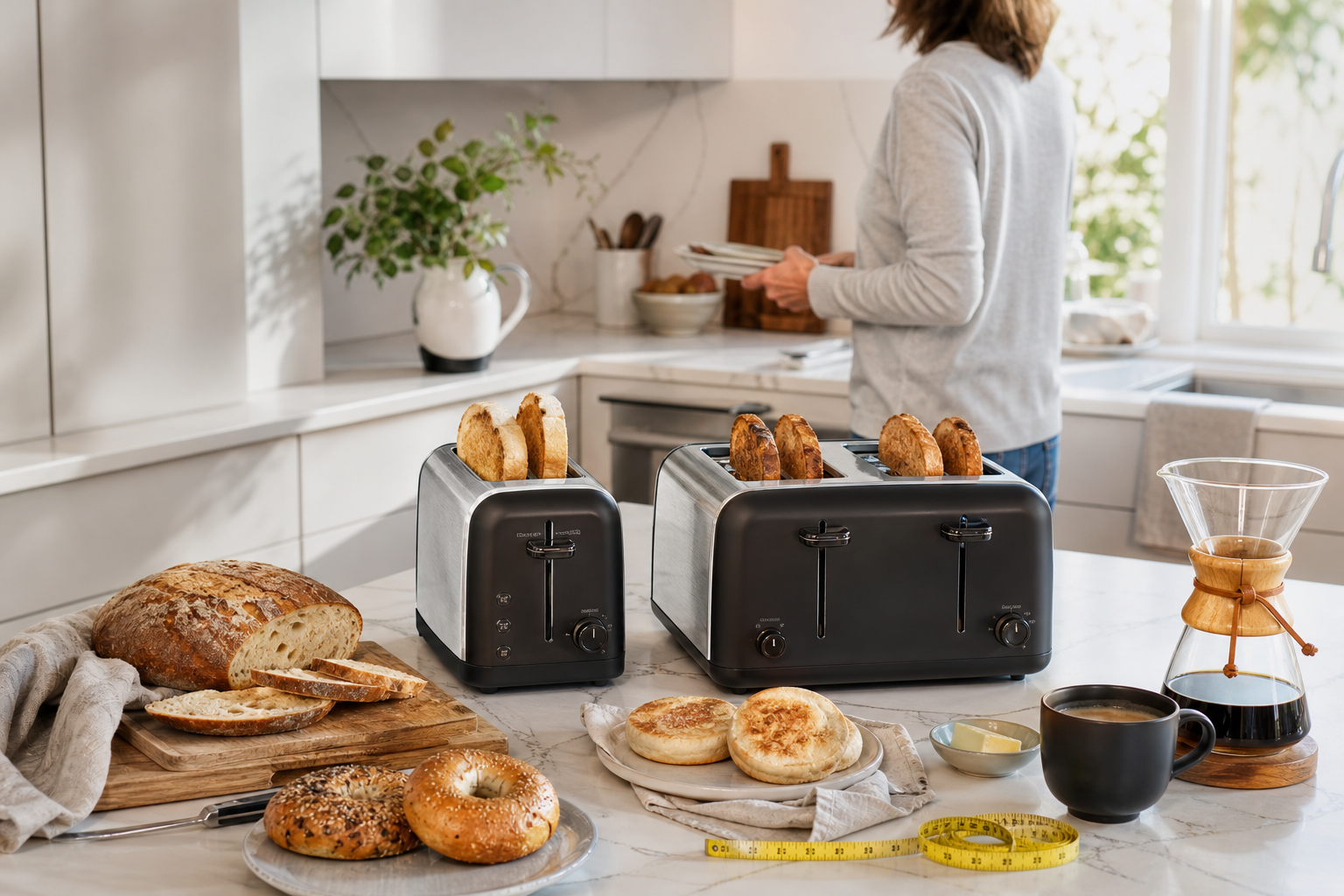
Choose a 2-slice toaster if you usually toast one or two slices, have limited counter space, or want the simplest appliance to store. Choose a 4-slice model if two people regularly eat toast at the same time, you prepare several slices in one sitting, or you want separate controls for different bread and browning preferences. Before buying, compare the actual width, depth, slot size, control layout, and crumb-tray access—not just the slice count.
What Matters Most
Explore Options That Fit Your Everyday Routine
Explore products that fit your priorities, compare current options and discover what works best for you.
Check prices, seller details and specifications on Amazon. Featured image is illustrative.
As an Amazon Associate I earn from qualifying purchases.
Start with the job: making breakfast without adding friction
A toaster has one basic job: turn bread, bagels, waffles, or English muffins into something ready to eat with as little waiting and adjustment as possible. Slice capacity matters because it changes how many cycles you need, but it does not automatically determine which toaster will feel most convenient in your kitchen.
For one person or a household that usually prepares one or two slices, a 2-slice toaster is often the more proportional choice. It can be easier to place near the refrigerator or coffee maker, easier to move when you need the counter, and less likely to feel oversized for a modest breakfast. A 4-slice toaster becomes more useful when the appliance is part of a shared routine rather than an occasional single-serving tool.
Think about your busiest ordinary morning, not a holiday brunch. If two people regularly wait for the same toaster, or if you make toast for children, guests, or a larger household, four slots can reduce repeated cycles. If that situation happens only a few times a year, a compact 2-slice model may still be the better daily fit.
- Best 2-slice fit: one person, one or two slices, limited counter space, or frequent storage.
- Best 4-slice fit: two or more people, batch breakfasts, or regular use of different settings.
Counter space: measure the footprint, not the label
The main space trade-off is usually width, but depth can matter just as much. Current manufacturer examples show why the product label is not enough: Cuisinart lists one compact 4-slice model at 10.8 inches long by 10.7 inches wide, while Hamilton Beach lists a 2-slice model at 11 inches wide by 6.8 inches deep. In other words, some 4-slice designs take more front-to-back space, while some 2-slice designs occupy a longer, narrower area. ([cuisinart.com](https://www.cuisinart.com/4-slice-compact-toaster/CPT-142P1.html?bvstate=pg%3A25%2Fct%3Ar&frt=14&utm_source=openai))
Measure the space from the wall to the front edge of the counter, and check the room around nearby appliances. You need enough clearance to insert bread, operate the levers and buttons, remove the crumb tray, and lift small items out safely. If the toaster sits beneath cabinets, check the manufacturer's guidance and your kitchen layout rather than assuming a compact footprint solves every clearance issue.
A long-slot 2-slice toaster can be an alternative when the counter is narrow but deep. Hamilton Beach describes a long-slot design that uses one extra-long slot for two slices or one long slice of bread. That layout may suit bakery-style or homemade bread, but its listed depth is greater than that of some conventional 2-slice models, so measure before buying. ([hamiltonbeach.com](https://hamiltonbeach.com/toasters?utm_source=openai))
- Record maximum width, depth, and height before shopping.
- Leave access for the lever, buttons, cord, and crumb tray.
- If you store the toaster, measure the cabinet or shelf where it will live.
Routine and speed: when four slots make a real difference
A 4-slice toaster is most useful when it prevents a second cycle. Four slices can be ready in one round, which is convenient for two people eating breakfast together or for serving toast with soup, eggs, or a family meal. The benefit is not that every batch finishes dramatically faster; it is that fewer batches may be needed.
A 2-slice toaster can still be efficient when your routine is small and predictable. If you usually make one slice for yourself, a 4-slice model does not automatically improve the experience. You may be paying in counter space for capacity that sits unused, and a larger toaster can be more awkward to move or clean around.
Consider whether you often toast different items at the same time. Four slots may let you toast two slices of sandwich bread alongside two bagel halves or waffles. However, the value depends on the controls. Some 4-slice models have separate control sections, while others operate more like one larger toaster. Look for independent shade controls if household preferences differ.
Controls and flexibility: capacity is only half the comparison
The most useful features are the ones that match what you actually toast. Extra-wide slots can accommodate thicker bread and bagels; high-lift or toast-boost functions help retrieve smaller items; and crumb trays simplify routine cleanup. Hamilton Beach lists these features across both 2-slice and 4-slice models, so you do not need four slots to get the basics. ([hamiltonbeach.com](https://hamiltonbeach.com/toasters?utm_source=openai))
A 4-slice toaster is more flexible when each pair of slots has its own shade control. That arrangement can support one person's lightly browned toast and another person's darker toast in the same cycle. Cuisinart's compact 4-slice model, for example, describes dual custom controls and seven shade settings, along with bagel, reheat, and defrost functions. ([cuisinart.com](https://www.cuisinart.com/4-slice-compact-toaster/CPT-142P1.html?bvstate=pg%3A25%2Fct%3Ar&frt=14&utm_source=openai))
A 2-slice toaster may be the better choice if you prefer fewer controls and a smaller learning curve. It can also be easier to keep consistent because you are managing one pair of slots. If you regularly use frozen bread, English muffins, or thick hand-cut slices, prioritize slot dimensions, self-centering guides, and high-lift access over decorative displays.
- For mixed preferences, prioritize independent controls over the number of slots.
- For thick bread, check the slot width and depth in the specifications.
- For small items, look for high-lift or toast-boost functionality.
Everyday ownership: cleaning, storage, and safety
Toasters collect crumbs by design, so cleanup should be part of the buying decision. Slide-out or removable crumb trays are easier to empty than designs that require turning the appliance over. Check whether the tray can be removed from the side or front, especially if the toaster will sit close to a wall or backsplash.
A 4-slice toaster has more slots and may collect more crumbs simply because it can handle more food, though maintenance depends on the design and how often you use it. A 2-slice toaster is not maintenance-free, but its smaller body may be easier to lift, wipe, and store. In either case, follow the owner's manual rather than using knives or metal utensils to retrieve stuck food.
The U.S. Fire Administration advises keeping combustibles away from cooking appliances and notes that crumbs in a toaster can catch fire. Manufacturer safety instructions commonly warn against operating a toaster near curtains, paper, plastic, towels, or other flammable materials. Do not cover a toaster while it is operating, and unplug or store it according to the manufacturer's instructions when appropriate. ([usfa.fema.gov](https://www.usfa.fema.gov/downloads/pdf/publications/cooking_fire_safety_flyer.pdf?utm_source=openai))
- Empty the crumb tray regularly.
- Keep the appliance clear of towels, paper, curtains, and other combustible materials.
- Never use a knife, fork, or other metal object to remove stuck food.
How to choose: a practical decision rule
Buy a 2-slice toaster when your normal routine is one or two slices, your counter is tight, or you want an appliance that is easy to store. It is also the sensible choice when you prefer a straightforward control layout and do not need to coordinate several items at once. A well-designed 2-slice model with wide slots, high-lift access, a crumb tray, and useful shade control can cover most everyday needs.
Buy a 4-slice toaster when two people commonly eat toast together, you regularly prepare four slices, or different people need different browning settings. The best 4-slice models justify their larger footprint with independent controls, wide slots, accessible crumb trays, and a layout that does not force every slice to use the same setting.
If you are between sizes, use this test: count how often you currently run a second cycle. If it happens most mornings, four slots may remove a genuine annoyance. If it happens only occasionally, keep the smaller footprint and spend your attention on slot size, control precision, cleanup, and storage. Capacity should solve a recurring problem, not create a permanent counter-space one.
- Choose 2 slices for compactness, simplicity, and one- or two-slice routines.
- Choose 4 slices for shared breakfasts, batch preparation, and separate preferences.
- Choose by dimensions and controls after deciding on capacity.
Ready to Find Your Best Match?
Explore products that fit your priorities, compare current options and discover what works best for you.
Check prices, seller details and specifications on Amazon. Featured image is illustrative.
As an Amazon Associate I earn from qualifying purchases.
Sources & editorial note
This guide is research-based and does not claim hands-on testing unless explicitly stated.
- Hamilton Beach Toasters — Supports current examples of 2-slice and 4-slice features, dimensions, long-slot layouts, wide slots, high-lift functions, crumb trays, and shade controls.
- Hamilton Beach 2-Slice Toasters — Supports comparison examples for compact 2-slice and 4-slice models, including dimensions and independent control features.
- Cuisinart 4-Slice Compact Toaster — Supports the example of a compact 4-slice design with dual controls, seven shade settings, wide slots, and listed dimensions.
- Breville BTA825/BTA845 Instruction Manual — Supports the broader point that 2-slice and 4-slice toaster designs can differ in controls, slot arrangements, and electrical requirements.
- U.S. Fire Administration Cooking Fire Safety — Supports basic toaster and kitchen fire-safety guidance, including the risk posed by crumbs and combustible materials.