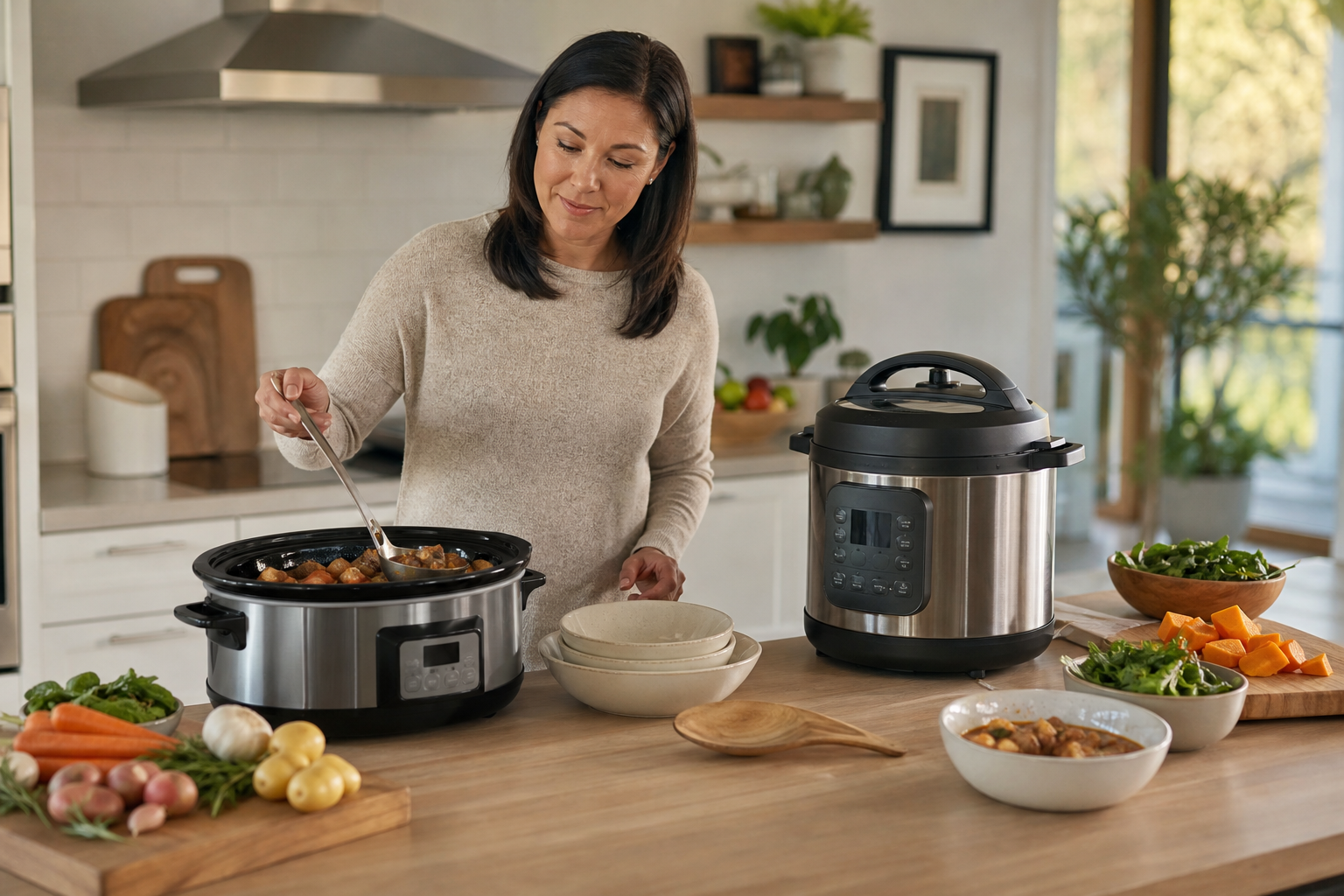
Choose a slow cooker if your ideal routine is adding ingredients in the morning and returning to a ready-to-serve stew, chili, roast, or soup. Choose a multicooker if you want one appliance that can slow-cook but can also pressure-cook, sauté in the same pot, steam, cook rice, and handle meals when you forgot to start dinner earlier. For many households, the slow cooker simplifies the process more; the multicooker simplifies the appliance collection more.
What Matters Most
Explore Options That Fit Your Everyday Routine
Explore products that fit your priorities, compare current options and discover what works best for you.
Check prices, seller details and specifications on Amazon. Featured image is illustrative.
As an Amazon Associate I earn from qualifying purchases.
Start with the kind of convenience you want
A slow cooker is built around one particularly useful promise: put prepared ingredients into the crock, choose Low or High, and let gentle heat do the work. Many programmable models switch to a Warm setting when the cooking time ends, which can make them practical for workdays, errands, and meals that need to wait briefly before serving. Current Crock-Pot models commonly offer timed cooking, automatic warming, removable stoneware, and dishwasher-safe parts. ([crock-pot.com](https://www.crock-pot.com/slow-cookers/crock-pot-one-touch-control-6-quart-easy-to-clean-slow-cooker-stainless-steel/SAP_2125324.html?bvrrp=Main_Site-en_US%2Freviews%2Fproduct%2F3%2FSP_1944176.htm&utm_source=openai))
A multicooker is designed to cover more cooking methods in one appliance. A typical pressure multicooker may offer pressure cooking, slow cooking, sautéing, steaming, rice cooking, yogurt making, and warming, although the exact list varies by model. Instant Pot’s current 6-quart RIO, for example, lists seven cooking functions, including pressure cook, slow cook, sauté, steam, rice, yogurt, and keep warm. ([instantpot.com](https://instantpot.com/collections/multi-cookers/products/instant-pot-rio-6qt-multi-cooker?utm_source=openai))
That difference affects the daily rhythm. The slow cooker asks you to plan ahead but then largely stays out of your way. The multicooker asks for more decisions, but it can adapt when your schedule changes. If dinner planning is the main burden, simple may beat versatile.
- Best for the fewest steps: slow cooker
- Best for replacing several appliances: multicooker
- Best for schedule flexibility: multicooker
Speed: the multicooker wins, but not every meal needs speed
A multicooker’s pressure function is the clearest advantage when dinner starts late. Pressure cooking uses steam and pressure to shorten cooking times for foods such as beans, braises, shredded meats, soups, and some grains. The programmed cooking time is not the entire process: the appliance may also need time to build pressure and release it afterward. Even so, pressure cooking can turn an evening project into a more manageable weeknight meal. Instant Pot’s cooking tables, for example, list pressure-cooking times for foods including dried chickpeas, lentils, pork shoulder, potatoes, and chicken. ([instantpot.com](https://instantpot.com/pages/multi-cookers?utm_source=openai))
A slow cooker is intentionally the opposite. Its strength is not getting food finished quickly; it is letting a meal cook gradually while you attend to other things. USDA guidance notes that slow cookers generally operate across Low and High settings, with Low suited to all-day cooking and less-tender cuts. ([ask.fsis.usda.gov](https://ask.fsis.usda.gov/article/What-setting-should-you-use-on-a-slow-cooker?utm_source=openai))
The practical question is not simply whether one appliance is faster. It is whether speed reduces stress in your routine. If you regularly decide what to eat at 5 p.m., a pressure multicooker can be the more useful tool. If you can prep before work or after breakfast, a slow cooker may provide the more effortless experience.
- Choose pressure cooking for late starts and time-sensitive dinners.
- Choose slow cooking when advance preparation is realistic.
- Allow for pressure-building and pressure-release time when estimating a multicooker meal.
Flavor, texture, and the number of steps
Slow cookers are especially well suited to dishes that benefit from a long, gentle simmer: chili, bean dishes, soups, stews, pulled pork, pot roast, and saucy chicken. They are also forgiving for meals where the goal is tender, spoonable texture rather than a crisp exterior. A glass lid lets you see the food without opening the cooker, and the removable crock can often move from appliance to table, depending on the model.
Multicookers can handle many of the same meals, but they offer more ways to build flavor. A sauté function can brown onions, garlic, or meat in the cooking pot before liquid and other ingredients are added. Instant Pot describes sauté and sear as a way to brown food directly in the pot, potentially avoiding a separate skillet. ([instantpot.com](https://instantpot.com/pages/multi-cookers?utm_source=openai))
That convenience comes with more interaction. You may need to choose a program, add enough liquid for pressure cooking, wait for pressure to release, and clean a lid with a sealing ring and steam-release components. A multicooker may reduce the number of pans without necessarily reducing the number of steps.
- Slow cooker: fewer controls and a gentler, more linear process.
- Multicooker: more control, more cooking methods, and often better one-pot browning.
- For crisp finishes, either appliance may still require a separate broiler, skillet, oven step, or air-fryer lid.
Cleanup, storage, and everyday handling
For routine cleanup, a slow cooker is hard to beat. Many current models have a removable stoneware crock and glass lid that are dishwasher-safe. Some stoneware is also oven-safe, although temperature changes and model-specific instructions matter. Crock-Pot’s product documentation lists dishwasher-safe stoneware and lids on several current models. ([crock-pot.com](https://www.crock-pot.com/slow-cookers/crock-pot-one-touch-control-6-quart-easy-to-clean-slow-cooker-stainless-steel/SAP_2125324.html?bvrrp=Main_Site-en_US%2Freviews%2Fproduct%2F3%2FSP_1944176.htm&utm_source=openai))
A multicooker typically has a removable inner pot, but the lid assembly requires more attention. Depending on the model, you may need to wash the sealing ring, steam-release parts, float valve area, and condensation collector. Instant Pot specifically warns users to keep hands and face away from the steam-release area and not to lean over the lid when opening it under residual pressure. ([instantpot.com](https://instantpot.com/pages/frequently-asked-questions?utm_source=openai))
Storage is another trade-off. A slow cooker has a simple body, lid, and crock. A multicooker has a deeper lid, electrical base, accessories, and sometimes multiple pressure or air-frying components. If cabinet space is limited, count the entire footprint rather than comparing only the cooking pot.
- Easiest cleanup for classic one-pot meals: slow cooker
- More parts to wash and understand: multicooker
- Check whether the removable pot, lid, sealing ring, and accessories are dishwasher-safe before buying.
Who should buy a slow cooker?
A slow cooker makes sense if your most common meals are soups, stews, chili, shredded meat, beans, or roasts and you are comfortable starting dinner hours ahead. It is also a good fit if you want a visible, uncomplicated control panel and do not need rice, pressure, steaming, or sauté functions.
It can be particularly useful for households that value predictable routines. A programmable model can cook for a set period and then switch to Warm, while a larger oval crock can accommodate family-size meals or a substantial roast. Exact capacity and warming behavior vary, so confirm the product manual rather than assuming every model works the same way. ([crock-pot.com](https://www.crock-pot.com/slow-cookers/crock-pot-one-touch-control-6-quart-easy-to-clean-slow-cooker-stainless-steel/SAP_2125324.html?bvrrp=Main_Site-en_US%2Freviews%2Fproduct%2F3%2FSP_1944176.htm&utm_source=openai))
The slow cooker is less appealing if you frequently forget to start dinner, want crisp textures, or dislike moving food between appliances. It also does not replace a pressure cooker when dried beans, tough cuts, or a late-start meal need to be finished sooner.
- Best fit: planned, hands-off meals
- Good for: soups, chili, stews, roasts, pulled meat, and batch cooking
- Skip it if: your schedule is unpredictable or you want one appliance for several cooking methods
Who should buy a multicooker?
A multicooker makes sense if you want one appliance to cover several dinner jobs and are willing to learn a few operating routines. It is the stronger choice for households that alternate between make-ahead meals and last-minute cooking, or that regularly prepare rice, beans, steamed vegetables, braises, soups, and one-pot meals.
It is also useful when reducing the number of separate appliances matters more than having the simplest individual appliance. A pressure multicooker can sauté ingredients, pressure-cook the main dish, slow-cook on another day, and keep food warm. Some models add air frying, baking, sous vide, yogurt, or other functions, but extra programs can also increase size, cost, and complexity. ([instantpot.com](https://instantpot.com/pages/multi-cookers?utm_source=openai))
Do not treat the pressure function as completely unattended cooking. Follow the manufacturer’s fill lines, liquid requirements, pressure-release instructions, and food-specific guidance. Instant Pot advises not filling above the stated maximum and using extra care with foods that expand, such as rice and dried vegetables. ([instantpot.com](https://instantpot.com/pages/frequently-asked-questions?utm_source=openai))
- Best fit: flexible schedules and varied cooking habits
- Good for: pressure-cooked dinners, rice, beans, steaming, sautéing, and slow cooking
- Skip it if: you want the fewest controls, simplest cleanup, or a dedicated serving crock
The verdict: which simplifies dinner more?
For the narrow question of making dinner feel easy, the slow cooker usually wins. It has fewer modes, fewer parts, and a straightforward workflow: prep, cook, serve, clean. If you can reliably start meals several hours early, its simplicity may be more valuable than the extra capabilities of a multicooker.
For the broader question of simplifying your kitchen, the multicooker often wins. It can replace several specialized tools and gives you a backup plan when the day runs late. Its pressure function is the deciding feature for many cooks, while sautéing in the same pot can reduce stovetop cookware.
A useful buying rule is this: buy the slow cooker for a routine, and buy the multicooker for options. Whichever you choose, look for a capacity that matches your usual batch size, controls you can read easily, parts that are practical to clean, and a manual with clear cooking and safety instructions. For leftovers, USDA advises reheating them to at least 165 degrees Fahrenheit and not using a slow cooker to reheat cold leftovers because they may remain too long in the food-safety danger zone. ([ask.fsis.usda.gov](https://ask.fsis.usda.gov/article/What-methods-of-reheating-food-are-safe?utm_source=openai))
- Choose slow cooker for maximum hands-off simplicity.
- Choose multicooker for speed, flexibility, and appliance consolidation.
- If uncertain, choose based on your most common dinner problem: lack of planning points to a multicooker; lack of time for active cooking points to a slow cooker.
Ready to Find Your Best Match?
Explore products that fit your priorities, compare current options and discover what works best for you.
Check prices, seller details and specifications on Amazon. Featured image is illustrative.
As an Amazon Associate I earn from qualifying purchases.
Sources & editorial note
This guide is research-based and does not claim hands-on testing unless explicitly stated.
- Instant Pot Multi-Cookers — Supports current multicooker functions, including pressure cooking, slow cooking, sautéing, steaming, rice, yogurt, warming, and model-specific programs.
- Crock-Pot One Touch Control 6-Quart Slow Cooker — Supports programmable cooking, automatic Warm mode, capacity information, removable stoneware, and dishwasher-safe parts.
- USDA FSIS: What setting should you use on a slow cooker? — Supports slow-cooker Low and High settings and the role of Low for longer cooking.
- Instant Pot Frequently Asked Questions — Supports pressure-release precautions, fill limits, liquid considerations, and pressure-cooking safety guidance.
- USDA FSIS: What methods of reheating food are safe? — Supports reheating leftovers to 165 degrees Fahrenheit and avoiding slow cookers for reheating cold leftovers.