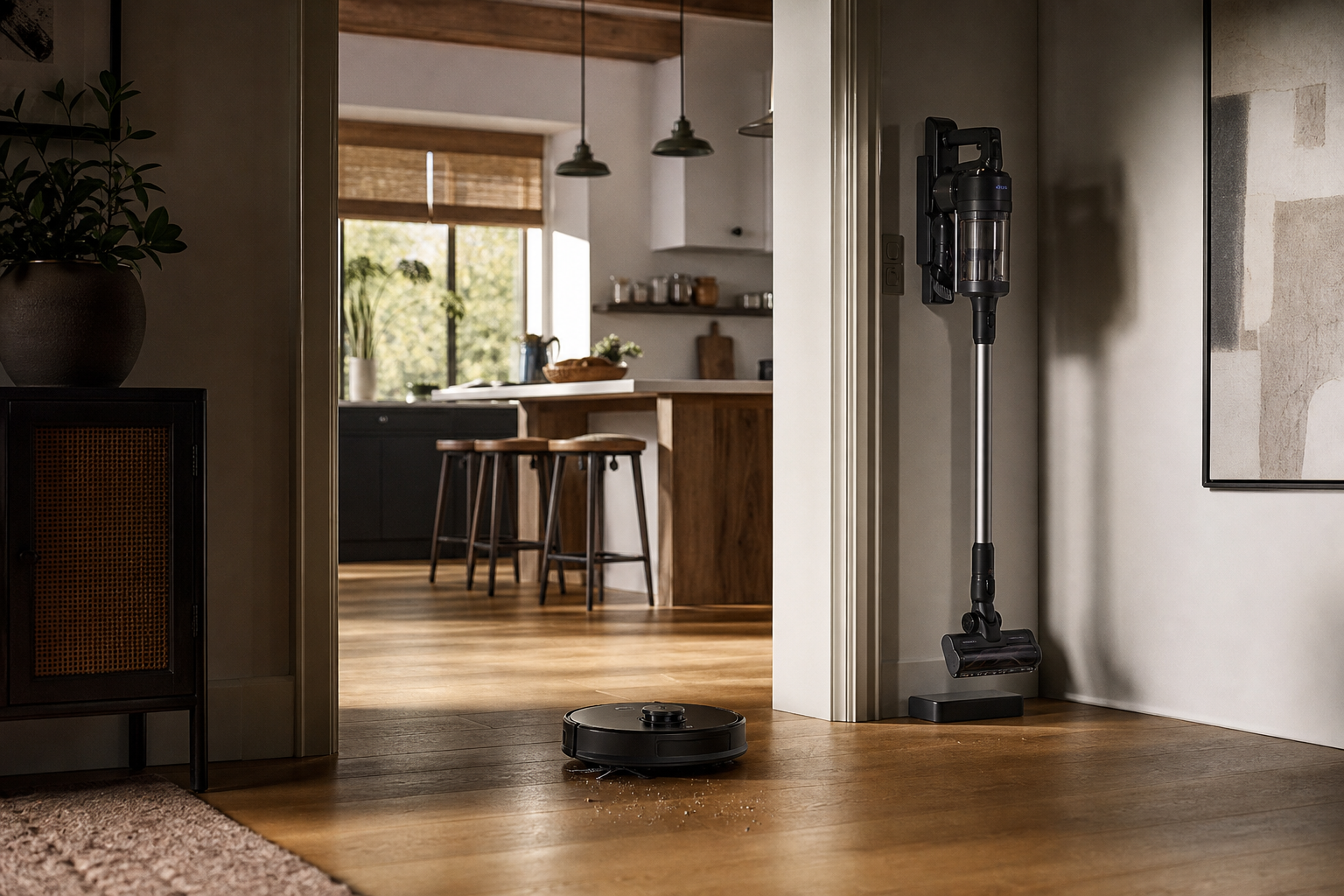
Choose a robot vacuum if your priority is reducing the number of times you personally vacuum open floor areas. Choose a cordless vacuum if you want one flexible tool for whole-home cleaning, quick pickups, stairs, furniture, and places a robot cannot reach. For many homes, the lowest-effort setup is a robot for routine floors plus a simple cordless vacuum for everything else.
What Matters Most
Start with the job to be done
If the job is “keep everyday dust, crumbs, and pet hair from accumulating on open floors,” a robot vacuum is designed to reduce your involvement. Current models can run on schedules, return to a dock to recharge, and on some models empty their dust bins automatically. That shifts vacuuming from a task you perform to a system you supervise. ([homesupport.irobot.com](https://homesupport.irobot.com/articles/en_US/Knowledge/45766?utm_source=openai))
If the job is “clean the whole home when I decide it needs cleaning,” a cordless vacuum gives you more direct control. You guide it exactly where you want it, switch between floor and handheld tools, and deal with a spill or visible debris immediately. A representative cordless model such as Dyson’s V15 Detect offers multiple power modes, a wall dock, and attachments for floors, stairs, upholstery, and narrow spaces, although actual runtime varies by mode and tool. ([dyson.com](https://www.dyson.com/vacuum-cleaners/cordless/v15/shop-all?utm_source=openai))
The key distinction is not simply smart versus manual. It is recurring maintenance versus on-demand cleaning. Robots reduce the number of cleaning sessions you personally perform; cordless vacuums reduce the time and setup involved when you are the person doing the cleaning.
- Best for recurring floor care: robot vacuum
- Best for targeted cleaning and reach: cordless vacuum
- Best for a mixed home: robot plus cordless vacuum
Where a robot vacuum saves more effort
A robot earns its place by cleaning often. Scheduling lets it run while you are away or occupied, and some apps support room-by-room routines or automations. Frequent cleaning can also prevent everyday debris from building up between larger cleaning sessions. ([homesupport.irobot.com](https://homesupport.irobot.com/articles/en_US/Knowledge/19596?utm_source=openai))
That convenience is strongest in homes with relatively open floors and predictable traffic patterns. Hard floors, low- to medium-pile carpets, and rooms without many loose objects are easier for a robot to cover consistently. If the robot has a self-emptying dock, you may empty the collected debris less often, though the dock adds another part to maintain and may use disposable bags depending on the design.
A robot can also reduce decision fatigue. You do not have to find the vacuum, attach a tool, unwind a cord, or decide which rooms need attention each day. The trade-off is that you still need to keep the floor reasonably ready: cables, socks, small toys, pet accidents, and clutter can interrupt a cleaning run or require rescue.
- Strong fit: open-plan floors, regular crumbs, dust, and pet hair
- Strong fit: households that benefit from scheduled cleaning
- Less convenient: homes with frequent floor clutter or many narrow transitions
Where a cordless vacuum saves more effort
A cordless vacuum is usually the more efficient choice for small, specific jobs. You can pick up a kitchen spill, clean a stair tread, vacuum a sofa, remove crumbs from a dining area, or reach a corner without waiting for a robot to map the area and complete a route. Its flexibility matters more as the number of surfaces increases.
It is also the better tool for vertical cleaning. Robots are floor machines; they generally cannot clean stairs, shelves, curtains, upholstery, mattresses, car interiors, or cobwebs. A cordless model with a detachable handheld unit and suitable attachments can cover those jobs without requiring a second appliance.
The main effort cost is physical and immediate: you must carry, steer, empty, and recharge it. Battery claims are typically maximum figures rather than guaranteed whole-home results. Higher-power modes and motorized tools can reduce runtime, and a full clean may require planning around the available charge. Dyson, for example, states that its advertised V15 runtime changes according to power mode, dust level, floor type, and attachments. ([dyson.com](https://www.dyson.com/vacuum-cleaners/cordless/v15/shop-all?utm_source=openai))
- Strong fit: stairs, upholstery, edges, spills, and high surfaces
- Strong fit: homes where cleaning needs vary from room to room
- Less convenient: people who want floors maintained without active participation
Maintenance: neither option is truly hands-off
Robot vacuums automate movement, not all care. Manufacturer guidance commonly includes emptying or checking the bin, cleaning filters, removing hair from brushes and wheels, and wiping sensors or charging contacts. iRobot’s current care guidance, for example, recommends frequent filter and brush attention, with more frequent cleaning in homes with pets; exact intervals vary by model. ([homesupport.irobot.com](https://homesupport.irobot.com/articles/en_US/Knowledge/20966?utm_source=openai))
A self-emptying dock can reduce the most repetitive task, but it does not eliminate maintenance. You may still need to replace bags, clear the dock’s air path, clean sensors, and deal with tangled hair or a robot that becomes trapped. More automation generally means more components, software, and troubleshooting points.
Cordless vacuums have a simpler maintenance routine, but you perform it directly. Expect to empty the dust cup, clear the brush roll, check for blockages, wash or replace filters, and keep the battery charged. Dyson’s V15 support guidance recommends washing its filter about monthly, with more frequent cleaning possible when collecting fine dust or using Boost mode. ([dyson.com](https://www.dyson.com/support/vacuum-cleaners/cordless/v15-detect?utm_source=openai))
For effort, compare the type of maintenance rather than assuming one option is maintenance-free. A robot creates light, recurring supervision; a cordless vacuum creates short, hands-on work whenever you clean.
- Robot maintenance: brushes, filters, sensors, wheels, dock, and possibly bags
- Cordless maintenance: dust cup, filters, brush roll, blockages, and battery
- Pet hair increases maintenance for both categories
How your home changes the answer
Choose a robot first if most of your home is accessible floor space and your main frustration is keeping up with everyday debris. Look for dependable mapping, room or zone controls, a dock that fits your available space, and a brush design that is practical for your hair or pet situation. Treat obstacle avoidance as helpful rather than permission to leave everything on the floor.
Choose a cordless vacuum first if your home includes stairs, multiple floor levels, lots of furniture, area rugs that need deliberate attention, or frequent messes in particular rooms. A lighter model may be easier to grab repeatedly, while a larger model may offer more capacity or cleaning power. Consider the machine’s weight in the hand, not only its advertised motor performance.
A robot may also be a poor fit if you dislike apps, do not want a dock visible in a room, or cannot provide a clear parking and charging area. A cordless vacuum may be the better low-complexity choice if you prefer one appliance, one charging routine, and no navigation problems.
For homes with pets, the most practical setup is often complementary. A robot can collect daily shedding from accessible floors, while a cordless vacuum handles fur on stairs, furniture, corners, and the occasional concentrated pile. Neither option removes the need to check brushes and filters.
What to buy for the lowest total effort
For a robot, prioritize the parts that reduce supervision: accurate mapping, room selection, reliable docking, easy-to-access brushes, a washable or readily replaceable filter, and a self-emptying dock if reducing bin handling is worth the added cost and upkeep. Confirm that the dock has a practical location and that replacement bags, filters, and brushes are easy to obtain.
For a cordless vacuum, prioritize the everyday handling experience: balanced weight, an easy-to-empty dust cup, a comfortable trigger or power control, useful attachments, a brush roll that is easy to clear, and a removable battery if you want the option of extending runtime later. Do not compare maximum runtime numbers without checking which power mode and tool produce them.
If you can buy only one, select the machine that removes your biggest recurring annoyance. If that annoyance is “I never get around to vacuuming the floors,” buy a robot. If it is “I need to clean many different surfaces quickly,” buy a cordless vacuum.
The direct answer is simple: a robot vacuum saves more effort over weeks and months when it can run reliably in your home. A cordless vacuum saves more effort per cleaning session when you need speed, control, and reach. The best match is the one you will actually use consistently, with maintenance that feels manageable rather than aspirational.
- Buy a robot for automated floor upkeep
- Buy cordless for flexible, immediate, whole-home cleaning
- Buy both when routine floors and above-floor cleaning are equally important
Sources & editorial note
This guide is research-based and does not claim hands-on testing unless explicitly stated.
- iRobot Roomba care and maintenance guidance — Supports robot filter, brush, bin, sensor, wheel, and dock maintenance expectations.
- iRobot scheduling and app features — Supports scheduled cleaning and automation features.
- iRobot poor-pickup and cleaning guidance — Supports frequent use, bin checks, brush care, and pet-hair considerations.
- Dyson V15 Detect support — Supports cordless filter-cleaning, blockage, dust-bin, battery, and runtime-maintenance considerations.
- Dyson V15 Detect product specifications — Supports examples of cordless runtime, charging, bin capacity, weight, and tool flexibility.