Choose a puzzle table if you mainly work on jigsaws and want built-in drawers, a dedicated felt surface, or a compact board that can move without disturbing your progress. Choose a folding table if you need one table for puzzles, crafts, paperwork, games, guests, or occasional projects and want more usable surface area for the money.
What Matters Most
Start with the job to be done
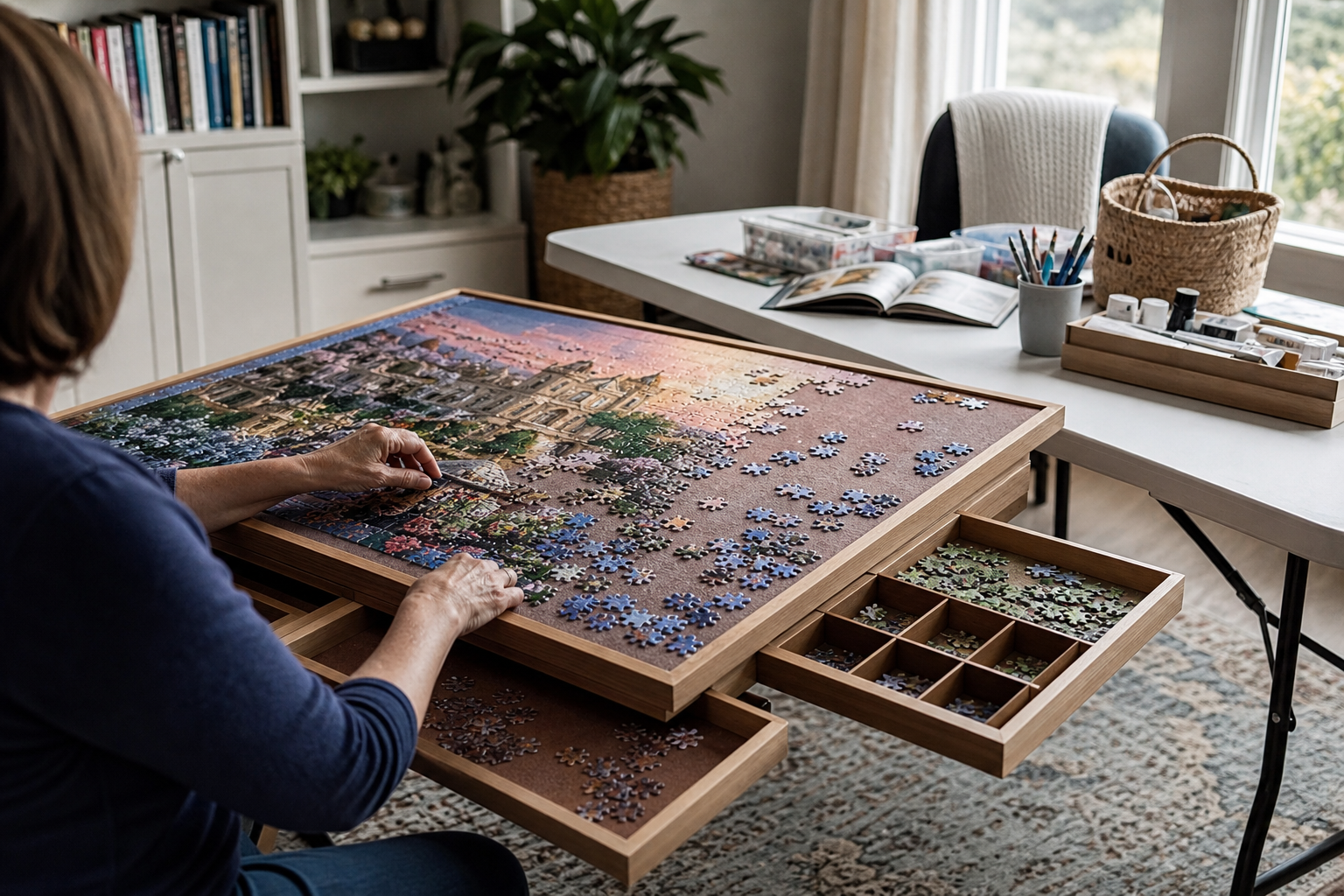
If your goal is to make a jigsaw puzzle easier to start, pause, sort, and resume, a dedicated puzzle table has the more focused design. Many models combine a puzzle-sized work area with drawers, a fabric or felt-like surface, and a shape that can be moved to another room or slid under furniture. For example, Mary Maxim describes its puzzle table as having a 35-by-35-inch non-slip felt top, two slide-out drawers, and a fold-flat design. ([marymaxim.com](https://www.marymaxim.com/products/puzzle-table?utm_source=openai))
If your goal is to create a temporary surface for several hobbies, a folding table is the more adaptable choice. It can support puzzles, card games, crafting, wrapping gifts, sorting mail, laptop work, or extra seating space during gatherings. The trade-off is that you usually supply the organization yourself with trays, shallow boxes, or a separate puzzle board.
The simplest decision is this: buy a puzzle table for a dedicated puzzle workflow; buy a folding table for a general-purpose hobby station. Neither is automatically better. The right choice depends on how often you change activities and how much you value built-in organization.
Where a puzzle table makes hobbies easier
A puzzle table earns its keep by reducing the number of setup steps. Instead of clearing a dining table, finding containers for loose pieces, and rebuilding the layout every time, you can keep the project on a dedicated surface. Drawers may also make it easier to separate edge pieces, colors, patterns, or sections without spreading sorting trays across the room.
That dedicated format is especially useful when a puzzle takes several days or weeks. A board that can be lifted, folded, or moved gives you a better chance of protecting an unfinished layout from meals, visitors, pets, or other household activities. Some puzzle tables are also designed to sit on an existing table or floor rather than replace a full-height desk, so check the intended setup before buying.
The limitations are just as important. Puzzle tables tend to be optimized around a particular working area, so a model advertised for a certain piece count may leave little room for sorting larger pieces or using multiple trays. Drawers add convenience but also add parts that can stick, loosen, or make the table bulkier. A puzzle table may also be less useful once you switch to another hobby.
- Best fit: frequent jigsaw puzzlers, multi-session projects, and homes where the dining or coffee table must stay available.
- Look for: a stable base, a surface large enough for your usual puzzle size, drawers that open smoothly, and a storage method you can actually use.
Where a folding table is the better tool
A folding table gives you a larger, more neutral surface and usually supports a wider range of activities. A representative COSCO 20-by-48-inch folding table is marketed for everyday tasks, workspaces, crafting, and gatherings; the manufacturer lists a 100-pound weight capacity and a 12.5-pound product weight. ([coscoproducts.com](https://www.coscoproducts.com/collections/folding/products/20-x-48-vinyl-top-folding-table?variant=38835399688377&utm_source=openai)) Those specifications illustrate why folding tables can be practical when you want one surface to do several jobs.
Larger models are useful when a puzzle needs space around it for sorting. A six-foot Lifetime table, for example, measures 30 by 72 inches when open and folds for storage. Costco lists that model at 34.2 pounds, so it offers generous room but may not be something you want to move repeatedly on your own. ([costco.com](https://www.costco.com/p/-/lifetime-commercial-6-fold-in-half-table-2-pack/4000390113?langId=-1&sp=grs&utm_source=openai))
The downside is that a basic folding table does not solve puzzle storage by itself. It may be too deep for convenient reach, too tall for comfortable floor-level sorting, or awkward to relocate while a puzzle is in progress. You may also need a separate cover, puzzle board, or trays to keep pieces contained.
- Best fit: mixed hobbies, larger puzzles, shared living spaces, occasional use, and buyers who want one table instead of a single-purpose accessory.
- Look for: a stable leg design, a surface that is easy to clean, manageable folded dimensions, and a weight you can carry safely.
Comfort, reach, and room layout
The table’s height and depth can matter more than its label. A large folding table may offer excellent puzzle space but force you to lean across the middle, especially if the table is 30 inches deep or more. A smaller puzzle table can be easier to reach, but some models are closer to lap or coffee-table height and may not suit everyone’s preferred seating position.
Adjustability can help, but it is not standard across the category. COSCO’s personal folding activity table, for example, offers several height and angle options from 23.5 to 28 inches and folds flat for storage. The manufacturer gives it a 30-pound distributed weight capacity, which is a reminder to check the actual rating rather than assume every folding table is built for heavy equipment. ([coscoproducts.com](https://www.coscoproducts.com/collections/folding/products/adjustable-height-personal-folding-activity-table?variant=41614840496313&utm_source=openai))
Before buying, measure the open footprint, not only the folded size. Leave enough clearance for a chair, walking paths, drawers, and the space needed to open the legs. If the table will stay in a bedroom or living room, also consider whether its folded profile can slide under a bed, behind a sofa, or into a closet without becoming difficult to retrieve.
Storage and setup: the practical difference
Puzzle tables are generally strongest when storage means protecting an active project. A felt or fabric-style surface can help pieces stay in place, while drawers keep loose pieces close to the work area. Some tables fold flat, but the exact mechanism varies, so confirm whether the puzzle surface folds with the table or whether the board must be lifted separately.
Folding tables are generally strongest when storage means putting the entire workstation away quickly. Manufacturer designs commonly emphasize fold-flat storage, portability, and easy cleaning. Lifetime’s 33-inch round folding table, for instance, is described as folding flat and weighing about 12.7 pounds, with an assembled height of 29 inches. ([lifetime.com](https://www.lifetime.com/lifetime-80230-33-inch-round-folding-table-putty?bvstate=pg%3A3%2Fct%3Aq&utm_source=openai))
Think about what you will store with the table. A folding table may take little space by itself but still require a box or shelf for puzzle pieces, sorting trays, and a cover. A puzzle table may organize those items more neatly but occupy more dedicated floor or closet space. The better storage solution is the one that keeps the whole hobby ready, not just the tabletop.
Which one should you buy?
Choose a puzzle table when jigsaw puzzles are the main event, you often pause projects, and sorting or containment matters as much as the work surface. It is also the better fit when you want to move a partially completed puzzle without rebuilding it. Prioritize usable puzzle dimensions over the advertised piece-count claim, because puzzle piece sizes and layouts vary.
Choose a folding table when you want maximum versatility, a larger surface, or a table that can serve guests and household tasks as well as hobbies. It is the more sensible option for someone who enjoys several activities or is not sure whether a dedicated puzzle station will become a regular part of the home.
There is also a useful middle path: pair a sturdy folding table with a removable puzzle board, sorting trays, and a lightweight cover. That setup will not be as integrated as a puzzle table, but it can deliver much of the same flexibility while preserving the folding table’s usefulness for crafts, games, reading materials, or occasional work.
- Choose a puzzle table for organization and unfinished-project storage.
- Choose a folding table for versatility, larger layouts, and shared household use.
- Choose a folding table plus puzzle board when you want a flexible compromise.
Sources & editorial note
This guide is research-based and does not claim hands-on testing unless explicitly stated.
- Mary Maxim Puzzle Table — Supports the example of a dedicated puzzle table with a felt top, drawers, and fold-flat storage.
- COSCO 20 x 48 Vinyl Top Folding Table — Supports the example of a general-purpose folding table with a 20-by-48-inch surface, 100-pound capacity, and 12.5-pound weight.
- COSCO Adjustable Height Personal Folding Activity Table — Supports the example of an adjustable folding activity table with multiple height and angle settings, compact storage, and a stated weight capacity.
- Lifetime 33-Inch Round Folding Table — Supports the example of a lightweight folding table with listed open and folded dimensions and fold-flat storage.
- Lifetime Commercial 6-Foot Fold-in-Half Table — Supports the example of a larger folding table with listed dimensions and weight.