Choose a puzzle board if you need to move an unfinished puzzle off the dining table, carry it between rooms, or store it in a closet with minimal fuss. Choose a puzzle table if you want a dedicated work surface, raised height, tilt, sorting trays, or drawers—and you have room to store a larger piece of furniture.
What Matters Most
Explore Options That Fit Your Everyday Routine
Explore products that fit your priorities, compare current options and discover what works best for you.
Check prices, seller details and specifications on Amazon. Featured image is illustrative.
As an Amazon Associate I earn from qualifying purchases.
The short answer: board for storage, table for everyday use
For most people comparing these two categories, a puzzle board is easier to store. It is generally a flat, portable work surface that can slide under a bed, stand behind a sofa, or rest on a closet shelf. Some boards include covers, compartments, or drawers, but the basic design remains relatively light and easy to move.
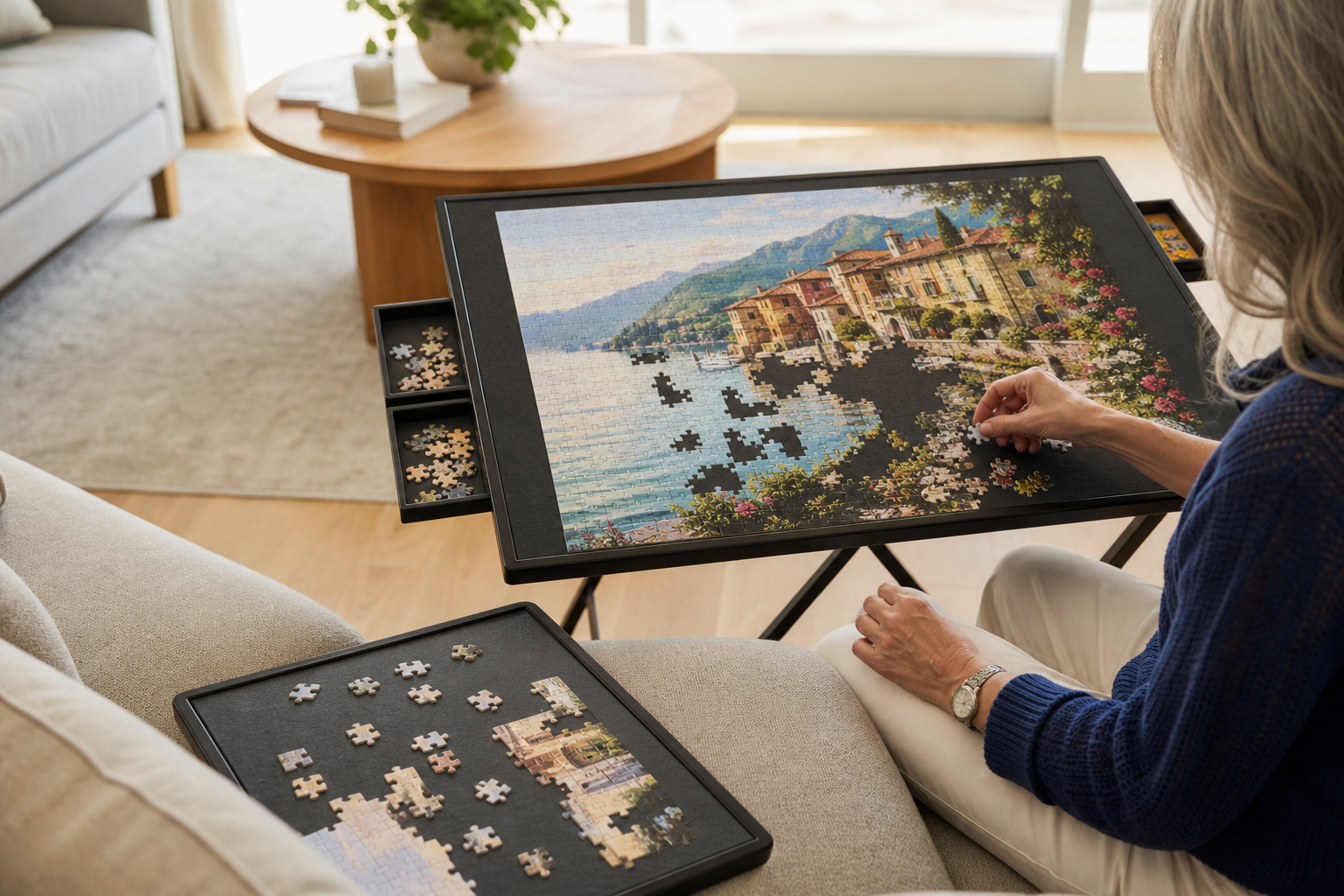
A puzzle table is easier to use when you want a dedicated station. Tables may raise the puzzle to a chair-friendly height, angle the surface toward you, add raised edges, or provide sorting trays. Those features reduce the need to lean over a coffee table or dining table, but they also make the product larger and more complicated to put away.
The important distinction is that “easier to store” and “easier to use” are not the same job. If you usually pause a puzzle because the room needs to be reclaimed, prioritize a board that protects the work in progress. If you puzzle for long stretches or keep several sections sorted at once, a table may repay the extra storage space.
- Best for compact storage: a flat puzzle board or caddy.
- Best for comfort and organization: a puzzle table with tilt, trays, or drawers.
- Best compromise: a foldable tabletop puzzle table or board with legs.
Which option stores more easily?
A board usually has the simpler storage footprint because it is thin and flat. A basic board can be picked up with both hands and moved without dismantling anything. If it has a cover or locking panels, it may also protect loose pieces while the puzzle is waiting for your next session. Manufacturer descriptions commonly position boards as portable workspaces that can be used in different rooms or on different surfaces. ([ravensburger.us](https://www.ravensburger.us/en-US/products/jigsaw-puzzles/puzzle-accessories/puzzle-stand-go-16529?utm_source=openai))
The catch is that a board still needs a safe, level place to rest. Sliding it under a bed may work only if the board and unfinished puzzle fit without being compressed. Storing it vertically can be convenient, but pieces may shift unless the product has a secure cover or the puzzle is otherwise stabilized. Check the board’s outside dimensions rather than relying only on the recommended piece count.
A table takes more room even when folded, and a rigid table may need a closet, spare room, or permanent corner. Some folding models are designed to go behind furniture or under a bed, but wheels, legs, drawers, and thicker frames can make them harder to handle than a board. A table with built-in storage may reduce the number of separate trays you need, but it does not necessarily reduce the table’s overall footprint.
- Measure the storage location first, including door openings and shelf height.
- Look for a protective cover, locking panels, or a raised border if pieces must stay in place.
- Treat a foldable table as easier to store than a fixed table—not necessarily easier than a board.
Which option is easier to use during a puzzle session?
A puzzle table generally has the advantage for comfort and access. A raised surface can bring the puzzle closer to seated eye level, while a tilting surface can reduce the need to bend over a flat tabletop. Some current table designs add non-slip felt, adjustable angles, casters, rotating work areas, or sorting trays. These features are especially useful when you work on a puzzle over multiple evenings and want the setup to feel deliberate rather than improvised. ([bitsandpieces.com](https://www.bitsandpieces.com/products/puzzle-plateau-table?utm_source=openai))
Tables also make it easier to keep unfinished sections and loose pieces visible. Side trays or drawers can separate edge pieces, colors, and partially completed areas without taking over the dining table. However, not every table includes storage: some offer tilt or rotation but require separate trays or containers. Read the product description carefully instead of assuming that “puzzle table” means drawers are included.
A board is often quicker for short sessions. Put it on a dining table, coffee table, lap desk, or another stable surface, then move it when you need the area back. The trade-off is that you may still be working at the height of the underlying furniture. Boards with legs or a raised frame improve that experience, but once legs, hinges, and adjustable parts are added, the product begins to overlap with a small folding table.
- For occasional puzzling: a board is usually enough.
- For long sessions: consider tilt, height, surface grip, and chair clearance.
- For shared puzzling: prioritize usable surface area and access from more than one side.
Match the product to your puzzle size
The finished puzzle dimensions matter more than the piece count. A typical 1,000-piece puzzle may measure about 27.6 by 19.7 inches, while a 1,500-piece puzzle may be about 31.5 by 23.6 inches; panoramic formats can be much wider. Those figures come from Ravensburger’s size guide and illustrate why a product that technically supports a piece count may still feel cramped once sorting space is included. ([ravensburger.us](https://www.ravensburger.us/en-US/blog/how-big-is-a-jigsaw-puzzle?utm_source=openai))
For a 500-piece puzzle, a compact board may be the most practical choice. It can give you a dedicated surface without demanding much storage space. For 1,000-piece puzzles, look for a board or table with room around the completed area for loose pieces. If you regularly work on 1,500-piece puzzles, a larger table may be more useful because sorting space becomes part of the workstation, not an optional extra.
Do not buy based only on the advertised maximum. Compare the actual work-surface dimensions with the puzzle’s finished size, then allow extra room for the box lid, reference image, sorting trays, or sections waiting to be joined. A snug fit may be acceptable for a board used only to transport a puzzle, but it can become frustrating as a primary workspace.
- 500 pieces: compact board or small tabletop surface.
- 1,000 pieces: board with sorting room or a medium foldable table.
- 1,500 pieces and above: larger table, easel-style surface, or dedicated work area.
When a puzzle board makes more sense
Choose a board when your home has limited storage, your puzzle area serves another purpose, or you prefer to move the project rather than dedicate a room or corner to it. A board is also a sensible choice when you puzzle in different locations—for example, at the dining table one day and in a living room chair the next. MasterPieces describes puzzle boards as portable surfaces, with some models adding built-in storage for loose pieces. ([masterpiecesinc.com](https://www.masterpiecesinc.com/blogs/news/holiday-shopping-guide-for-the-jigsaw-puzzler-on-your-list?utm_source=openai))
A board can be the better value in terms of features you will actually use. If you do not need tilt, wheels, or drawers, paying for a full table may add bulk without solving your main problem. Look for a firm, flat surface, a border that helps contain pieces, and a cover or closure system if the unfinished puzzle must be moved.
The main limitation is ergonomics and capacity. A flat board on a low table may still require frequent leaning, and a compact model may leave little room for sorting. If you enjoy brief sessions and usually complete smaller puzzles, those compromises may be minor. If you regularly spend hours on large puzzles, they can become the reason to step up to a table.
When a puzzle table makes more sense
Choose a puzzle table when puzzling is a regular part of your week and you have a reliable place to keep the setup. A table is particularly useful for people who want the puzzle raised, angled, or organized in one dedicated station. Current examples range from simple folding surfaces to adjustable tables with felt tops, sorting trays, rotating areas, and locking wheels. ([bitsandpieces.com](https://www.bitsandpieces.com/collections/tables?utm_source=openai))
The best table for storage is usually not the one with the most features. Foldable legs, a removable top, or a slim profile may matter more than drawers if the table must live behind a door. Conversely, if the table will stay in a craft room or reading nook, built-in sorting trays and a stable frame may be worth more than compact folding.
Before buying, confirm assembly requirements, folded dimensions, table height, surface angle, and whether the product includes a cover. Also check whether the table is intended for a particular puzzle range. For example, one compact board from Bits and Pieces is designed around 15-by-19-inch puzzles, while another table lists a 34-by-25-inch work surface for puzzles up to 1,500 pieces. ([bitsandpieces.com](https://www.bitsandpieces.com/products/petite-plateau-with-storage-drawer?utm_source=openai))
The bottom line is straightforward: buy a puzzle board if your priority is reclaiming space and moving an unfinished puzzle safely. Buy a puzzle table if your priority is a more comfortable, organized workstation and you can accept a larger storage footprint. For many households, the most versatile choice is a foldable board-table hybrid that can be used on a regular surface, then closed or folded between sessions.
- Choose a board for portability, quick setup, and small-space storage.
- Choose a table for comfort, sorting, larger projects, and frequent use.
- Choose a hybrid when you need both a portable surface and a modest height boost.
Ready to Find Your Best Match?
Explore products that fit your priorities, compare current options and discover what works best for you.
Check prices, seller details and specifications on Amazon. Featured image is illustrative.
As an Amazon Associate I earn from qualifying purchases.
Sources & editorial note
This guide is research-based and does not claim hands-on testing unless explicitly stated.
- Ravensburger US: Puzzle Accessories — Supports the distinction between lightweight boards, foldable tables, and storage accessories.
- Ravensburger US: How Big Is a Jigsaw Puzzle? — Supports typical finished dimensions for 500-, 1,000-, 1,500-, and larger-piece puzzles.
- Bits and Pieces: Puzzle Tables — Supports table features such as raised surfaces, tilt, storage trays, folding legs, and portability.
- Bits and Pieces: Puzzle Plateau Table — Supports an example of a table with adjustable height, tilt, rotating work area, trays, and stated work-surface dimensions.
- Bits and Pieces: Adjustable Puzzle Tableau — Supports an example of a non-slip felt surface, adjustable angle, cover, wheels, and stated puzzle capacity.
- MasterPieces: Holiday Shopping Guide for the Jigsaw Puzzler — Supports the description of puzzle boards as portable surfaces and the availability of boards with built-in storage.