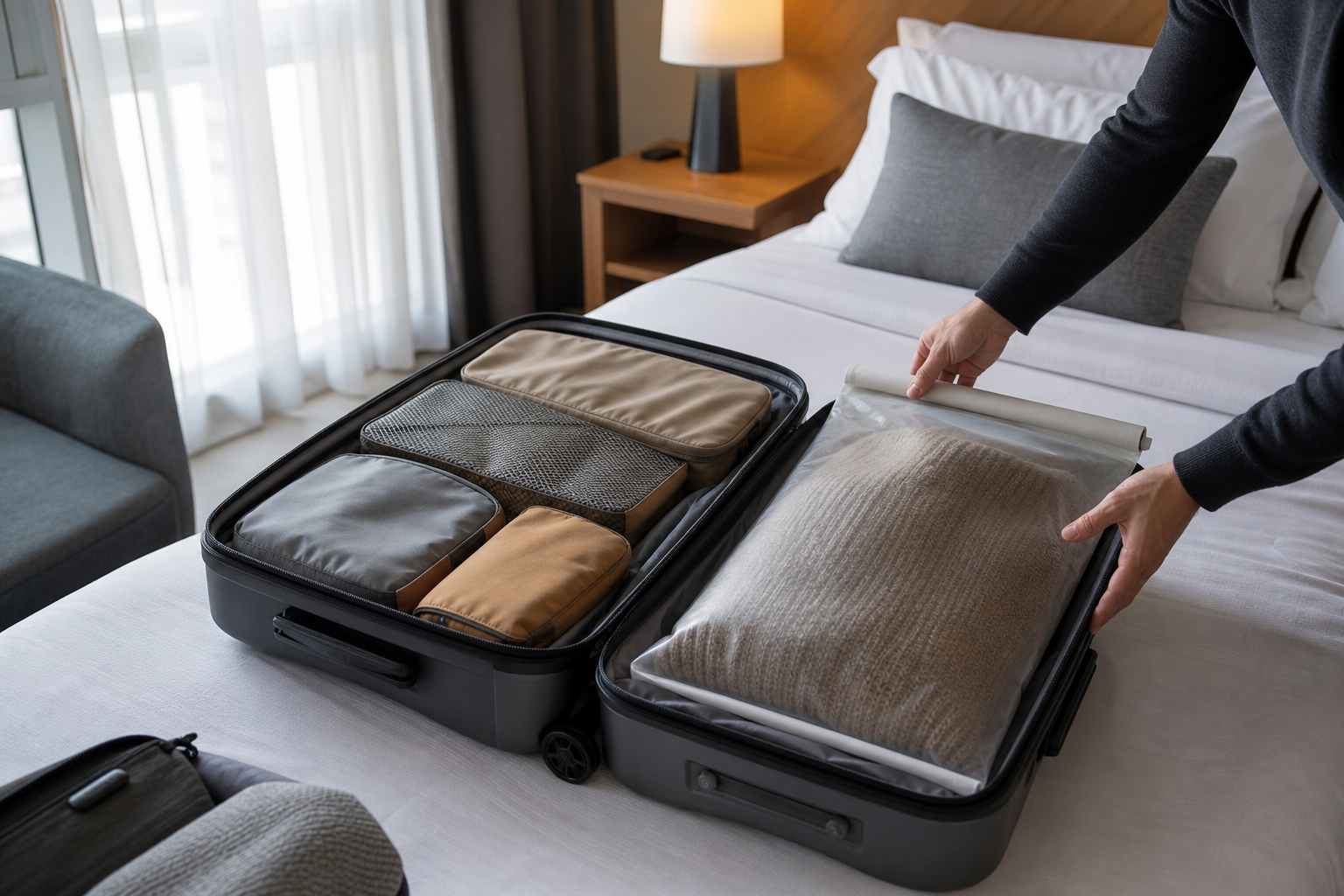
Choose packing cubes if you want tidy categories, easier unpacking, and faster access to everyday clothes. Choose compression bags for bulky sweaters, jackets, or dirty laundry when saving volume matters most; for many travelers, a combination of cubes and one compression bag is the most practical setup.
What Matters Most
Packing cubes and compression bags solve different problems
A standard packing cube is a soft, zippered container that divides a larger suitcase, duffel, or travel pack into manageable sections. You might use one for tops, another for underwear and socks, and a third for workout clothes or sleepwear. The main benefit is organization: instead of searching through one large compartment, you pull out the category you need.
A compression bag is designed to reduce the volume of soft items. Roll-up travel compression bags generally work by packing clothing into the bag, closing the seal, and rolling or pressing out excess air. Some versions use a compression zipper or straps rather than a separate air-removal valve. Eagle Creek recommends compression sacks for bulky garments and dirty laundry, while REI describes compression bags as useful for squeezing down clothing and gear. ([eaglecreek.com](https://www.eaglecreek.com/blogs/articles/buying-guide-pack-it-packing-organizers-and-compression-bags?utm_source=openai))
There is also a middle option: the compression packing cube. It keeps the rectangular, easy-to-handle shape of a cube while adding a second zipper or compression panel. That makes it useful when you want some space savings without giving up a defined compartment. Thule, for example, describes its compression cubes as having a zipper that removes excess air between clothes while maintaining a cube format. ([thule.com](https://www.thule.com/en-us/luggage/travel-duffel-bags/thule-compression-packing-cube-small-_-3205114?utm_source=openai))
- Packing cube: best for sorting and access.
- Compression bag: best for reducing bulk.
- Compression cube: a compromise between organization and space savings.
When packing cubes organize travel better
Packing cubes are the better choice when your frustration is rummaging. They create smaller, predictable groups inside a larger bag, which is especially useful when you are changing hotels, sharing luggage, packing for more than one person, or carrying a mix of clothing and accessories. REI recommends lightweight packing cubes for separating items such as socks, underwear, shirts, and other clothing categories. ([rei.com](https://www.rei.com/learn/expert-advice/travel-clothing.html?utm_source=openai))
Their shape also makes unpacking easier. A cube can move from suitcase to dresser, shelf, or hotel closet without requiring you to handle every garment individually. If you prefer to live out of your luggage, cubes let you pull out only the category you need and leave the rest contained.
Cubes can also make a soft-sided duffel or travel backpack feel less like one large compartment. REI notes that travel cubes or stuff sacks can add organization to a duffel’s simple, open interior. Consistent shapes may help use luggage volume efficiently, although a rigidly rectangular cube will not always fit the curved corners of a small backpack as well as a flexible sack. ([rei.com](https://www.rei.com/learn/expert-advice/luggage-packs.html?related-style-id=177054&utm_source=openai))
- Best for multi-city trips and frequent hotel changes.
- Useful when several people share one suitcase.
- Good for separating clean clothes, laundry, shoes, and accessories.
- Usually easier to label, color-code, grab, and repack.
When compression bags make more sense
Compression bags earn their place when clothing is bulky rather than numerous. Puffy jackets, sweaters, fleece layers, scarves, and other lofty items can occupy a disproportionate amount of space. A compression bag lets you group those items and reduce their volume before placing them in the main luggage compartment.
They can also be useful for dirty laundry. Instead of mixing worn clothing with clean items or allowing laundry to spread through an open suitcase, you can place it in a separate bag and compress it as the trip continues. Eagle Creek specifically lists bulky items and dirty laundry among the uses for its compression sacks. ([eaglecreek.com](https://www.eaglecreek.com/blogs/articles/buying-guide-pack-it-packing-organizers-and-compression-bags?utm_source=openai))
The trade-off is access. A compressed bag is usually less structured than a cube, and it may become a dense bundle that is awkward to open and repack repeatedly. It works well for items you will not need until later in the trip, but less well for daily basics such as shirts, socks, or medication-related personal items that you want to reach quickly.
- Best for cold-weather layers and bulky soft clothing.
- Helpful when luggage volume is the main constraint.
- Useful as a contained laundry zone.
- Less convenient for frequently accessed items.
The trade-offs: access, wrinkles, weight, and shape
Neither option creates free capacity. Compression removes air and reduces bulk, but it does not make clothing lighter. REI cautions that compression can tempt travelers to pack more, which may increase the total weight of the bag. That matters if you are lifting a carry-on into an overhead compartment, carrying a travel pack between stations, or approaching a checked-bag weight limit. ([rei.com](https://www.rei.com/learn/expert-advice/traveling-light.html?utm_source=openai))
Compression can also make soft clothing denser and more tightly packed. That is not automatically a problem, but it may increase wrinkling if garments are folded tightly or left compressed for a long time. Packing cubes do not prevent wrinkles by themselves either; for dress shirts, trousers, or other wrinkle-prone pieces, a garment folder or a careful folding method may be more appropriate than either a cube or a compression bag.
Shape is another important difference. Cubes create neat blocks that stack well in rectangular luggage, while flexible compression bags can fill irregular spaces more easily. A compression cube offers a tidy block but can become overstuffed, making zippers harder to close and contents more compressed than your clothing needs. The best system leaves room for the bag’s lid or expansion panel to close without forcing it.
- Compression saves volume, not weight.
- Overpacking can turn extra space into a heavier bag.
- Use a folder or careful folding for wrinkle-sensitive clothing.
- Match the organizer’s shape to the luggage, not just the clothing.
Which setup fits different kinds of travel?
For a weekend in a wheeled carry-on, standard packing cubes are usually the simplest choice. Use a small cube for underwear and socks, a medium cube for tops, and the remaining luggage space for shoes, toiletries, and one flexible layer. You may not need compression unless the trip involves bulky cold-weather clothing.
For a longer trip with changing weather, consider a mixed system. Standard cubes can hold everyday clothes, while one compression bag handles the sweater, jacket, or spare layers you will not need immediately. This keeps the frequently used items accessible without allowing bulky pieces to dominate the bag.
For backpack travel or a soft duffel, prioritize low weight and flexible shapes. REI notes that stuff sacks may fit some travel backpacks better than rectangular cubes, and that organizers can feel unnecessary on trips where every ounce matters. A lightweight cube or soft compression bag may be preferable to a large set of structured organizers. ([rei.com](https://www.rei.com/learn/expert-advice/adventure-travel-gear-checklist.html?utm_source=openai))
For family or shared luggage, cubes generally have the edge because each person can have a separate color or compartment. For a ski, winter, or shoulder-season trip, compression bags become more valuable because they can reduce the space taken by thick layers. For business travel, use cubes for casual clothing and a folder or garment solution for formal pieces.
- Weekend carry-on: standard cubes.
- Longer or mixed-weather trip: cubes plus one compression bag.
- Backpack or duffel: lightweight, flexible organizers.
- Family luggage: color-coded cubes.
- Bulky winter packing: compression bag or compression cube.
How to choose without buying too much
Start with the problem you can describe most clearly. If your suitcase is full but orderly, a compression bag may help. If your suitcase has room but everything is difficult to find, packing cubes are the better first purchase. If both problems are equally annoying, begin with two or three cubes and add one compression bag only for bulky layers or laundry.
Look for organizers that fit the actual dimensions of your luggage. Check the expanded and compressed measurements, not just the product label. A cube that is too tall may waste space under a suitcase lid, while a bag that is too large may encourage you to fill it beyond a manageable weight. Current product designs vary widely in size, weight, materials, and closure systems; manufacturer specifications are more useful than assuming every cube or bag behaves the same way. ([thule.com](https://www.thule.com/en-us/luggage/travel-duffel-bags/thule-compression-packing-cube-small-_-3205114?utm_source=openai))
Pay attention to the closure and fabric. A compression zipper or strap system is convenient for regular access, while a roll-up bag may compress more flexible loads. Handles make cubes easier to move around a hotel room, and semi-transparent fabric can help identify contents without opening the organizer. For damp or wet items, do not assume a travel organizer is waterproof unless the manufacturer specifically says so; use a dedicated wet bag when separation from dry clothing is important.
The direct answer is simple: packing cubes organize travel better, while compression bags maximize usable space better. For most travelers, the strongest all-purpose setup is not choosing one over the other—it is using regular cubes for daily categories and reserving one compression bag or compression cube for the bulkiest, least frequently accessed items.
- Buy cubes first if access and order are the priority.
- Buy a compression bag first if bulky clothing is crowding out everything else.
- Choose a hybrid setup when you want both organization and space savings.
- Do not confuse compressed volume with a lighter or smaller total load.
Sources & editorial note
This guide is research-based and does not claim hands-on testing unless explicitly stated.
- REI Expert Advice: How to Pack Light for Traveling — Supports the distinction between organization and compression, and the warning that compression can encourage heavier packing.
- REI Expert Advice: Adventure Travel Gear Checklist — Supports the use of packing cubes for organization, compression cubes for saving space, and the importance of keeping organizer weight in mind.
- REI Expert Advice: How to Choose Luggage, Packs and Bags — Supports matching organizers to luggage type, trip style, weight, and carrying conditions.
- Thule: Compression Packing Cube — Supports current examples of compression-cube features, sizing, materials, handles, and zipper-based compression.
- Eagle Creek: Buying Guide for Packing Cubes and Compression Bags — Supports recommended use cases for cubes, compression sacks, bulky items, and dirty laundry.
- Osprey: How to Use Packing Cubes — Supports the role of consistent cube shapes, rolling or folding clothing, and compression zippers.