Compression cubes win when you pack soft, bulky items such as sweaters, jeans, leggings, and T-shirts. Standard cubes are often the better everyday option for lighter clothing, shorter trips, or travelers who value simple access more than maximum capacity.
What Matters Most
Explore Options That Fit Your Everyday Routine
Explore products that fit your priorities, compare current options and discover what works best for you.
Check prices, seller details and specifications on Amazon. Featured image is illustrative.
As an Amazon Associate I earn from qualifying purchases.
The direct answer: compression cubes save more space
Compression packing cubes have an additional zipper that closes around the contents and reduces the cube’s height. That design removes some air between garments and creates a flatter bundle. Standard packing cubes usually provide organization without actively reducing the packed volume.
The difference is most useful with soft clothing. A compression cube can make a stack of T-shirts, underwear, socks, leggings, or knitwear more compact. It will not make shoes, toiletries, electronics, or structured jackets meaningfully smaller, and it cannot create space that the garments themselves do not have.
As one current example, Thule lists its medium compression cube at 14 by 10 by 5.9 inches when expanded and 13.4 by 9.1 by 1.25 inches when compressed. Those published dimensions illustrate the design’s potential, but they should not be treated as a guaranteed percentage of real-world suitcase space saved. How much room you gain depends on what you pack, how full the cube is, and the shape of your luggage.
- Best for maximum clothing capacity: compression cubes
- Best for straightforward organization: standard cubes
- Best overall for many travelers: a mix of both
How standard and compression packing cubes differ
A standard packing cube is essentially a lightweight fabric container with a zipper, often with a mesh panel, handle, or internal divider. It keeps shirts, underwear, sleepwear, or accessories together so they do not spread throughout the suitcase. It also makes unpacking easier because you can move one category from bag to drawer or shelf.
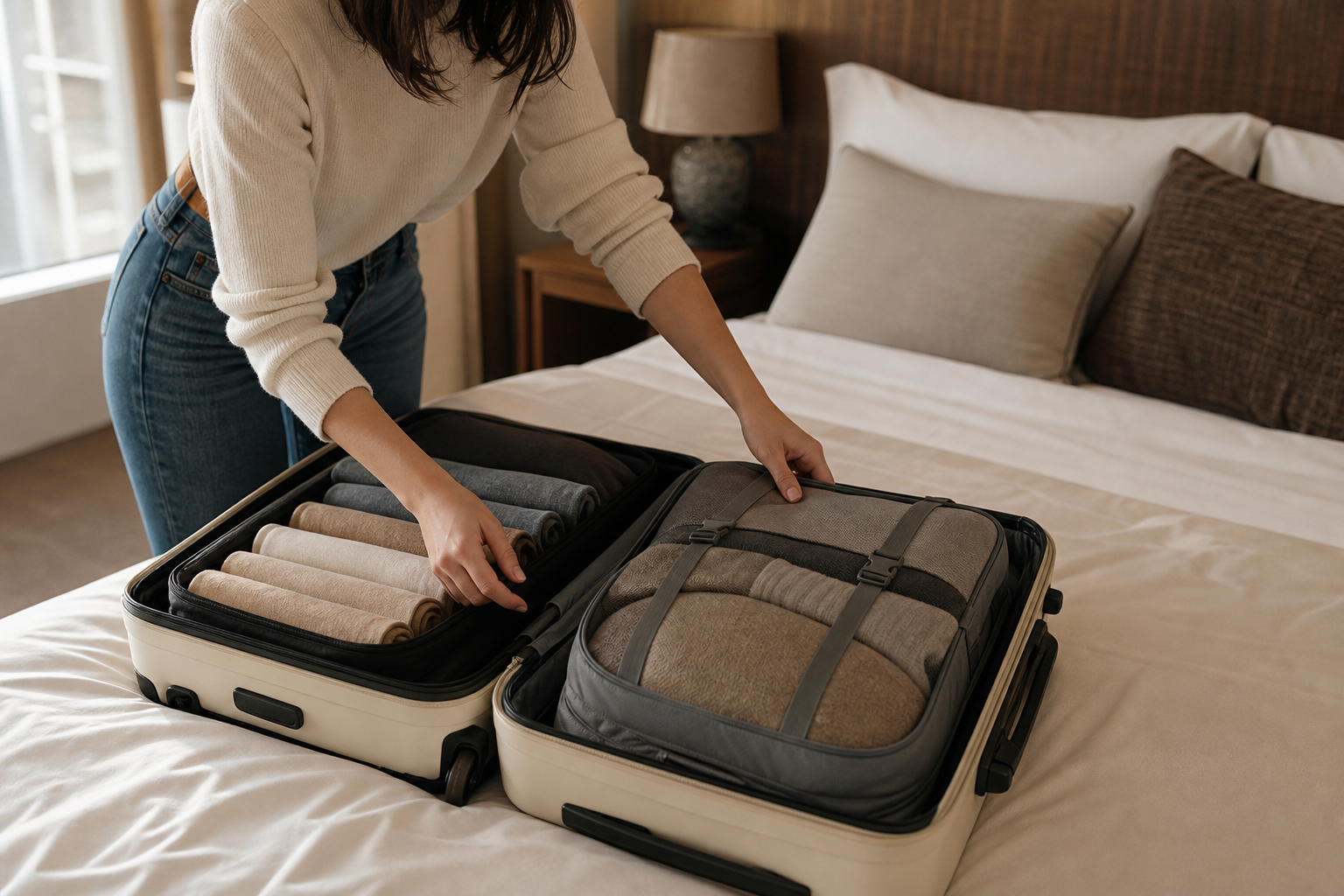
Compression cubes add a second zipper or compression panel. You normally pack the cube while it is expanded, close the main compartment, and then use the outer zipper to flatten the contents. The compression zipper is doing the work; you do not need a vacuum pump, and the cube does not remove all air from the clothing.
The extra hardware usually means a compression cube costs more or weighs slightly more than the simplest standard cube. It can also make the packed bundle firmer and less flexible, which may be useful in a rectangular suitcase but less convenient in a backpack with irregular corners.
- Standard cube: organizes and contains
- Compression cube: organizes, contains, and flattens
- Neither type increases the luggage’s stated capacity
When compression cubes are worth it
Choose compression cubes when your limiting factor is clothing volume rather than luggage weight. They make the most sense for cold-weather trips, longer journeys, family packing, or one-bag travel where every inch of a carry-on matters. Bulky but pliable items benefit most because they can be pressed into a denser layer.
They are particularly useful when your suitcase has unused height above a regular clothing stack. Compressing a cube can lower that stack and leave room for another small cube, a pair of shoes, or a toiletry bag. Thule, for example, describes its small cube as suitable for socks, underwear, and shirts, while its medium cube is intended for pants, shirts, and sweaters.
Compression cubes can also make a partly used suitcase easier to manage. If you remove clothing during a trip, the outer zipper may help keep the remaining items from spreading across the case. That said, do not force the zipper around an overstuffed cube. Excessive pressure can strain the zipper, seams, or fabric, especially when the contents include thick denim or bulky knitwear.
- Cold-weather travel with sweaters and heavier layers
- Carry-on-only trips where clothing volume is tight
- Longer trips with several categories of soft clothing
- Sharing luggage with a partner or child
When standard cubes are the smarter choice
Standard cubes are often enough when you mainly want order. For a short trip with a few outfits, the organizational benefit may matter more than squeezing out the last inch of space. A small or medium cube for undergarments, another for tops, and a third for sleepwear can make a suitcase much easier to use without adding compression hardware.
They are also a good fit for travelers who unpack at the destination. Standard cubes tend to stay flexible and can be lifted out quickly, opened wide, and placed in a drawer. Their softer shape may fit more naturally around shoes, toiletry kits, or the tapered corners of a soft-sided suitcase.
Consider standard cubes for wrinkle-sensitive clothing as well. Compression does not automatically cause wrinkles, but pressing garments into a flatter, tighter bundle can create sharper folds if clothing is packed carelessly. Rolling or folding neatly helps with either style, but standard cubes give you more room to avoid overpacking.
- Weekend trips and light packers
- Travelers who unpack into drawers
- Soft-sided luggage with curved or irregular interiors
- Garments that need more breathing room
- People who want the lightest, simplest setup
The trade-offs that matter in real luggage
The biggest mistake is comparing an expanded compression cube with a standard cube without checking the dimensions that fit your luggage. A cube can advertise generous capacity but still waste space if it is too tall for your suitcase or too wide for the area beside the handle rails. Measure the usable interior of your bag, not just the manufacturer’s exterior dimensions.
Compression also works best when the cube is filled evenly. A loosely packed cube may flatten easily but provide little practical benefit. An overfilled cube may compress at the center while bulging at the sides, making it harder to close the suitcase. Medium compression cubes are often more versatile than one very large cube because they divide the load and fit around the luggage’s internal structure.
Look at zipper quality, fabric weight, handles, visibility, and opening style. A wide opening makes packing easier. A mesh or semitransparent panel helps identify contents without unpacking. Handles are useful when moving cubes between a suitcase and a hotel room. Water resistance may help with minor spills, but a packing cube should not be treated as waterproof luggage.
- Compare compressed dimensions, not only capacity
- Favor two medium cubes over one oversized cube when fit is uncertain
- Check the cube’s weight if you travel with strict bag limits
- Avoid packing so tightly that the compression zipper has to be forced
A practical buying strategy
For most travelers, the best setup is not all standard or all compression. Use one or two compression cubes for bulky clothing and standard cubes for underwear, accessories, electronics, or items you want to reach frequently. This gives you extra capacity without turning every category into a tightly packed bundle.
If you are buying only one cube, choose based on your most common trip. Pick compression if you regularly fly with a carry-on, pack sweaters or jeans, or find that your suitcase runs out of room before it runs out of weight. Pick standard if you mainly take short trips, pack light layers, or want the fastest access to organized categories.
Before buying a set, lay out the clothing you normally take and measure the available packing area. Check the cube’s expanded and compressed dimensions, capacity range, weight, opening style, and return policy. A well-sized standard cube will save more usable space than a compression cube that does not fit your bag, while a correctly sized compression cube is the clear winner when soft clothing is the problem.
- Best space-saving choice: compression cubes for bulky soft clothing
- Best organization choice: standard cubes for lighter, shorter-trip packing
- Best balanced setup: compression cubes for layers plus standard cubes for small items
Ready to Find Your Best Match?
Explore products that fit your priorities, compare current options and discover what works best for you.
Check prices, seller details and specifications on Amazon. Featured image is illustrative.
As an Amazon Associate I earn from qualifying purchases.
Sources & editorial note
This guide is research-based and does not claim hands-on testing unless explicitly stated.
- Thule Compression Packing Cube product pages — Supports the compression mechanism, intended clothing categories, published dimensions, materials, and weight for a current medium compression cube.
- Thule Compression Cube Set — Supports current small and medium cube dimensions, carry-on compatibility claims, and intended uses.
- REI Co-op Packing Cubes category — Supports the current range of standard, expandable, and compression packing cube formats available in the U.S. market.
- REI Co-op Expandable Packing Cube Set — Provides a current example of a non-compression expandable cube with adjustable volume and organization-focused features.
- Cotopaxi Cubo Expandable Packing Set — Provides a current example of an expandable cube that changes capacity between expanded and compressed dimensions.