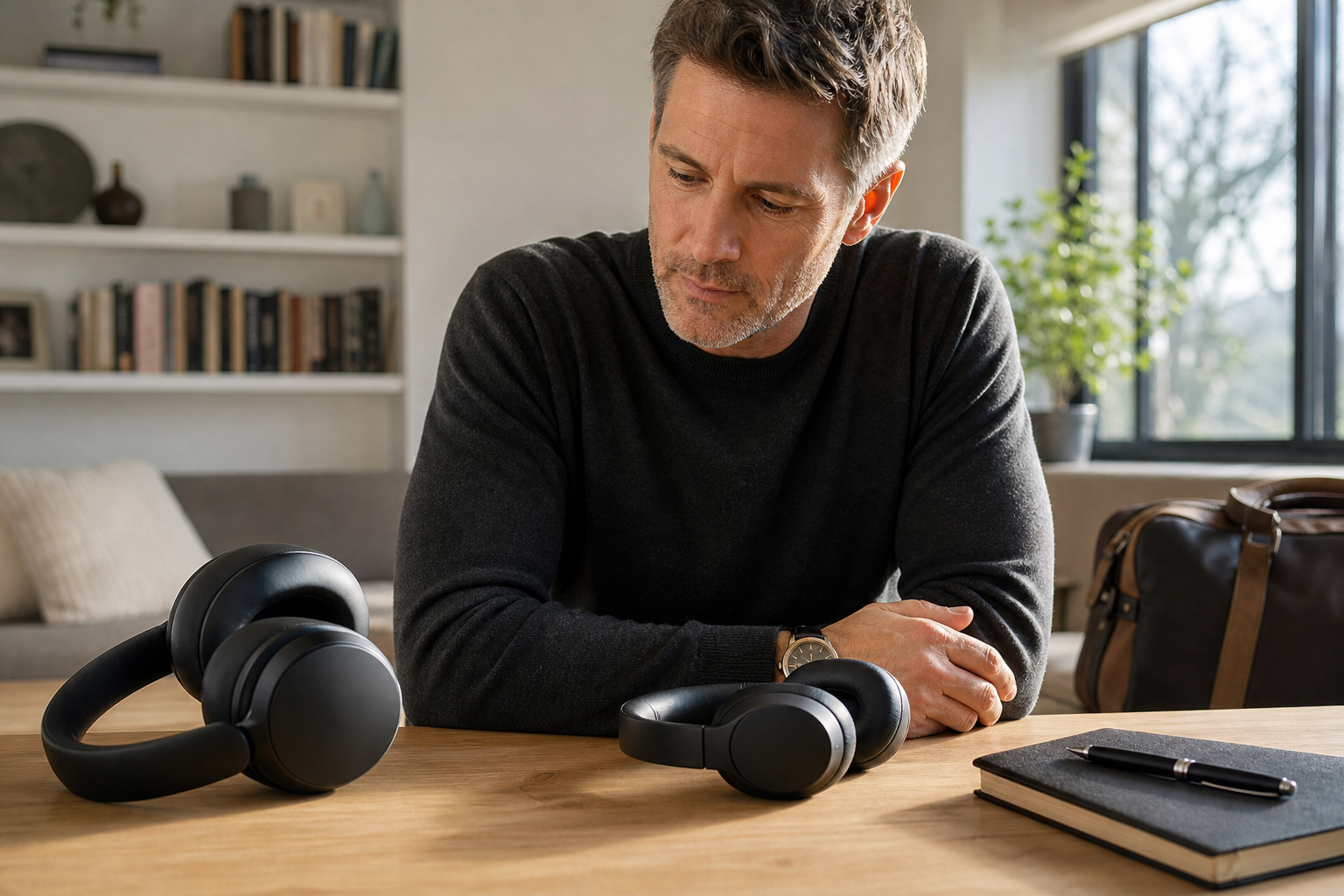
Choose over-ear headphones for long flights, office focus, home listening, and stronger passive isolation. Choose on-ear headphones if you prioritize a lighter fit, easier portability, less heat around the ears, or a more compact design—and you do not mind some pressure on the outer ears or more sound leakage.
What Matters Most
Explore Options That Fit Your Everyday Routine
Explore products that fit your priorities, compare current options and discover what works best for you.
Check prices, seller details and specifications on Amazon. Featured image is illustrative.
As an Amazon Associate I earn from qualifying purchases.
The short answer: over-ear usually wins for extended comfort
Over-ear headphones have earcups large enough to surround the ears. Their padding rests against the area around the ear rather than directly on the ear itself. For many listeners, that makes them more comfortable during long work sessions, flights, movie watching, or relaxed listening at home.
On-ear headphones use smaller cushions that sit on the outer ear. Their reduced size can make them lighter and easier to carry, but the trade-off is direct contact with the ear. If the headband clamps firmly, pressure can build on the cartilage after an hour or two. Some people barely notice this; others find it uncomfortable quickly.
There is no universal winner because comfort is shaped by head size, ear shape, hair, eyewear, and personal tolerance for pressure. The best design is the one that stays stable without squeezing, leaves your ears in a natural position, and does not make you constantly readjust the fit.
- Best default for long sessions: over-ear
- Best for a lighter, less bulky feel: on-ear
- Most important fit factor: pressure and stability, not just weight
Where over-ear headphones feel better
The biggest advantage of over-ear headphones is that the earcups distribute contact around the ear. When the cushions are deep and soft enough, they can avoid the concentrated pressure that on-ear pads place on the outer ear. This is especially helpful if your ears are sensitive to pressure or if you expect to wear the headphones through a long journey or workday.
Over-ear designs also tend to create a more complete physical seal around the ears. That seal can reduce some outside sound before active noise cancellation does its work. It can also limit sound leakage, which is useful in a shared office, library, or quiet room. Noise cancellation is available in both over-ear and on-ear styles, but the fit still matters: gaps around the ear can reduce isolation and affect the overall listening experience.
The drawbacks are bulk and warmth. Large cushions can make the ears feel enclosed, particularly in a warm room or during light activity. A heavy model may also create pressure on the top of the head or feel tiring if the headband is poorly shaped. Over-ear headphones can be comfortable for the ears but less comfortable overall if they are heavy or clamp too tightly.
- Look for earcups that fully surround the ears without touching them
- Check that the headband spreads pressure rather than creating one sore spot
- Consider breathable cushions if you often listen in warm spaces
Where on-ear headphones make more sense
On-ear headphones appeal to people who want a smaller, lighter design. They often take up less room in a bag and may feel less enclosing than over-ear models. If you dislike the sensation of having your ears surrounded, an on-ear pair can feel more natural and less isolating.
They may also be preferable when heat is your main complaint. Smaller pads cover less of the side of the head, so they can allow more airflow around the ears. That does not guarantee comfort, however. The same compact cushions that reduce warmth sit directly on the ear, and a strong clamp can become uncomfortable even when the headphones themselves are lightweight.
On-ear models generally provide less passive isolation than over-ear headphones because they do not form a full seal around the ears. That can be useful if you want to remain more aware of nearby conversations or announcements, but it is less helpful when your priority is quiet concentration. On-ear headphones may also allow more music to escape into the surrounding space.
- Best fit for shorter listening sessions and frequent travel
- Useful when you want less bulk or a less enclosed feel
- Avoid models that press hard on the upper or lower edge of the ear
Glasses, earrings, hair, and fit can change the answer
Eyewear is one of the clearest reasons a theoretically comfortable design may not work for you. Over-ear cushions can press against glasses frames where the arms pass behind the ears, creating a pressure point or breaking the seal. On-ear pads may avoid some of that surrounding pressure, but they can still shift when the glasses and headband compete for space.
Earrings and other earwear can also interfere with either design. Over-ear pads may press against larger jewelry, while on-ear cushions can sit directly over it. If you wear hearing devices, hats, or thick-framed glasses, fit should be judged with those items in place rather than during a quick try-on by itself.
Hair can affect stability and sealing as well. Very smooth hair may allow a headband to slide, while thick hair can change how the cushions contact the head. These are not reasons to rule out one category; they are reasons to test the exact combination you use in daily life. A return policy is especially valuable when buying online.
- Try headphones with your usual glasses or other earwear
- Check whether the earcup seal breaks when you turn your head
- Do not judge comfort after only two minutes; wear them for at least 20 to 30 minutes
Noise cancellation, pressure, and the feeling of quiet
Active noise cancellation uses microphones and electronic processing to reduce ambient sound. It is particularly useful for steady, low-frequency noise such as engine rumble, but it does not make every voice or sudden sound disappear. Both over-ear and on-ear headphones can include active noise cancellation, so the category label alone does not determine performance.
Many listeners describe a pressure or plugged-up sensation when active noise cancellation is switched on. That experience varies from person to person and is not the same as the physical clamp of the headphones. If you notice it, look for adjustable cancellation levels, an ambient or transparency mode, or the ability to use the headphones with cancellation turned off.
Fit remains central. A poor seal can reduce passive isolation and may also affect how well the noise-canceling system performs. Over-ear headphones usually have more opportunity to seal around the ear, while on-ear models depend more on consistent pad contact. Either style can work well when the cushions and headband fit your head securely without excessive pressure.
- For maximum isolation, start by comparing over-ear models
- For awareness of announcements or nearby activity, look for an adjustable ambient mode
- If cancellation feels uncomfortable, test the headphones with ANC off before rejecting the entire category
How to choose for your routine
Choose over-ear noise-canceling headphones if you regularly spend several hours listening, travel by plane or train, work near conversation, or want a more immersive and isolated experience. They are also the better starting point if direct pressure on your ears is usually uncomfortable. Focus on moderate weight, generous earcup depth, a flexible headband, and cushions that do not touch the ear.
Choose on-ear noise-canceling headphones if you value portability, dislike enclosed earcups, listen in shorter stretches, or want a less substantial design for commuting and casual use. They can be a good fit for someone who finds over-ear headphones hot or heavy, provided the pads do not press painfully and the reduced isolation is acceptable.
Whichever style you choose, comfort is more than softness. Check the clamp, headband pressure, earcup rotation, adjustment range, heat, stability, and how the headphones interact with glasses or jewelry. If you are shopping online, favor a retailer with a practical return window. In the end, the most comfortable pair is the one you can leave on without thinking about it.
- Long sessions and stronger isolation: over-ear
- Lightweight portability and less enclosure: on-ear
- Uncertain fit: buy from a retailer with easy returns
Ready to Find Your Best Match?
Explore products that fit your priorities, compare current options and discover what works best for you.
Check prices, seller details and specifications on Amazon. Featured image is illustrative.
As an Amazon Associate I earn from qualifying purchases.
Sources & editorial note
This guide is research-based and does not claim hands-on testing unless explicitly stated.
- Consumer Reports Headphone Buying Guide — Supports the distinction between over-ear earcup seals and on-ear designs, plus the importance of comfort, fit, isolation, and intended use.
- Consumer Reports Noise-Canceling Headphone Ratings — Supports that noise-canceling wireless headphones are available in both over-ear and on-ear categories.
- Sony Support: Over-Ear Headphones, Noise Canceling and Ambient Sound Mode — Supports the role of fit, adaptive noise-canceling adjustment, and ambient-sound modes.
- Headphones.com: What Are Noise Cancelling Headphones? — Supports the explanation that active noise cancellation is especially effective against steady, low-frequency background noise.
- Consumer Reports: Bose vs. Sony Noise-Canceling Headphones — Supports the importance of clamp pressure, fit, earcup seal, glasses-related fit concerns, and the connection between fit and noise-canceling performance.