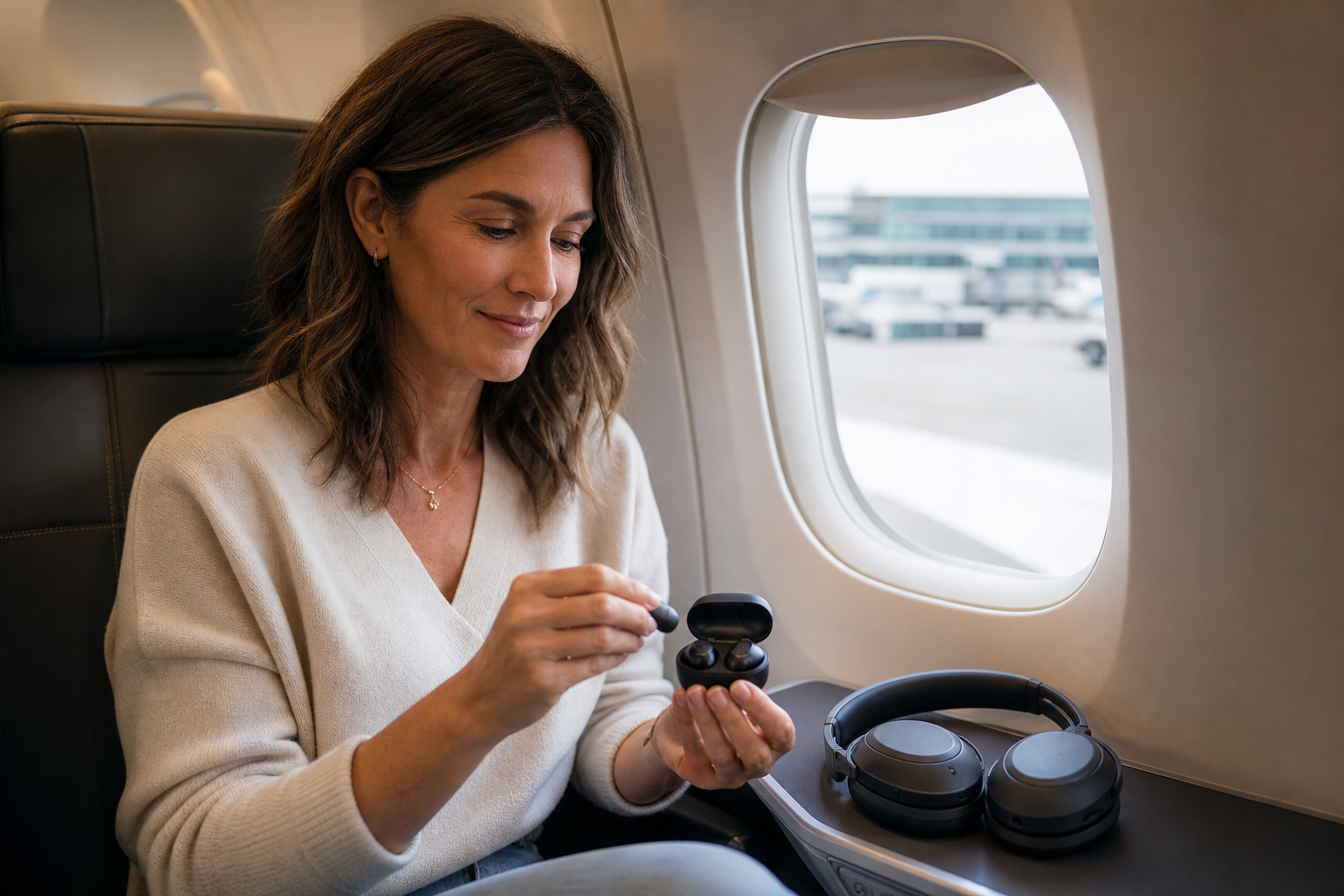
Choose noise-canceling headphones if you want a relaxed fit for flights, trains, desk work, or long listening sessions and do not mind carrying a larger case. Choose earbuds if you prioritize a small travel footprint, easy calls, exercise, and the ability to use just one earbud at a time. If you are undecided, think about your longest regular listening session: that usually reveals the better match.
What Matters Most
Start with the job to be done
Noise-canceling headphones and earbuds solve the same broad problem: reducing distractions so your music, podcasts, calls, or videos remain clear without forcing you to raise the volume. Active noise cancellation, or ANC, uses microphones and signal processing to reduce parts of the surrounding sound. Both formats can also offer a transparency or ambient mode that feeds outside sound back in when you need awareness. ([support.bose.com](https://support.bose.com/article/quietcomfort-ultra-headphones-using-modes?utm_source=openai))
The practical difference is how each format fits into your day. Over-ear headphones make a stronger case when you settle in for a long flight, a train ride, focused work, or a movie. Earbuds make more sense when you move between short listening sessions, take calls while walking, store your audio gear in a pocket, or want something that disappears into a small case.
A useful rule is to buy for your most demanding routine rather than your occasional use. If you fly twice a year but wear audio gear for hours at your desk every day, prioritize long-session comfort. If you travel light and listen in 20-minute bursts, the portability of earbuds may matter more than maximum battery capacity.
- Best overall for long listening: over-ear noise-canceling headphones.
- Best for portability and quick use: noise-canceling earbuds.
- Best choice when uncertain: the format you are more likely to wear consistently.
Comfort and fit: the decision most people feel immediately
Headphones rest around your ears, so they avoid placing a tip inside the ear canal. That can feel less intrusive during long sessions, especially for listeners who dislike an in-ear seal. The trade-offs are added weight, a headband, pressure around the ears, and possible warmth after several hours. Fit also varies with glasses, hairstyles, head size, and how firmly the headband clamps.
Earbuds are lighter and easier to carry, but comfort depends heavily on shape and tip selection. A good seal can improve bass response and help ANC perform consistently; a poor seal can create looseness, pressure, or the need to keep adjusting them. Current premium earbuds commonly include multiple tip sizes, but a wide range of ear shapes means no design will fit everyone equally well. Apple’s current AirPods Pro specifications, for example, list silicone tip options, venting for pressure equalization, and a very low per-ear weight. ([apple.com](https://www.apple.com/airpods-pro/specs/?utm_source=openai))
For long travel, try to imagine wearing the device for the full duration of your journey, not just for five minutes in a store. For earbuds, pay attention to pressure and stability. For headphones, check whether the cushions surround your ears rather than pressing directly on them, and whether the headband remains comfortable when you lean back against a seat.
- Choose headphones if you dislike in-ear pressure or want to listen for several uninterrupted hours.
- Choose earbuds if you prefer a light, low-profile fit and can find tips that seal securely.
- Do not assume lighter automatically means more comfortable; fit stability matters as much as weight.
Travel and noise control: where headphones usually pull ahead
For airplanes, trains, buses, and busy terminals, over-ear headphones generally offer a more substantial physical barrier around the ears in addition to ANC. That combination can make steady engine or vehicle noise easier to ignore. They also tend to provide longer continuous battery life, which is useful when charging access is uncertain. As one current example, Sony lists up to 30 hours with noise canceling enabled for its WH-1000XM6 over-ear model. ([sony.com](https://www.sony.com/electronics/support/wireless-bluetooth-headphones/wh-1000xm6/specifications?utm_source=openai))
Earbuds are easier to pack and less cumbersome when moving through an airport. Their charging case can extend total listening time, and you can put them away quickly when staff, travel companions, or announcements need your attention. The compromise is that a single charge may last fewer hours than an over-ear model. Apple lists up to eight hours of ANC listening for AirPods Pro 3, with up to 24 hours using the charging case. ([apple.com](https://www.apple.com/airpods-pro/specs/?utm_source=openai))
Neither format should be treated as a substitute for situational awareness. Transparency or aware modes are useful for conversations and announcements, but their performance depends on microphones, software, wind, and the surrounding environment. Bose describes an Aware mode that lets outside sound through and an ActiveSense feature that can add noise reduction when sudden loud sounds occur. ([support.bose.com](https://support.bose.com/article/quietcomfort-ultra-headphones-using-modes?utm_source=openai))
- Frequent flyer or long-distance rail traveler: headphones are usually the easier long-session choice.
- Light packer or occasional traveler: earbuds save space and are quicker to stow.
- Anyone traveling in unfamiliar surroundings: prioritize easy-to-access transparency controls.
Battery, calls, workouts, and daily convenience
Battery life is not simply a headphones-versus-earbuds contest; compare continuous listening time with ANC on, not the maximum figure with every feature disabled. Over-ear models often provide longer single-charge sessions, while earbuds divide the battery between two small earpieces and rely on a case for top-ups. Features such as immersive audio, high-quality wireless codecs, voice processing, and multipoint connections can change the real-world result.
Earbuds are usually the more flexible choice for workouts, errands, and short calls because they are compact and less visually prominent. They can also be useful when you want to leave one ear open, provided the design and controls support that use. Headphones may be better for desk calls and long video meetings, especially if you prefer a stable fit and larger physical controls, but they take up more room and can feel excessive for a quick conversation.
Look closely at the controls rather than assuming an expensive model will be effortless. You want a simple way to switch between ANC and awareness, pause audio, answer a call, and adjust volume without opening an app. If you regularly move between a phone and a computer, multipoint support can be more valuable than a small improvement in sound quality; Sony lists multipoint connection among the WH-1000XM6 specifications. ([sony.com](https://www.sony.com/electronics/support/wireless-bluetooth-headphones/wh-1000xm6/specifications?utm_source=openai))
- For a desk, phone, and computer routine: prioritize multipoint and comfortable controls.
- For exercise and errands: earbuds are usually easier to carry and wear discreetly.
- For all-day listening: compare ANC-on battery life and charging convenience.
Sound, hearing habits, and what to check before buying
Noise cancellation is most valuable when it lets you listen at a lower volume. The World Health Organization recommends keeping volume down, taking listening breaks, monitoring sound levels, and using well-fitted noise-canceling headphones in noisy settings so you are less tempted to turn the audio up. Its safe-listening guidance gives 80 dB for up to 40 hours per week as an example reference, with less safe listening time as volume rises. ([who.int](https://www.who.int/news-room/questions-and-answers/item/deafness-and-hearing-loss-safe-listening?utm_source=openai))
That guidance does not make one format automatically safer. A poorly sealed pair of earbuds may encourage louder listening, while a badly fitting pair of headphones may tempt you to increase volume or remove them frequently. Look for volume-limit settings, sound-exposure tracking, and controls that make awareness mode easy to use. Treat persistent ringing or difficulty hearing conversations as a reason to step away from loud audio and seek appropriate professional guidance rather than trying to solve the issue with a different product.
Before buying, confirm the return policy and test comfort over a meaningful period. Check whether the case fits your bag, whether replacement ear tips or cushions are available, whether the headphones can be used with a cable, and whether the controls work without a phone. The best match is the one that removes friction from your real routine: easy to wear, easy to charge, easy to pause, and comfortable enough that you do not avoid using it.
- Pick headphones for long sessions, steady travel noise, and a less intrusive fit.
- Pick earbuds for portability, workouts, quick calls, and compact storage.
- Whichever you choose, keep volume moderate and take regular listening breaks.
Sources & editorial note
This guide is research-based and does not claim hands-on testing unless explicitly stated.
- Apple AirPods Pro 3 Technical Specifications — Supports current earbud features, fit details, awareness modes, weight, and ANC-on battery examples.
- Sony WH-1000XM6 Specifications — Supports current over-ear design, ambient sound, multipoint, and ANC-on battery examples.
- Bose QuietComfort Ultra Headphones: Using Modes — Supports the distinction between full noise cancellation, transparency, custom modes, and adaptive awareness features.
- World Health Organization: Safe Listening — Supports volume, duration, listening breaks, monitoring, and the value of noise cancellation in noisy environments.
- WHO-ITU Safe Listening Devices and Systems Standard — Supports sound-exposure tracking, volume-limiting options, and the 80 dB for 40 hours per week reference for adults.