Choose a U-shaped travel pillow if you want cushioning around the sides of your neck, often sleep against a window, or prefer a familiar pillow shape. Choose a neck wrap if you pack light, tend to sit upright, dislike bulky pillows, or want adjustable support that can hold your head more securely in one direction.
What Matters Most
Explore Options That Fit Your Everyday Routine
Explore products that fit your priorities, compare current options and discover what works best for you.
Check prices, seller details and specifications on Amazon. Featured image is illustrative.
As an Amazon Associate I earn from qualifying purchases.
Start with the job to be done: control head movement without creating a new pressure point
A travel pillow has two related jobs: it can cushion your neck and help limit the head drop or sideways tilt that happens when you relax in a narrow seat. Those goals are not identical. A pillow may feel soft but still allow your head to fall forward, while a more structured design may control movement better but feel restrictive if the fit is wrong.
Your seat matters as much as the pillow. A window seat gives you a wall to lean against, while a middle or aisle seat leaves the pillow responsible for more of the support. Headrests, seat wings, recline angle, shoulder width, and how warm you get can all change which shape feels most comfortable.
Poor posture and holding your head in one position for long periods can contribute to neck discomfort. Mayo Clinic recommends keeping the head centered over the spine, taking movement breaks during long-distance travel, and adjusting support so the neck stays aligned rather than bent forward. A travel pillow can assist with positioning, but it cannot replace changing position occasionally. ([mayoclinic.org](https://www.mayoclinic.org/diseases-conditions/neck-pain/symptoms-causes/syc-20375581?utm_source=openai))
- Best comparison question: Does the design support the way your head rests when you are tired?
- No travel pillow works equally well for every seat, body shape, or sleep position.
U-shaped travel pillow: broader cushioning and familiar comfort
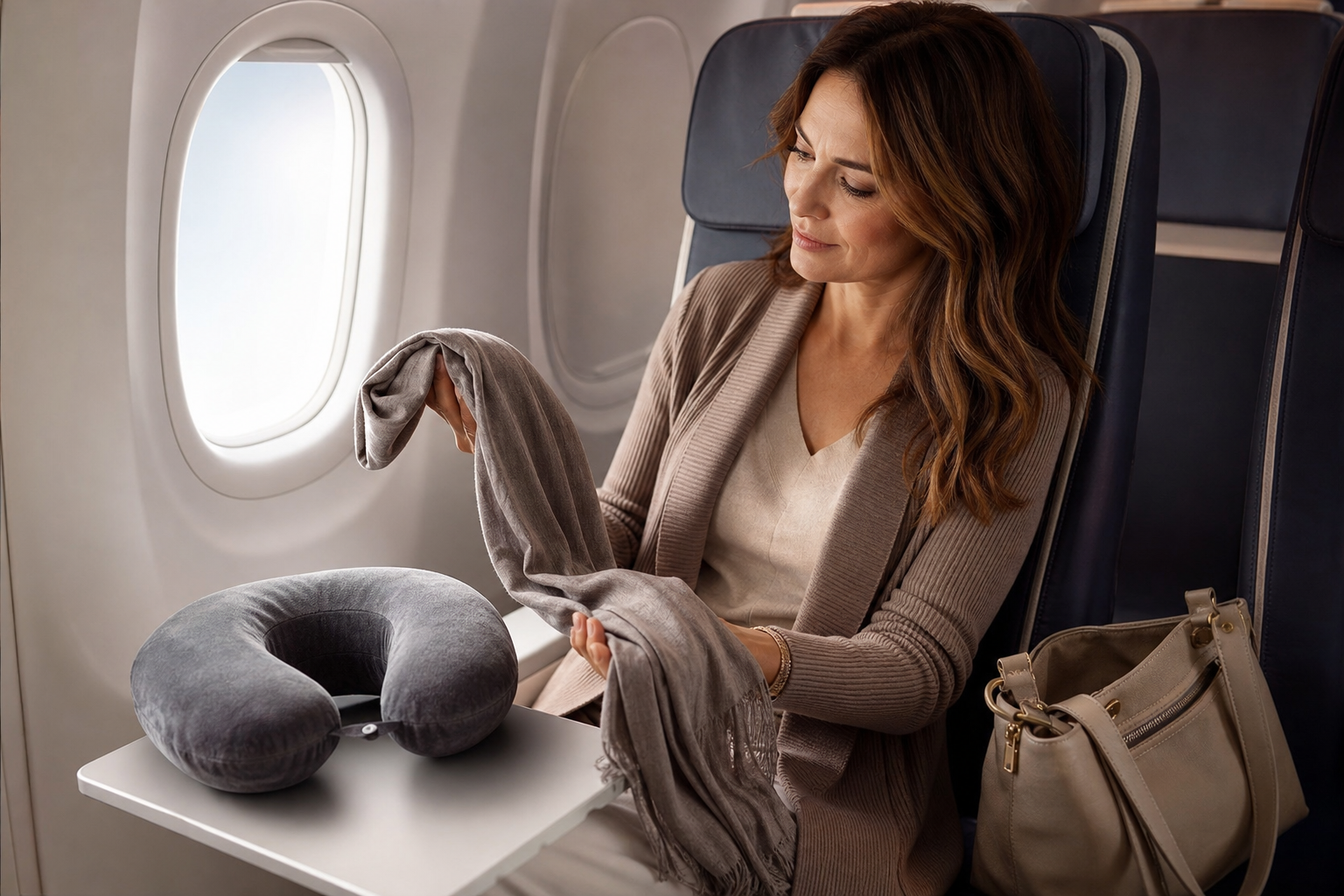
A traditional U-shaped pillow wraps around the back and sides of the neck. Depending on its height and firmness, it can cushion both sides of the head and give your jaw or cheeks somewhere to rest. That broad contact can feel reassuring if you move from side to side or prefer a softer, pillow-like experience.
The U shape makes the most sense for travelers who lean toward a window, sit in a car or train, or want padding between the neck and a hard seat or wall. It can also be a good fit if you do not want to fuss with a scarf-like wrap or an internal support panel.
The trade-off is bulk and fit. A tall U-shaped pillow can push the head forward, especially in an airline seat with a high headrest or limited recline. A loose fit may provide comfort without preventing head movement; a tight fit may feel confining around the jaw or throat. Look for an adjustable front closure, a flatter back, or compressible construction if you want the classic shape without as much forward pressure.
- Choose it for: side support, window-seat leaning, soft cushioning, and familiar pillow feel.
- Watch for: forward head pressure, excess warmth, shoulder interference, and packing bulk.
Neck wrap: closer fit, lower bulk, and more directional support
A neck wrap is usually built more like a scarf than a horseshoe pillow. It may use fleece, foam, a flexible internal support, or a structured panel that sits along one side of the neck. The wrap is secured around the neck, allowing you to adjust how snugly it holds the head.
This design can suit travelers who want to keep the head from tipping toward one side while remaining relatively upright. For example, Trtl describes its pillow as a scarf-style wrap with an internal support that can be positioned on the left, right, or front of the neck. The company also recommends changing the wrap position and tightness to fine-tune the fit. ([trtltravel.com](https://trtltravel.com/collections/all-products/products/trtl-travel-pillow?utm_source=openai))
The main advantage is usually portability. A wrap can lie flatter in a bag than a full U-shaped pillow, and some models can be worn without looking or feeling like a large cushion around the neck. The compromise is that support is often more directional: one side may feel well supported while the opposite side has less padding. A wrap can also feel warm or snug if the fabric overlaps heavily around the neck.
- Choose it for: compact packing, upright sleeping, adjustable fit, and one-sided head control.
- Watch for: uneven support, warmth, fastening pressure, and a learning curve when positioning it.
Which supports better on a flight?
For a window-seat traveler who leans sideways, a U-shaped pillow often has the advantage because it provides cushioning on both sides and can work with the aircraft wall. It is also the simpler choice if you want to rest your head without learning a particular wrapping technique.
For an aisle or middle-seat traveler who tends to nod forward or tilt toward one shoulder, a neck wrap may offer more useful support—provided it is positioned correctly and does not force the head forward. Some structured travel pillows add seat straps or headrest attachments. Cabeau’s Evolution S3, for example, combines a U-like neck pillow with front support, raised sides, a flat back, and straps designed to attach around the headrest area. Those features are product-specific rather than universal to every U-shaped pillow. ([cabeau.com](https://cabeau.com/products/evolution-s3-neck-pillow?utm_source=openai))
Neither style should be judged only by softness. Try to keep your ears roughly over your shoulders rather than allowing the pillow to push your chin toward your chest. If the support makes it difficult to turn your head, speak comfortably, or adjust your seat, it may be too tight, too tall, or simply the wrong shape for that seat.
- Window seat: U-shaped support often makes more sense.
- Aisle or middle seat: a close-fitting wrap or structured pillow may control movement better.
- Seat with usable headrest wings: a pillow that works with those wings may outperform either shape used alone.
How the choice changes for trains, buses, and road trips
On trains and buses, you may have more upright seating, less predictable headrest design, and more movement from turns or track vibration. A neck wrap can be practical when you want support without carrying a bulky item through stations or storing it beside you. A U-shaped pillow may be more comfortable when the seat has room and you plan to sleep for a longer stretch.
For road trips, consider who controls the vehicle. A passenger can use either style, but a large pillow may interfere with a seat belt, shoulder position, or the ability to look around. The driver should not use a pillow or wrap that restricts head movement, interferes with the shoulder belt, or distracts from the road.
Inflatable and hybrid designs are another option when packing space matters. Travelrest, for example, describes an inflatable pillow that can attach to an airline or car seat, be worn across the body, and roll to a compact size. This is not the same design as a neck wrap, but it shows why attachment method and storage size can matter as much as the basic pillow shape. ([travelrest.net](https://www.travelrest.net/products/travelrest-travel-pillow?utm_source=openai))
- Long trip with limited storage: prioritize compressibility and a carry case.
- Frequent seat changes: choose a design that is easy to put on and reposition.
- Car passenger: check that the pillow does not interfere with the seat belt or window.
Buying checklist: fit, fabric, cleaning, and return policy
Start with height and circumference. A pillow that is too tall can tip your head forward; one that is too short may leave the jaw unsupported. Adjustable toggles, front clasps, hook-and-loop closures, or movable internal supports can make a bigger difference than the label on the package. If possible, check the product’s dimensions and intended fit before buying.
Next, consider temperature and maintenance. Fleece and memory foam can feel cozy but warm, especially during a long flight. Breathable panels or lighter fabrics may suit travelers who dislike heat around the neck. A removable, washable cover is useful for a product that touches your skin and travels through airports. Cabeau lists a removable washable cover and a case that compresses the pillow for storage; other models may require hand washing or have different storage instructions. ([cabeau.com](https://cabeau.com/products/evolution-s3-neck-pillow?utm_source=openai))
Finally, use the return window strategically. Travel pillows are highly individual, and a design that looks compact online may feel too tight, too warm, or too tall once you are seated. Test it in a chair with your feet on the floor, then try it with the seat slightly reclined. Make sure you can release or loosen it easily before committing to a long trip.
- Prioritize: adjustable fit, a back that does not push the head forward, washable materials, and compact storage.
- Avoid assuming that a higher price, thicker foam, or a brand’s ergonomic language guarantees a better fit.
- Pack an eye mask and earplugs as well if sleep is the goal; reducing light and noise can matter as much as neck support. ([cdc.gov](https://www.cdc.gov/niosh/aviation/prevention/aircrew-jetlag.html?utm_source=openai))
Ready to Find Your Best Match?
Explore products that fit your priorities, compare current options and discover what works best for you.
Check prices, seller details and specifications on Amazon. Featured image is illustrative.
As an Amazon Associate I earn from qualifying purchases.
Sources & editorial note
This guide is research-based and does not claim hands-on testing unless explicitly stated.
- Mayo Clinic: Neck pain—symptoms, causes, and prevention — Supports guidance on neutral head position, posture, movement breaks, and using small pillows for neck support.
- Mayo Clinic Connect: Travel tips for people living with chronic pain and symptoms — Supports the practical point that a travel pillow may help maintain better posture while sleeping during overnight travel and that movement breaks matter.
- Trtl Travel: Trtl Travel Pillow — Supports the description of a scarf-style neck wrap with internal support, adjustable positioning, and compact design.
- Cabeau: Evolution S3 Neck Pillow — Supports the example of a structured travel pillow with front clasp, raised side supports, flat back, seat straps, washable cover, and compression case.
- Travelrest: Ultimate Inflatable Travel Pillow — Supports the example of an inflatable, attachable, multi-position travel pillow designed for aircraft and car seats.
- CDC Yellow Book: Jet Lag Disorder — Supports the advice that sleep during travel is affected by light, alcohol, caffeine, hydration, and timing—not just the pillow.