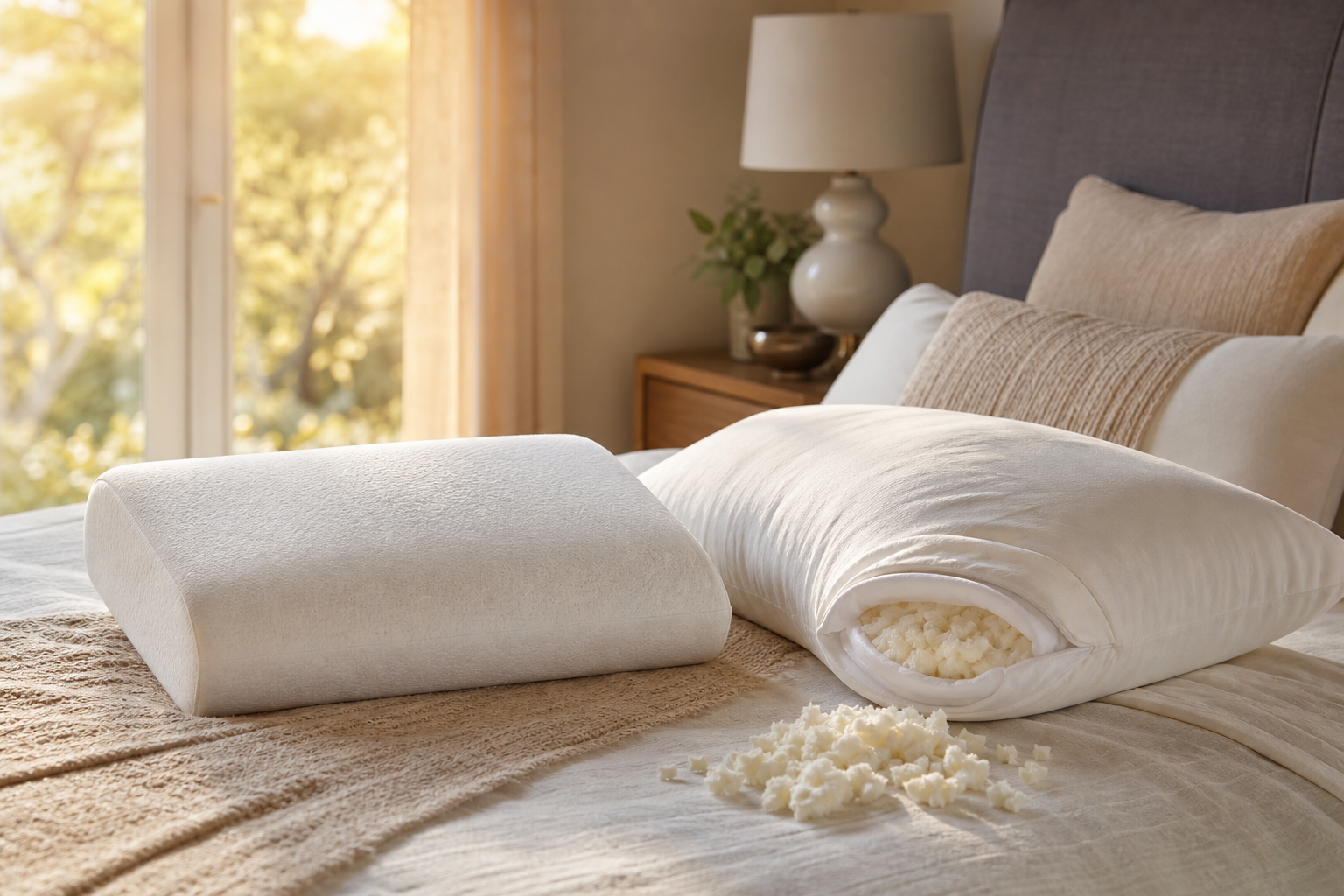
An adjustable-fill pillow is easier to tune because you can add or remove material and, in some designs, reshape the fill inside the cover. A solid memory foam pillow is easier to live with once chosen: it keeps a consistent shape, needs little adjustment, and offers a more predictable feel—but there is less room to correct a poor match.
What Matters Most
First, clarify the two categories
“Memory foam pillow” and “adjustable-fill pillow” are not always opposites. A memory foam pillow may contain one solid piece of foam, while an adjustable-fill pillow may use shredded or cross-cut memory foam, sometimes blended with microfiber, latex, or another fill. In other words, some adjustable pillows are memory foam pillows too; the real comparison is usually solid foam versus loose, adjustable fill.
A one-piece memory foam pillow is molded or cut into a fixed shape. It may be traditionally rectangular or contoured with raised areas intended to cradle the head and neck. An adjustable-fill pillow uses a zippered inner chamber so you can change the amount, distribution, or sometimes the type of material inside.
That distinction matters because “tuning” can mean several different things. You might want to change height, firmness, shape, surface feel, or the way the pillow behaves when you turn your head. Adjustable fill gives you more control over those variables, while solid foam gives you fewer decisions after purchase.
- Solid memory foam: fixed volume, stable shape, consistent feel.
- Adjustable fill: removable or addable material, more loft choices, more hands-on setup.
- Overlap: many adjustable-fill pillows use shredded memory foam.
Which is easier to tune for loft?
Adjustable fill is the clear winner for changing loft, or pillow height. Removing fill lowers the profile; adding it creates more height and resistance. This is especially useful if you are between positions, share a bed with someone whose preferences differ, or are still working out whether your mattress and shoulder width call for a lower or higher pillow.
The process is not entirely instant. Loose foam pieces can be awkward to handle, and the pillow may need to be fluffed and redistributed before you can judge the result. A change that feels obvious in your hands may feel smaller once your head compresses the fill. Plan on making small adjustments rather than removing half the contents at once.
A solid memory foam pillow offers much less flexibility. Some models include removable layers or inserts, but a standard one-piece pillow generally has one intended height. You can change the pillowcase or add a thin layer on top, but those workarounds do not provide the same control as changing the interior volume.
- Best for frequent loft changes: adjustable fill.
- Best for one-and-done simplicity: solid memory foam.
- Useful adjustment method: change a small amount, sleep on it for several nights, then reassess.
Which gives you a more predictable feel?
Solid memory foam is easier to predict from night to night. It conforms under pressure and then gradually returns toward its original shape. The support comes from the foam block itself, so the pillow is less likely to migrate or develop a different profile simply because you turned over.
That stability can be valuable if you dislike rearranging bedding or want the pillow to feel familiar every time you lie down. A contoured design may also provide a more structured experience than loose fill, particularly for people who prefer a defined edge or a noticeable change in height from one area of the pillow to another.
Adjustable fill is more moldable, but that is both its advantage and its trade-off. You can bunch it, flatten it, or concentrate it where you want support. The result may feel plush and adaptable, but it can also shift during the night or require occasional fluffing. If you want the pillow to hold one exact shape without intervention, solid foam is usually easier.
- Choose solid foam for consistent shape and a more structured feel.
- Choose loose fill for moldability and the ability to create a custom surface.
- Expect shredded or cross-cut fill to feel less uniform than a single foam block.
Where each option makes the most sense
An adjustable-fill pillow makes the most sense for combination sleepers, people who alternate between side and back sleeping, and shoppers who do not yet know their ideal loft. It is also a practical choice when your comfort preferences change with different mattresses, seasonal bedding, or changes in how you position yourself at night.
Side sleepers often need more height than stomach sleepers because the pillow fills the space between the head and the mattress-side shoulder. Back sleepers commonly prefer a middle ground, while stomach sleepers often find a lower profile more comfortable. These are starting points rather than rules, but an adjustable design lets you move between them without buying multiple pillows.
A solid memory foam pillow makes more sense when you consistently sleep in one position, already know the height you like, and prefer a stable, supportive shape. It can also suit shoppers who do not want loose pieces of foam to handle or store. The best choice is less about which material sounds superior and more about how much uncertainty you want to keep after purchase.
- Adjustable fill fits: combination sleepers, uncertain shoppers, changing preferences.
- Solid memory foam fits: consistent sleepers, contour fans, low-maintenance routines.
- Neither design guarantees comfort; height, shape, cover, and mattress feel still matter.
Maintenance, cooling, and practical trade-offs
Adjustable-fill pillows usually require more attention. You may need to unzip the liner, remove or add material, redistribute the contents, and store the excess in a clean, dry place. Some covers and liners are machine washable, but the fill itself generally follows the manufacturer’s specific care instructions and should not be treated like ordinary laundry.
Solid memory foam is usually simpler to maintain because there is no loose interior to rebalance. The cover may be washable, but the foam core often needs spot cleaning or careful airing rather than a full wash. Always check the care label: washing or soaking foam when the manufacturer prohibits it can damage the material and make drying difficult.
Temperature is another trade-off, not a guaranteed result. A solid foam block is dense, while loose pieces leave more air gaps inside the pillow. That can make an adjustable shredded-foam design feel more ventilated in comparable constructions, although cover fabric, foam formulation, room temperature, and personal sensitivity all influence the experience.
- Lowest maintenance: usually solid foam.
- Most adaptable: usually adjustable fill.
- For warmth concerns, compare the cover, ventilation, and care instructions—not just the word “cooling.”
How to make the decision without overthinking it
Start with the question: do you need a pillow that can be corrected after you buy it? If the answer is yes, adjustable fill gives you a useful margin for error. Look for a wide, secure zipper, a separate inner liner, clear adjustment instructions, and enough included fill to raise the pillow again if you remove too much.
If you choose solid memory foam, pay close attention to the dimensions and design rather than relying only on labels such as “medium” or “firm.” A contoured pillow and a traditional rectangular pillow can feel very different even when both use memory foam. Check whether the height is measured at the edge, center, or highest contour, and confirm the return policy before buying.
Whichever style you choose, change one variable at a time. Keep the same pillowcase and mattress while you evaluate it, and give your setup several nights before making another adjustment. The goal is not to create a perfect laboratory setting; it is to avoid mistaking a first-night impression for a reliable fit.
- Pick adjustable fill if customization is the priority.
- Pick solid memory foam if consistency and simplicity are the priority.
- If you are undecided, adjustable fill is the safer category for experimentation.
Sources & editorial note
This guide is research-based and does not claim hands-on testing unless explicitly stated.
- Sleep Foundation Pillow Research Methodology — Supports definitions of pillow loft, the relationship between loft and sleep position, and the role of adjustable fill.
- Sleep Foundation: Best Memory Foam Pillow — Supports the distinction between one-piece and shredded memory foam, along with trade-offs involving moldability, support, airflow, and maintenance.
- Coop Sleep Goods: The Original Adjustable Collection — Provides a manufacturer example of add-or-remove fill, included extra material, and adjustable loft.
- Coop Sleep Goods: The Original Adjustable Pillow — Supports how a zippered inner liner, memory foam blend, care instructions, and fill adjustment work in practice.
- Brooklinen: Marlow Pillow — Provides a manufacturer example of a memory foam pillow that changes firmness through its zipper design rather than loose-fill removal.