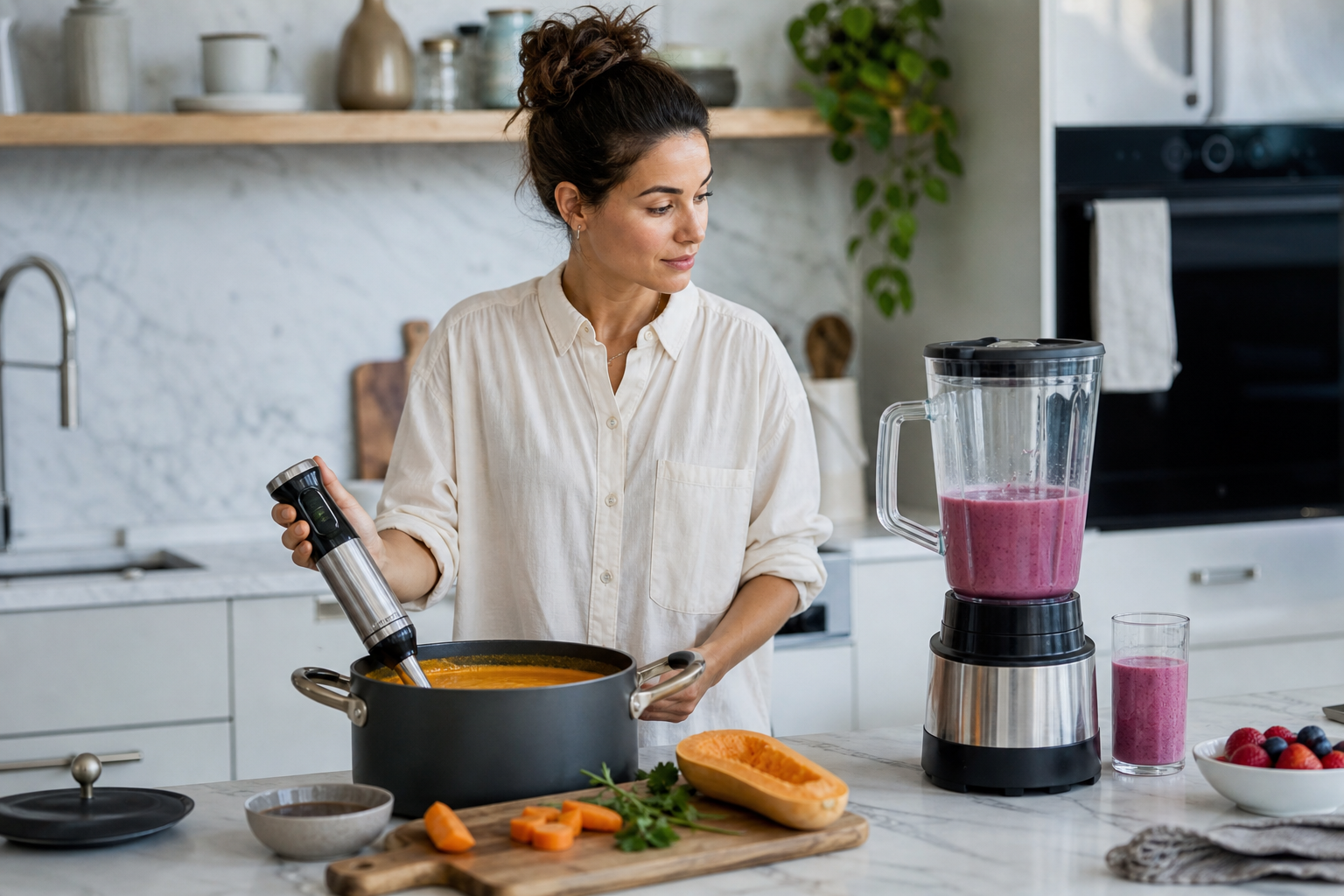
Choose an immersion blender if you often make soup, sauces, dressings, gravy, small portions, or quick purées and want compact storage with fewer dishes. Choose a countertop blender if smoothies, crushed ice, frozen fruit, nut butters, large batches, or very smooth results are central to your routine. If you regularly do both, owning one of each can be practical rather than redundant.
What Matters Most
Start with the job you want the blender to do
An immersion blender, also called a stick or hand blender, puts the blades directly into the food. You can blend soup in its cooking pot, purée beans in a saucepan, emulsify dressing in a jar, or make a small smoothie in a tall container. Because there is no fixed blending jar, you are not limited to one working capacity. KitchenAid describes immersion blenders as useful in bowls, pots, and cups, while also noting that they take up less storage space than many countertop models. ([kitchenaid.com](https://www.kitchenaid.com/countertop-appliances/pinch-of-help/heres-why-you-need-an-immersion-blender?utm_source=openai))
A countertop blender uses a motor base, blending jar, lid, and fixed blade assembly. That setup creates a contained blending environment and is generally better suited to recipes that benefit from a strong vortex, such as frozen drinks, smoothies with fibrous ingredients, thick spreads, and larger batches. Countertop jars commonly fall in the 4- to 8-cup range, although exact capacity varies by model. ([kitchenaid.com](https://www.kitchenaid.com/content/kitchenaid/en_us/pinch-of-help/countertop-appliances/how-to-choose-a-blender.html?utm_source=openai))
The key distinction is workflow. An immersion blender brings the tool to the food, which can shorten prep and cleanup. A countertop blender brings the food to the blades, which can produce more consistent results when the ingredients need sustained circulation.
- Best starting point for an immersion blender: soups, sauces, gravy, dressings, dips, small portions, and quick purées.
- Best starting point for a countertop blender: smoothies, frozen drinks, ice crushing, large batches, thick blends, and highly uniform texture.
When an immersion blender fits better
Choose an immersion blender when your cooking happens in pots and pans. For a batch of soup, you can blend the vegetables and liquid in the same vessel instead of cooling the mixture, transferring it to a jar, blending in batches, and washing another container. The same advantage applies to tomato sauce, bean soup, pan gravy, and other recipes where a rustic or moderately smooth texture is acceptable.
It is also a strong fit for small or variable quantities. You can blend a little vinaigrette for two people, purée a small amount of cooked fruit, or mix a sauce in the container where you plan to store it. Some models include a blending cup, whisk, or chopper attachment, but accessories differ widely, so treat them as model-specific rather than standard features. ([kitchenaid.com](https://www.kitchenaid.com/countertop-appliances/pinch-of-help/heres-why-you-need-an-immersion-blender?utm_source=openai))
Storage is another reason to choose this format. The motor body and blending arm are easier to tuck into a drawer or cabinet than a full-size base and jar. Cordless versions can add flexibility around the kitchen, but they introduce battery charging and runtime considerations that do not apply to corded models. ([kitchenaid.com](https://www.kitchenaid.com/countertop-appliances/pinch-of-help/heres-why-you-need-an-immersion-blender?utm_source=openai))
- Look for: a comfortable grip, variable-speed control, a removable blending arm, a protective blade guard, and an arm long enough for your usual pot.
- If you blend large pots, check the arm length. KitchenAid notes that many residential arms are about 8 inches, while longer arms can help reach deeper cookware and keep your hands farther from heat. ([kitchenaid.com](https://www.kitchenaid.com/countertop-appliances/pinch-of-help/how-to-choose-a-blender?utm_source=openai))
When a countertop blender earns its space
A countertop blender makes more sense when you want reliably smooth results from challenging ingredients. Its jar and blade design help keep food moving through the blending zone, which is useful for frozen fruit, ice, fibrous greens, thick smoothies, and spreads. KitchenAid specifically notes that regular blenders are better suited to crushing ice than stick blenders. ([kitchenaid.com](https://www.kitchenaid.com/countertop-appliances/pinch-of-help/heres-why-you-need-an-immersion-blender?utm_source=openai))
It is also the better match for repeatable batches. If you make several servings of smoothies, salsa, frozen cocktails, puréed sauces, or blended soups, a marked jar and dedicated lid can make quantities easier to judge. Some models add pulse controls, variable speeds, preset programs, tampers, or smaller accessory containers; the value depends on whether those features match recipes you actually make. ([kitchenaid.com](https://www.kitchenaid.com/content/kitchenaid/en_us/pinch-of-help/countertop-appliances/how-to-choose-a-blender.html?utm_source=openai))
The trade-off is a larger footprint and more parts to handle. You need counter or cabinet space for the base and jar, and the jar must be washed after use. A countertop blender may also be more appliance than you need if your main goal is blending a small amount of soup or sauce directly in cookware.
- Look for: a jar size that matches your usual batch, pulse control, a speed range that is easy to adjust, dishwasher-care information, and a lid designed for the ingredients you plan to blend.
- Do not assume the most powerful-looking model is automatically the best fit. A smaller, simpler blender can be more useful if it stays accessible and matches your serving size.
Texture, hot liquids, and cleanup trade-offs
Texture is where the difference becomes most noticeable. An immersion blender can create excellent smooth soups, sauces, and dressings, but you usually need to move the blade around the container for even results. KitchenAid recommends starting at a lower speed, keeping the blade below the surface, and moving gradually to reduce splashing. ([kitchenaid.com](https://www.kitchenaid.com/countertop-appliances/pinch-of-help/immersion-blender-uses?utm_source=openai))
A countertop blender is often easier when you want a very uniform texture or need to process ingredients that are dense, icy, or fibrous. It can also be easier to repeat the same result once you learn the right liquid-to-solid balance and speed setting. That said, texture depends on the specific motor, blade design, jar shape, recipe, and batch size—not simply on whether the blender is handheld or countertop.
Hot ingredients require particular attention. Follow the manual for your exact model, especially when blending soup or other steaming liquids. Vitamix advises allowing hot liquids to cool before blending and warns that steam can create pressure; it also says containers without a vent should not be used to blend hot recipes. ([vitamix.com](https://www.vitamix.com/us/en_us/articles/how-to-use-a-blender-guide?utm_source=openai)) An immersion blender can avoid transferring soup to another container, but it can still splash, so use a deep vessel, start slowly, and keep the blade submerged.
- Immersion cleanup advantage: fewer dishes and, on some models, a removable dishwasher-safe blending arm. ([kitchenaid.com](https://www.kitchenaid.com/countertop-appliances/pinch-of-help/heres-why-you-need-an-immersion-blender?utm_source=openai))
- Countertop cleanup advantage: some manufacturers describe self-cleaning routines, but you still need to follow the care instructions for the jar, lid, seals, and blade area. ([vitamix.com](https://www.vitamix.com/us/en_us/articles/how-to-use-a-blender-guide?utm_source=openai))
How to choose without overbuying
If you are replacing a blender rather than adding one, write down the last 10 times you wished you had one. Count how many were soups, sauces, dressings, or small portions and how many involved ice, frozen fruit, large quantities, or a particularly smooth texture. The majority usually points to the better format.
For an immersion blender, prioritize control and handling over an oversized accessory bundle. A variable-speed trigger or dial can help you begin gently and adjust as the mixture changes. Check the length and material of the blending arm, whether the arm detaches for cleaning, how the blade guard is shaped, and whether the handle feels manageable for the time you expect to hold it.
For a countertop blender, prioritize usable capacity and everyday accessibility. A large jar may be convenient for family-size batches but awkward for small amounts. Check the minimum recommended batch size, lid design, controls, cleaning instructions, storage height under cabinets, and whether the jar is comfortable to lift when full. Presets can be convenient, but manual speed control may matter more if you make varied recipes.
There is no rule that says you must choose only one. An immersion blender can handle everyday soups and sauces while a countertop blender takes on smoothies, frozen mixtures, and larger batches. For many cooking routines, that combination reduces compromise: the stick blender stays quick and convenient, and the countertop model handles the jobs that need more power or circulation.
- Choose immersion first if convenience, small portions, pot-to-table cooking, and storage are your priorities.
- Choose countertop first if frozen ingredients, ice, large batches, and maximum smoothness are your priorities.
- Choose both if those two lists describe your routine equally often.
Sources & editorial note
This guide is research-based and does not claim hands-on testing unless explicitly stated.
- KitchenAid: What Is an Immersion Blender? — Supports the differences between immersion and countertop blenders, common uses, storage, cleanup, accessories, and ice-crushing trade-offs.
- KitchenAid: How to Choose a Blender — Supports typical countertop capacities, immersion-blender storage benefits, arm lengths, speed controls, and accessory considerations.
- KitchenAid: Immersion Blender Uses and Tips — Supports guidance on starting slowly, moving the blade, avoiding splashes, and cleaning removable blending arms.
- Vitamix: Blender Mastery Guide — Supports hot-liquid precautions, countertop-blender controls, capacity and power comparisons, and cleaning guidance.
- Breville: Types of Blenders — Supports the differing applications of countertop and immersion blenders and the role of controls and presets.