Choose a humidifier when the problem is genuinely dry air, such as static, dry-feeling skin, or low humidity measured with a hygrometer. Choose an air purifier when you are trying to reduce airborne particles from smoke, dust, pollen, or similar sources. Neither appliance fixes the other’s problem, and both work best when paired with source control, ventilation, and regular maintenance. ([epa.gov](https://www.epa.gov/indoor-air-quality-iaq/use-and-care-home-humidifiers?utm_source=openai))
What Matters Most
Start with the job to be done
A humidifier and an air purifier are not competing versions of the same product. They perform opposite kinds of work: a humidifier increases the amount of water vapor in the air, while an air purifier moves room air through filters or other treatment technology to reduce certain airborne contaminants.
That distinction matters because common indoor-air complaints can overlap. A room may feel uncomfortable because heating has lowered humidity, because dust or smoke is suspended in the air, or because a moisture problem is producing musty odors. The visible symptom is not always enough to identify the cause, so start with a simple measurement: use a hygrometer to check relative humidity and look for an identifiable source of particles or odors.
The U.S. Environmental Protection Agency generally recommends keeping indoor relative humidity around 30% to 50%. Higher humidity can encourage mold and dust mites, while very low humidity may contribute to static and dry-feeling indoor conditions. ([epa.gov](https://www.epa.gov/indoor-air-quality-iaq/care-your-air-guide-indoor-air-quality?utm_source=openai))
- Dry air problem: consider a humidifier.
- Particle problem: consider an air purifier.
- Moisture or mold problem: address the source first; neither appliance is a complete fix.
- Unclear problem: measure humidity and inspect likely pollutant sources before buying.
When a humidifier makes sense
A humidifier is designed for rooms where humidity is persistently low. That can happen during heating season, in arid climates, or in a room where dry air is confirmed with a humidity meter. Adding moisture may make the space feel more comfortable and can reduce nuisances associated with dry conditions, such as static electricity and some types of material cracking. ([epa.gov](https://www.epa.gov/indoor-air-quality-iaq/use-and-care-home-humidifiers?utm_source=openai))
The key trade-off is that a humidifier adds something to the room rather than removing something from it. If the room already has condensation on windows, damp surfaces, musty odors, or a humidity reading above the recommended range, adding more moisture may worsen the underlying issue. A humidifier should not be used as a response to mold caused by leaks, condensation, flooding, or poor ventilation.
Humidifiers also require more hands-on water care than many shoppers expect. EPA guidance recommends emptying, wiping dry, and refilling portable units daily, cleaning them about every third day, and using water with low mineral content to reduce scale and mineral dispersal. The exact routine should follow the manufacturer’s instructions. ([epa.gov](https://www.epa.gov/indoor-air-quality-iaq/use-and-care-home-humidifiers?utm_source=openai))
- Best fit: a dry room with measured humidity below the comfortable range.
- Look for: an adjustable humidistat, easy-to-clean tank, automatic shutoff, and a design that suits your water quality.
- Be cautious with: units that are difficult to disassemble or that leave the area around them damp.
- Remember: ultrasonic and impeller models can disperse minerals and microorganisms from standing water if poorly maintained.
When an air purifier makes sense
An air purifier is the more relevant tool when your concern is airborne particles. Depending on its design and filter, a portable unit may reduce some dust, pollen, smoke particles, and other particulates in a single room. Filtration is not instantaneous: the unit must move enough air through the filter, and performance depends on room size, fan speed, placement, and how consistently it runs.
For particle removal, compare the purifier’s room-size guidance and clean air delivery rate, or CADR, rather than relying only on broad marketing language such as “fresh air” or “deep clean.” EPA guidance notes that portable air cleaners are intended to serve a room or limited area, while HVAC filtration can serve more of the home when the system is compatible with the filter. ([epa.gov](https://www.epa.gov/indoor-air-quality-iaq/guide-air-cleaners-home?utm_source=openai))
An air purifier is not a substitute for fixing the source. It will not solve a plumbing leak, eliminate mold growth inside a wall, stop indoor smoking, or replace ventilation. It may remove some airborne particles generated by a moisture problem, but the moisture problem itself still needs attention. ([epa.gov](https://www.epa.gov/indoor-air-quality-iaq/guide-air-cleaners-home?utm_source=openai))
- Best fit: smoke, airborne dust, pollen, or particles from a known indoor or outdoor source.
- Look for: a particle filter, appropriate CADR or room-size guidance, manageable noise, and affordable replacement filters.
- For odors and gases: check whether the model includes a meaningful activated-carbon stage; particle filtration alone is not the same as gas removal.
- Avoid: ozone generators and products that intentionally release ozone into occupied rooms.
The technology trade-offs that matter
With humidifiers, the main choice is how moisture reaches the air. Evaporative models use a fan and a wet wick or similar material. Steam vaporizers heat water, while ultrasonic and impeller models create a visible or cool mist. EPA notes that ultrasonic and impeller units can disperse minerals and microorganisms from their tanks, making water quality, cleaning, and daily water changes especially important. Steam models reduce mineral dispersal but involve hot water and burn hazards, particularly around children or pets. ([epa.gov](https://www.epa.gov/indoor-air-quality-iaq/use-and-care-home-humidifiers?utm_source=openai))
With air purifiers, mechanical filtration is usually the simplest technology to evaluate. A fan pulls air through a filter, and the filter captures a portion of particles. Some products add ionization, plasma, ultraviolet light, or other features. Those additions may complicate the safety and performance picture, especially if the device can produce ozone or if the manufacturer provides little independent performance information.
EPA specifically advises avoiding portable air cleaners that intentionally produce ozone. If a purifier uses bipolar ionization or another electronic technology, look for credible evidence about ozone emissions and understand that established mechanical filtration is generally easier for a shopper to assess. ([epa.gov](https://www.epa.gov/indoor-air-quality-iaq/guide-air-cleaners-home?utm_source=openai))
- Humidifier priority: humidity control, cleanability, water handling, and safe placement.
- Air purifier priority: particle-filter performance, room coverage, CADR, noise, and replacement-filter cost.
- For either product: simple controls and easy maintenance are often more useful than a long feature list.
Can you use both in the same room?
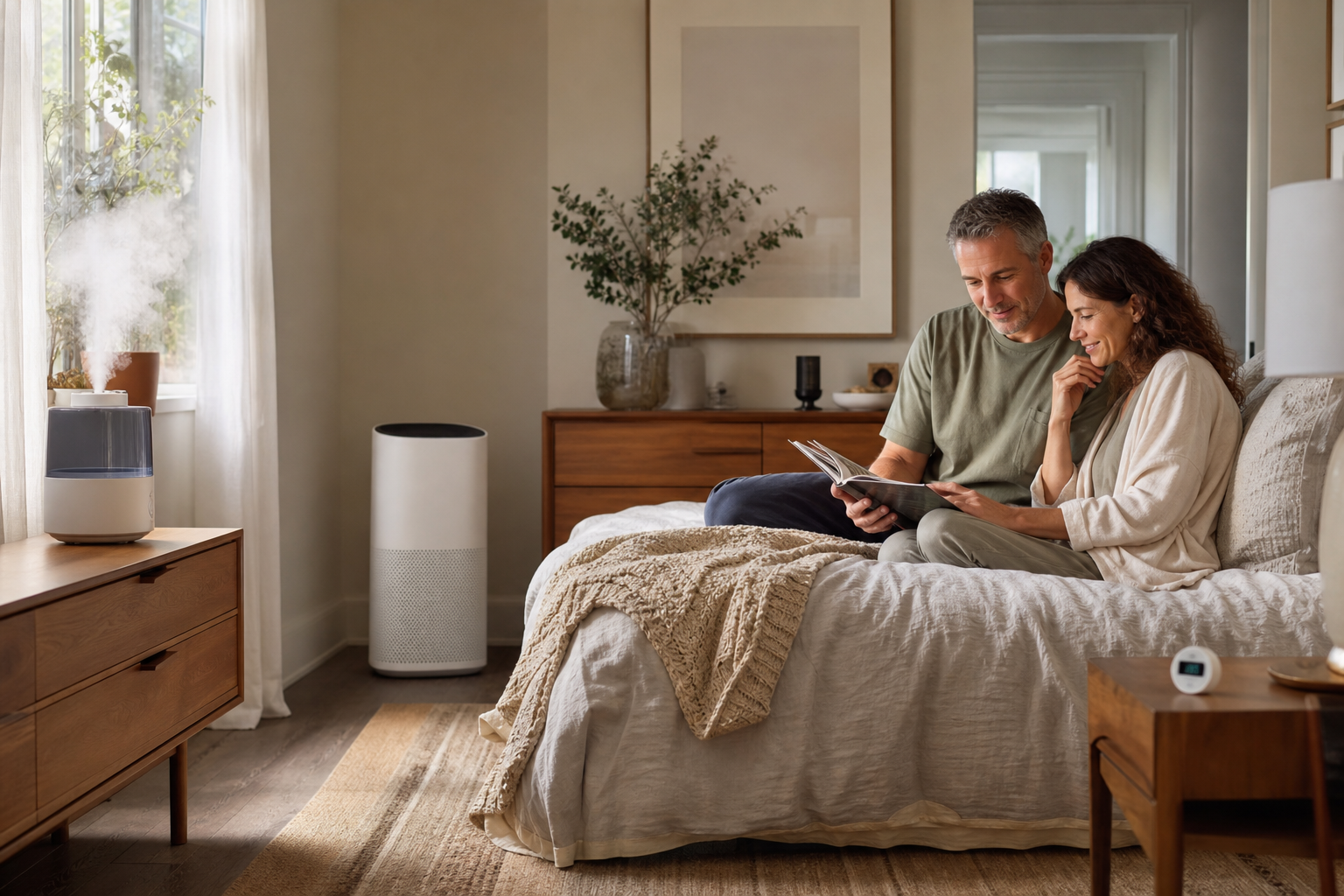
Yes, but they should solve two separate problems rather than operate as an automatic pair. A bedroom might need a humidifier during a dry heating season and an air purifier because of smoke or pollen. In that situation, the appliances have different jobs, and one does not make the other unnecessary.
Placement and maintenance become more important when both are running. Keep the humidifier from blowing mist directly into the purifier, because moisture can dampen the purifier’s filter or sensor. Do not allow water to collect on floors, furniture, walls, or window glass. Keep the purifier’s intake and exhaust clear, and follow the manufacturer’s spacing guidance.
If the room is damp or has recurring condensation, start with moisture control rather than adding a humidifier. If the room smells musty, investigate leaks, wet materials, ventilation, and mold. If the concern is smoke, dust, or pollen, focus on filtration and source reduction. EPA describes source control and ventilation as foundational steps, with air cleaning used as a supplement. ([epa.gov](https://www.epa.gov/indoor-air-quality-iaq/guide-air-cleaners-home?utm_source=openai))
- Use both only when humidity and airborne-particle problems are both present.
- Keep mist away from the purifier and surrounding surfaces.
- Do not use a purifier to disguise a moisture problem or a humidifier to address smoky air.
- Reassess after a week: measure humidity, inspect surfaces, and note whether the original complaint has changed.
A practical buying checklist
If you are shopping for a humidifier, buy for the room you want to humidify, not the largest space mentioned in an advertisement. Prioritize a built-in humidistat or another way to control output, a tank and base that are easy to clean, an automatic shutoff, and replacement parts that are readily available. If your tap water is mineral-heavy, factor in the ongoing cost and convenience of distilled or otherwise low-mineral water when the manufacturer permits or recommends it.
If you are shopping for an air purifier, compare the unit’s stated coverage with your room size, check CADR when available, and look up the price and expected replacement schedule for filters. A purifier that is too small may need to run loudly at high speed, while a model with expensive or hard-to-find filters may be inconvenient over time. A quiet, appropriately sized unit that you will actually run is often a better fit than a feature-heavy model that stays switched off.
The direct answer is simple: choose a humidifier for low humidity, an air purifier for airborne particles, and neither as the primary solution for leaks, mold growth, inadequate ventilation, or other sources of indoor-air problems. If your home has both dry air and particle concerns, using both can make sense—provided humidity stays controlled and each appliance is maintained as directed. ([epa.gov](https://www.epa.gov/indoor-air-quality-iaq/use-and-care-home-humidifiers?utm_source=openai))
- Choose humidifier: measured humidity is low and the room feels dry.
- Choose air purifier: smoke, dust, pollen, or airborne particles are the main concern.
- Choose source control first: moisture damage, mold, persistent odors, combustion pollutants, or poor ventilation.
- Choose both: only when you have independently confirmed both problems.
Sources & editorial note
This guide is research-based and does not claim hands-on testing unless explicitly stated.
- U.S. Environmental Protection Agency — Use and Care of Home Humidifiers — Supports humidifier types, humidity limits, cleaning frequency, water quality, mineral dispersal, and moisture-related trade-offs.
- U.S. Environmental Protection Agency — Guide to Air Cleaners in the Home — Supports air-cleaner capabilities, room filtration, CADR context, limits of air purifiers, and ozone cautions.
- U.S. Environmental Protection Agency — Care for Your Air — Supports the recommended indoor humidity range and the importance of source control and ventilation.
- U.S. Environmental Protection Agency — Indoor Air Filtration — Supports portable air-cleaner room coverage, CADR guidance, mechanical filtration, and low-ozone considerations.
- U.S. Environmental Protection Agency — Ozone Generators Sold as Air Cleaners — Supports the recommendation to avoid ozone-generating air-cleaning products in occupied spaces.