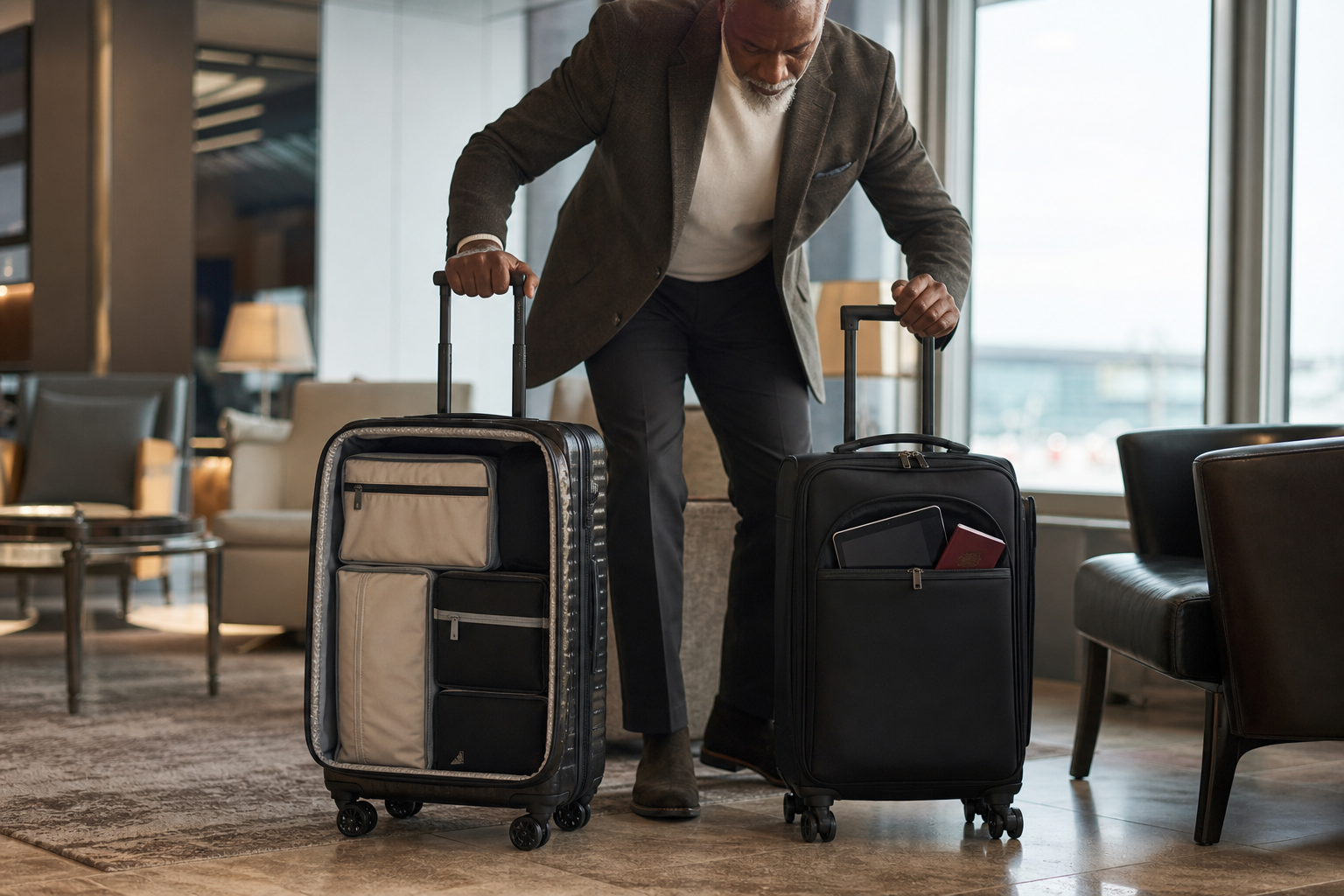
Choose hard-shell luggage if you regularly carry fragile items, prefer a structured case, or want an exterior that is easy to wipe clean. Choose soft-shell luggage if you value quick-access pockets, flexible packing, and a suitcase that can adapt to crowded closets, car trunks, and tight overhead bins.
What Matters Most
Start with the job your suitcase needs to do
Before comparing materials, identify the travel problem you want the bag to solve. A suitcase for airport-to-hotel trips has different priorities from one used for road trips, train travel, work travel, or longer stays where you will repack several times.
Hard-shell luggage creates a defined, protective container. It is often a good match for travelers who like organized compartments, carry delicate souvenirs, or want a suitcase that keeps its shape when stacked with other bags. The rigid exterior can also make the case easier to wipe down after a busy trip. Samsonite describes common hard-side materials as polycarbonate, polypropylene, aluminum, and ABS plastic, each with different weight, flexibility, and durability characteristics. ([shop.samsonite.com](https://shop.samsonite.com/ultimate-luggage-guide.html?utm_source=openai))
Soft-shell luggage behaves more like a structured fabric bag. It can be easier to compress into a car trunk, closet, or crowded overhead compartment, and many models include exterior pockets for items you need during transit. That convenience may matter more than rigid protection if your typical trip involves frequent stops, changing layers, or last-minute access to travel documents.
- Best starting question: Do you need maximum structure, or maximum adaptability?
- Neither format is automatically more durable; construction quality, wheels, handles, zippers, seams, and warranty matter just as much as the shell style.
Hard-shell luggage: where it makes sense
Hard-shell luggage is the stronger candidate when protecting the contents is your first concern. A rigid case can provide a firm barrier around clothing, electronics, bottles, and souvenirs. That does not make the contents invulnerable—checked bags can still be dropped, crushed, or exposed to rough handling—but the shell gives the case a defined protective structure.
The smooth exterior is another practical advantage. Dirt, spills, and airport grime can generally be wiped from a hard shell more easily than from fabric. Some hard-shell cases also use split construction, with packing space on both sides of the suitcase and a divider or compression panel between them. That layout can make it easier to separate shoes, laundry, or belongings for two travelers.
The trade-off is access. Unless the case has an exterior compartment, reaching one small item usually means opening the suitcase completely. Hard shells can also be less forgiving when you are trying to fit an overstuffed case into a narrow space. Scratches and scuffs may become visible over time, especially on glossy finishes, even when the suitcase remains functional.
- Consider hard shell for: fragile souvenirs, structured packing, frequent checked-bag use, or travelers who prefer a wipe-clean exterior.
- Look closely at: shell material, corner protection, wheel housings, zipper quality, handle stability, and whether the case expands.
Soft-shell luggage: where it makes sense
Soft-shell luggage is often the more convenient choice when you need access while traveling. Exterior pockets can hold a boarding pass, book, charging cable, light jacket, or laptop without requiring you to open the main compartment. Travelpro specifically highlights exterior pockets and quick access as central softside features, while its softside bags use coated high-density fabrics designed to resist water, stains, and abrasions. ([travelpro.com](https://travelpro.com/pages/about-travelpro?utm_source=openai))
Fabric construction can also make packing more forgiving. A soft case may flex around a few extra items or fit more easily into a tight closet, car trunk, or overhead bin. Some models include expansion zippers, compression panels, garment sections, and outside pockets that make them useful for business trips or itineraries where you are repeatedly opening and closing the bag.
The trade-offs are equally clear. Fabric offers less of a rigid barrier against pressure, and an overstuffed soft case may bulge beyond the dimensions you expected. Exterior pockets also add places where rain, spills, or opportunistic handling may become concerns, so look for weather-resistant fabric and secure zippers. A soft-sided case can be highly durable, but the fabric, seams, zipper tape, and pocket construction deserve careful inspection.
- Consider soft shell for: frequent access, business travel, road trips, flexible packing, and travelers who use outside pockets.
- Look closely at: fabric density, water-resistant treatment, zipper quality, seam reinforcement, wheel protection, and pocket placement.
Carry-on travel changes the decision
For carry-on luggage, exterior dimensions and weight matter more than the broad hard-versus-soft label. Airlines set their own limits, and the usable space can vary by aircraft, route, and overhead-bin configuration. Check the airline’s current carry-on rules before buying, including whether the listed dimensions include wheels and handles.
A soft-sided carry-on can be appealing when you regularly use front pockets, need to fit the bag into variable spaces, or prefer a little flexibility while loading an overhead bin. But flexibility is not permission to overpack: a bag that expands or bulges may no longer meet the airline’s stated limits.
A hard-shell carry-on can protect electronics and keep its shape, particularly when the bag is placed under pressure in a full bin. However, a rigid case may be less accommodating if the bin is shallow or crowded. For either style, weigh the empty bag, measure the entire exterior, and check the handle and wheel design rather than relying only on the advertised interior capacity.
- TSA screening is separate from airline baggage limits. TSA’s current travel guidance says carry-on liquids, gels, aerosols, creams, and pastes generally must follow the 3-1-1 rule: containers of 3.4 ounces or less, placed in one quart-size clear bag, one bag per passenger. ([tsa.gov](https://www.tsa.gov/news/press/factsheets/tsa-travel-tips?utm_source=openai))
- Keep frequently screened items easy to reach. TSA advises organizing carry-ons so officers can obtain a clear X-ray image and recommends placing the liquids bag where it is accessible. ([tsa.gov](https://www.tsa.gov/travel/security-screening/whatcanibring/all-list?pubDate=20250608&utm_source=openai))
Match the suitcase to your travel rhythm
Choose hard shell when your trip is mostly airport, hotel, and taxi, and you want a clean, structured case that protects its contents. It is also sensible if you tend to pack in two balanced halves, travel with breakable purchases, or dislike fabric bags that sag when partially full. A hard shell may be especially appealing for travelers who check luggage and want a more substantial exterior barrier.
Choose soft shell when you move through different kinds of transportation or need to reach your belongings throughout the day. Train platforms, rental cars, hotel lobbies, and work trips often reward outside access and flexible loading. A soft case can also be more practical for travelers who pack differently from one trip to the next rather than filling the same compartments every time.
If you are undecided, consider a mixed luggage setup instead of forcing one format to do everything. A hard-shell checked suitcase paired with a soft-sided personal item can combine protection with easy access. Alternatively, a soft carry-on with a protective laptop compartment may be more useful than a rigid case if your main priority is keeping documents and electronics close at hand.
- Hard shell fits: protection-first packing, structured organization, checked luggage, and wipe-clean surfaces.
- Soft shell fits: access-first packing, flexible capacity, mixed transportation, and frequent use of exterior pockets.
What to inspect before buying
Do not judge a suitcase by its shell alone. Roll it with one hand, extend the handle fully, and check whether the handle wobbles or catches. Spinner wheels are convenient on smooth floors, but wheel size, housing, and replacement support can matter more than the number of wheels. Look for a zipper that opens smoothly around corners and does not snag on the lining.
For hard shell, inspect the corners, closure, shell flexibility, and interior divider system. Polycarbonate and polypropylene are common choices, but individual designs vary widely. For soft shell, inspect the fabric, seams, pocket openings, zipper tracks, and the area where the handle attaches. Briggs & Riley, for example, emphasizes ballistic nylon, compression features, and an exterior-mounted handle in parts of its soft-sided range; those are design choices to evaluate rather than assumptions to make about every fabric suitcase. ([briggs-riley.com](https://www.briggs-riley.com/collections/soft-side-luggage?utm_source=openai))
Finally, read the warranty terms and confirm what is excluded. Wheel damage, cosmetic scuffs, zipper wear, and airline handling may be treated differently from manufacturing defects. The best choice is usually the suitcase whose compromises you will notice least during your normal trips—not the one that wins a generic hard-versus-soft argument.
- Check total exterior dimensions, empty weight, expansion depth, wheel clearance, handle height, and repair or replacement policies.
- Buy for your most common trip, not the one unusual vacation that happens once every few years.
Sources & editorial note
This guide is research-based and does not claim hands-on testing unless explicitly stated.
- Transportation Security Administration: TSA Travel Tips — Supports current carry-on screening and 3-1-1 liquids guidance.
- Transportation Security Administration: Travel Checklist — Supports advice about organizing carry-ons and keeping liquids accessible.
- Samsonite: Ultimate Luggage Guide — Supports common hard-shell materials and general hard-side trade-offs.
- Travelpro: Hardside vs Softside Luggage — Supports differences in exterior pockets, flexible capacity, and expansion options.
- Travelpro: About Travelpro — Supports examples of coated softside fabrics, hard-shell construction, and access features.
- Briggs & Riley: Soft Luggage — Supports examples of ballistic nylon, exterior-mounted handles, and softside organization.