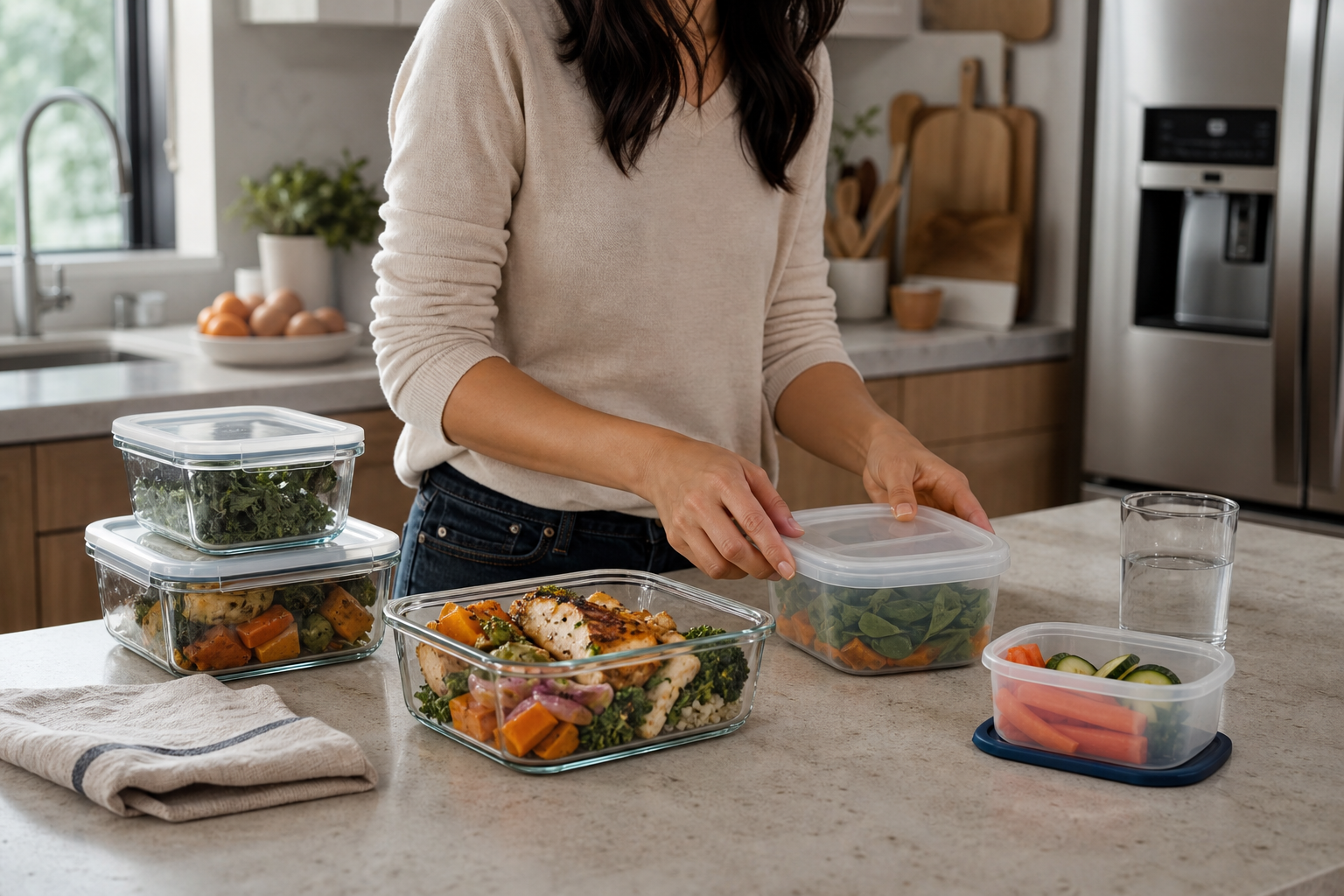
Choose glass if you regularly reheat leftovers in the same dish, want containers that do not retain tomato stains or food odors, or prefer oven-safe bases. Choose plastic if you carry lunches, pack food for gatherings, need containers that are easier to handle, or want a lower-stress option around hard floors and busy countertops. For many kitchens, a mix works better than choosing only one material.
What Matters Most
Start with the job your containers need to do
Food storage is rarely just storage. A container may need to hold last night’s pasta, survive a trip to work, stack neatly in the refrigerator, go through the dishwasher, and then reheat lunch without creating another dish to wash. Looking at that full routine is more useful than treating glass or plastic as an automatic winner.
Glass and plastic can both be suitable for food contact when the product is made and used for its intended purpose. The FDA evaluates food-contact substances according to their intended uses and conditions, including refrigerated storage, frozen storage, and reheating. The practical question is therefore not simply whether one material is “safe,” but whether a particular container is labeled for the temperatures and appliances you use. ([fda.gov](https://www.fda.gov/food/food-ingredients-packaging/food-packaging-other-substances-come-contact-food-information-consumers?utm_source=openai))
A useful way to decide is to separate home use from transport. Glass often makes more sense for food that stays in your kitchen. Plastic often makes more sense for food that leaves it. If your routine includes both, a coordinated set with matching footprints—or a combination of glass bases and plastic containers—can reduce the compromises.
- Best starting point for glass: reheating, baking, serving, and stain-prone foods.
- Best starting point for plastic: lunches, picnics, crowded shelves, and lightweight packing.
- Best starting point for a mixed set: frequent meal prep with both home and portable portions.
When glass fits better
Glass is especially convenient when one container needs to do several jobs. Many current glass storage lines are designed for refrigerator, freezer, microwave, dishwasher, and—when the product specifically allows it—conventional oven use. Pyrex, for example, says its glassware can be used for cooking, baking, warming, reheating, refrigerator storage, freezer storage, and dishwasher cleaning when its care instructions are followed. The lid is a separate matter: plastic lids generally should not go into a conventional oven. ([pyrexshome.com](https://pyrexshome.com/product-warranty-product-use-care/?utm_source=openai))
Glass also suits foods that are visually messy or strongly colored. Smooth glass does not absorb odors or discolor in the same way some plastics can, which makes it appealing for tomato sauce, curry, chili, and garlic-heavy leftovers. That can mean less scrubbing and fewer containers that look permanently connected to their previous meal. IKEA and OXO both describe their glass storage products as resistant to staining or odors. ([ikea.com](https://www.ikea.com/us/en/p/ikea-365-food-container-with-lid-square-glass-plastic-s69567118/?utm_source=openai))
The trade-off is weight and breakability. A glass container can feel substantial in a packed refrigerator, and a dropped container may chip or shatter. That does not make glass impractical; it simply makes it better suited to deliberate kitchen use than to tossing into a work bag. Choose containers with comfortable rims, secure lids, and sizes you can lift safely when full.
- A strong match for casserole leftovers, roasted vegetables, sauces, and batch cooking.
- Useful when you want to reheat without transferring food to another dish.
- Look for clearly labeled oven-safe glass and follow instructions about thermal shock.
- Keep plastic or silicone lids out of a conventional oven unless the manufacturer specifically approves them.
When plastic earns its place
Plastic is often the more practical material for food that travels. It is lighter to carry, less likely to create a dangerous mess if dropped, and easy to distribute among lunch bags, picnic baskets, or family members. A lightweight container can also be easier to lift from a high refrigerator shelf or carry when it is filled with soup, fruit, or a dense grain bowl.
Modern plastic storage products vary widely, so the label matters. Rubbermaid’s Brilliance line, for example, is labeled safe for the dishwasher, microwave, and freezer, and its containers use airtight seals and locking features. That does not mean every plastic container shares those capabilities. Check whether the base, lid, seal, and vent are each approved for the task. ([rubbermaid.com](https://www.rubbermaid.com/food-storage/everyday-use-containers/brilliance/brilliance-food-storage-containers-set/SAP_1990616.html?utm_source=openai))
Plastic is also convenient when you need many containers in a small cabinet. It usually weighs less, can be easier to nest, and may be less stressful for everyday handling. Its compromises include potential staining, odors, warping, scratched surfaces, and lids or seals that eventually stop fitting well. If a container becomes cracked, badly warped, or difficult to clean, replace it rather than continuing to rely on it.
- A strong match for packed lunches, errands, travel, and shared household use.
- Useful when break resistance and low weight matter more than oven use.
- Choose clearly labeled microwave-safe plastic and vent the lid as directed.
- Top-rack dishwasher guidance is common for plastic lids; do not assume the bottom rack is suitable.
Reheating, freezing, and temperature changes
For reheating leftovers, both materials can work when labeled for microwave use. The FDA notes that microwaves pass through glass and plastic, but some plastic containers can melt from the heat of the food inside. The container itself may also become hot because the food heats it. Use the microwave instructions supplied with the container and avoid treating a generic takeout tub as a reusable reheating dish. ([fda.gov](https://www.fda.gov/radiation-emitting-products/resources-you-radiation-emitting-products/microwave-ovens?utm_source=openai))
Glass has the advantage when your routine includes oven reheating or baking. It can move from refrigerator or freezer to microwave or oven only when the manufacturer allows that specific transition and the container is handled according to its instructions. Sudden temperature changes, damaged glass, direct heat, stovetops, broilers, and toaster ovens are common restrictions. Pyrex specifically warns against direct heat sources and says plastic lids are not for conventional or convection ovens. ([pyrexshome.com](https://pyrexshome.com/product-warranty-product-use-care/?utm_source=openai))
Freezing requires attention with either material. Leave room for food to expand, use a leak-resistant lid, and do not force a frozen lid open. USDA guidance emphasizes airtight or sealed storage, shallow containers for faster cooling, and prompt refrigeration of leftovers. Containers should support good food-handling habits, but they do not replace them: leftovers should be chilled promptly and generally used within three to four days when refrigerated. ([fsis.usda.gov](https://www.fsis.usda.gov/food-safety/safe-food-handling-and-preparation/food-safety-basics/leftovers-and-food-safety?utm_source=openai))
- For microwave use, vent lids so steam can escape.
- For oven use, use only the container base if the lid is not oven-rated.
- For freezer use, leave expansion space and follow the product’s temperature limits.
- Never assume a symbol on one piece applies to every part of the set.
Cleanup, organization, and everyday durability
If cleanup is the deciding factor, glass usually has the simpler surface. It is less likely to hold onto strong food colors and odors, and many glass bases can go into the dishwasher. The lids still require attention: removable silicone seals may need to be taken out for thorough cleaning, and plastic lids are often limited to the top rack. A container that is technically dishwasher-safe is not necessarily effortless if its lid has several grooves or a seal that traps food.
Plastic can be perfectly manageable when the design is straightforward and the material resists stains. Look for wide openings, smooth interiors, removable seals, and lids that do not have hidden channels. If your dishwasher is crowded, plastic can also be easier to place around larger dishes, although manufacturer instructions about rack position and heating elements should take priority. Rubbermaid’s care instructions warn users to keep containers away from dishwasher heating elements. ([s7d2.scene7.com](https://s7d2.scene7.com/is/content/RubbermaidConsumer/PDF/Brilliance%20Use%20and%20Care%20Instructions.pdf?utm_source=openai))
For organization, prioritize a system rather than isolated pieces. Matching lids, stackable shapes, and a small number of useful sizes will usually improve a kitchen more than a large assortment of mismatched containers. Square and rectangular shapes use refrigerator space efficiently; round containers can be easier for soups and sauces. Before buying, measure the shelf height where the containers will live.
- Glass bases are usually easier to deodorize and less prone to tomato stains.
- Plastic sets can be easier to carry and may nest more lightly in cabinets.
- Removable seals are convenient to clean but add another small part to manage.
- A smaller, coordinated set is often easier to maintain than a large mixed collection.
The best answer for most kitchens: use both strategically
A glass-and-plastic combination often reflects real kitchen life better than an all-or-nothing choice. Keep glass containers for dinners, baked dishes, leftovers that need reheating, and foods you want to see clearly after several days. Keep plastic containers for packed lunches, snacks, outdoor meals, freezer portions, and situations where weight or break resistance matters.
If you want to begin with one material, choose glass when your priority is oven-to-table convenience, stain resistance, and reheating in the same container. Choose plastic when your priority is carrying food, minimizing weight, or reducing concern about drops. In either case, buy fewer sizes than you think you need and make sure the lids seal securely.
The most useful purchase is not the material with the longest list of theoretical advantages. It is the set that makes your normal routine easier enough that you actually use it, clean it, label it, and return it to the right shelf. Check each product’s care instructions before purchase, especially for microwave, freezer, oven, dishwasher, and lid use. That small step prevents most of the frustration associated with food storage.
- Choose mostly glass for home meal prep and oven-based cooking.
- Choose mostly plastic for transport-heavy routines and shared lunches.
- Choose a mixed set if your week includes both.
- Prioritize secure seals, useful sizes, stackability, and clear care instructions over sheer piece count.
Sources & editorial note
This guide is research-based and does not claim hands-on testing unless explicitly stated.
- U.S. Food and Drug Administration: Food Packaging and Food Contact Substances — Supports the explanation that food-contact materials are evaluated for intended uses and conditions.
- U.S. Food and Drug Administration: Microwave Ovens — Supports microwave guidance for glass and plastic and the warning that some plastic containers can melt.
- USDA Food Safety and Inspection Service: Leftovers and Food Safety — Supports cooling, sealing, refrigerating, freezing, and reheating guidance for leftovers.
- Pyrex: Product Warranty, Use and Care — Supports glass, plastic-lid, oven, microwave, refrigerator, freezer, dishwasher, and thermal-handling guidance.
- Rubbermaid: Brilliance Food Storage Containers — Supports the example of plastic containers labeled for dishwasher, microwave, freezer, and leak-resistant storage.
- IKEA: IKEA 365+ Glass Food Containers — Supports the example of glass containers labeled oven-safe, microwave-safe, freezer-safe, dishwasher-safe, and resistant to odors or discoloration.