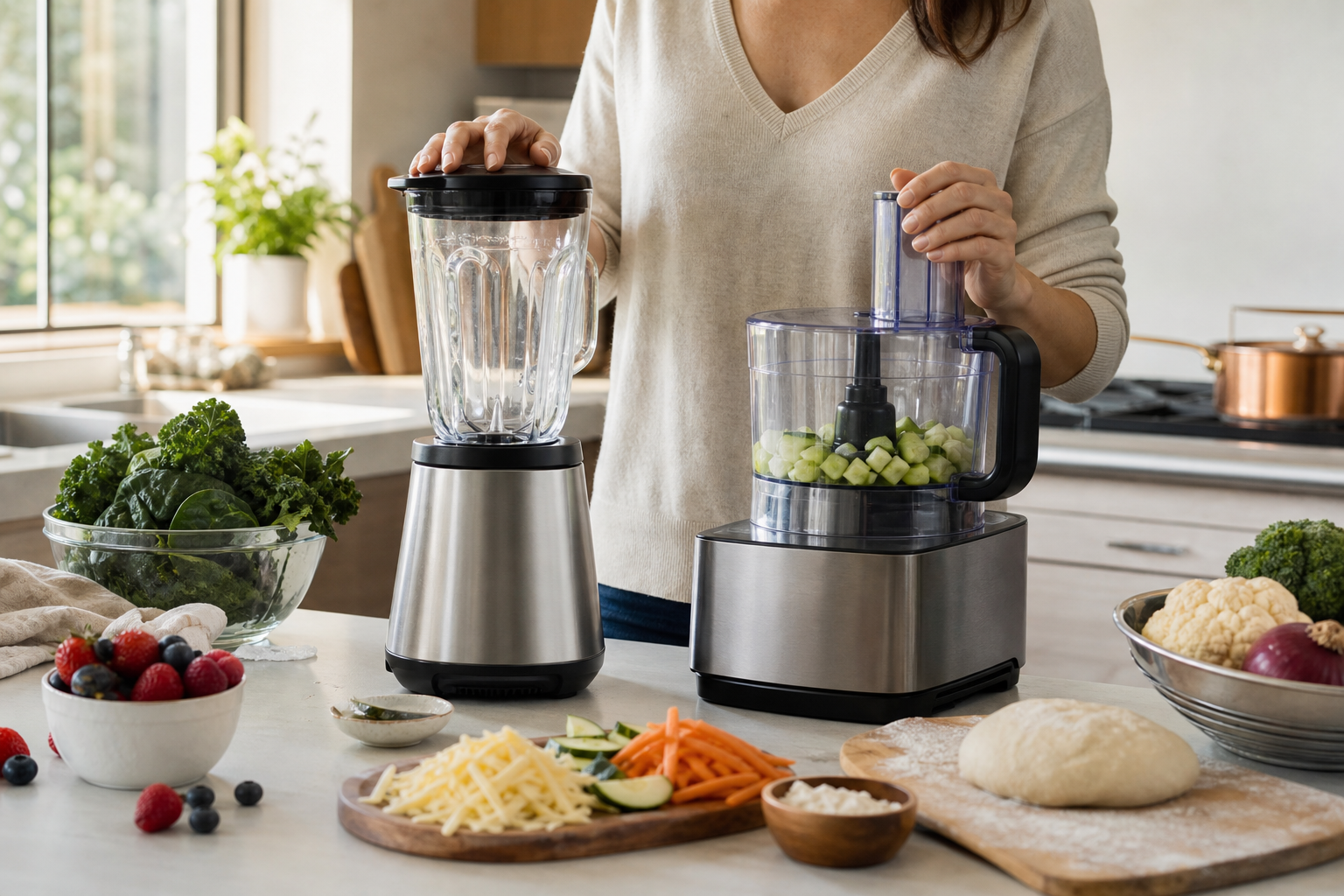
Choose a blender if you regularly make smoothies, blended soups, frozen drinks, sauces or other pourable recipes. Choose a food processor if you want to chop vegetables, slice produce, shred cheese, make breadcrumbs, mix dough or prepare larger batches with little added liquid. If you make both kinds of food often, the appliances overlap in a few areas but are not complete substitutes.
What Matters Most
Explore Options That Fit Your Everyday Routine
Explore products that fit your priorities, compare current options and discover what works best for you.
Check prices, seller details and specifications on Amazon. Featured image is illustrative.
As an Amazon Associate I earn from qualifying purchases.
Start with the job, not the appliance
A blender is built around circulation. Its tall jar and fixed blade draw ingredients toward the bottom, making it well suited to recipes with enough liquid to move through the container. That design is useful when the desired result is a drink, pourable sauce, smooth puree or finely blended mixture. Manufacturer guidance commonly places smoothies, pureed soups, sauces, frozen drinks and similar recipes in the blender category. ([kitchenaid.com](https://www.kitchenaid.com/content/kitchenaid/en_us/pinch-of-help/countertop-appliances/difference-between-food-processor-and-blender.html?utm_source=openai))
A food processor is built around controlled cutting and mixing. Its wider work bowl, multipurpose blade and optional slicing or shredding discs give ingredients more room to spread out rather than forcing everything into a liquid-driven vortex. That makes it a better match for chopped vegetables, grated cheese, sliced potatoes, breadcrumbs, pesto with texture and dough. ([cuisinart.com](https://www.cuisinart.com/the-kitchen-guide/food-processor-guide.html?utm_source=openai))
A simple rule works surprisingly well: if the finished food will be poured or sipped, start with a blender. If it will be eaten with a fork or spoon and you want visible pieces, start with a food processor. The rule is not absolute, but it quickly narrows the field.
- Blender: smooth, liquid, drinkable or pourable results.
- Food processor: chopped, sliced, shredded, mixed or kneaded results.
What a blender does better
Blenders are the more natural choice for smoothies and shakes because the jar and blade are designed to keep liquid and soft ingredients moving. They are also useful for silky soups, smooth salad dressings, blended marinades, fruit sauces and frozen beverages. If you dislike bits of leafy greens, fruit skins or ice in a drink, a blender is generally the better tool for breaking those ingredients down finely.
The same strengths apply when texture matters more than shape. A blender can turn cooked vegetables into a smooth soup, nuts and liquid into a creamy sauce, or fruit into a pourable puree. Some high-powered models are also designed for tougher ingredients, but the exact capabilities vary by motor, container and blade design, so do not assume every blender will handle every dense mixture equally well. ([kitchenaid.com](https://www.kitchenaid.com/content/kitchenaid/en_us/pinch-of-help/countertop-appliances/difference-between-food-processor-and-blender.html?utm_source=openai))
The trade-off is control. A blender is not designed to create uniform slices or neat vegetable dice. Even when it can chop in short pulses, the ingredients closest to the blade may become much finer before the rest is processed. Adding liquid can also change the texture, which matters when you want salsa, chopped nuts or vegetables that retain their shape.
- Best blender jobs: smoothies, milkshakes, blended soups, frozen drinks, smooth sauces and liquid dressings.
- Blender limitation: difficult to produce consistent slices, shreds or chunky pieces.
What a food processor does better
A food processor earns its counter space through preparation work. Its S-shaped multipurpose blade can chop onions, herbs, vegetables, nuts and cooked ingredients, while slicing and shredding discs can process produce and cheese into more consistent shapes. A feed tube also lets you guide ingredients toward a disc, which is useful when preparing several pounds of vegetables or a large amount of grated cheese. ([cuisinart.com](https://www.cuisinart.com/the-kitchen-guide/food-processor-guide.html?utm_source=openai))
It is also the better choice for dry or dense mixtures. Food processors can make breadcrumbs, chop nuts, mix crumb crusts, combine ingredients for burgers or fritters and prepare pesto without requiring the amount of liquid a blender often needs. Many full-size models include a dough blade or a setting for kneading yeast dough, although the included accessories differ from one model to another. ([kitchenaid.com](https://www.kitchenaid.com/countertop-appliances/pinch-of-help/best-food-processor?utm_source=openai))
The trade-off is smoothness. A food processor can puree hummus, soup, dips and sauces, but the result may be less silky than one made in a blender. It can also leave small pieces around the bowl or require scraping during processing. For recipes where a perfectly uniform, pourable texture is the main goal, the blender usually has the edge.
- Best food processor jobs: chopping, slicing, shredding, grating, breadcrumbs, pesto, chunky dips and dough.
- Food processor limitation: may not produce the same ultra-smooth texture as a blender.
Where the two appliances overlap
Both appliances can make hummus, pesto, salsa, dips, dressings and purees. The better choice depends on the texture you want. A blender is more likely to create a smooth, cohesive dip or sauce; a food processor is more useful when you want some texture or need to begin with relatively dry ingredients. KitchenAid describes both appliances as capable of tasks such as pureeing and emulsifying, while emphasizing that their containers and blade systems favor different results. ([kitchenaid.com](https://www.kitchenaid.com/content/kitchenaid/en_us/pinch-of-help/countertop-appliances/difference-between-food-processor-and-blender.html?utm_source=openai))
A blender can sometimes stand in for a food processor when you work in short pulses and stop frequently to check the texture. This can be adequate for a small batch of chopped tomatoes or a quick dip, but it is less dependable for uniform cuts, dough, shredding or grating. A food processor can also stand in for a blender for some purees, especially thicker mixtures, but it may require more scraping and may not liquefy ingredients as completely.
Attachments can blur the distinction. Some blender systems offer food-processing bowls or specialized containers, while some food processors include blending accessories. Treat those as model-specific features rather than standard capabilities. Before buying, check exactly which bowl, blade, disc or container is included rather than relying on the appliance category alone.
- Choose based on final texture first, then check whether the model includes the needed accessory.
- “Can do” is not the same as “does well” or “does conveniently.”
Capacity, cleanup and everyday convenience
Capacity should match the way you cook. Personal and compact blenders can be convenient for one serving, while larger blender jars suit family-size smoothies or soups. Food processors commonly come in small, mid-size and full-size bowls; larger bowls are useful for batch prep, shredded vegetables, sliced produce and dough. Manufacturer guidance places many home food processors in the broad range of roughly 6 to 14 cups, but bowl capacity and practical working capacity are not always identical. ([kitchenaid.com](https://www.kitchenaid.com/content/kitchenaid/en_us/pinch-of-help/countertop-appliances/difference-between-food-processor-and-blender.html?utm_source=openai))
Cleanup is part of the buying decision. A blender may have fewer removable parts, but thick mixtures can cling around the blade and under the jar assembly. A food processor may involve a bowl, lid, pusher, blade and discs, with additional pieces to wash and store. On the other hand, a food processor can save preparation time by replacing several manual tools when you are chopping, slicing and shredding in one cooking session.
Storage matters too. A blender usually has one jar and one blade assembly, while a food processor may require space for multiple discs and attachments. If your kitchen is compact, consider which tool you will use at least once or twice a week. An appliance that stays assembled and accessible is more useful than a more versatile model that is difficult to store.
- Prioritize a blender for quick liquid recipes and simpler storage.
- Prioritize a food processor if it can replace repeated knife, grater and dough-prep tasks.
Which one should you buy?
Buy a blender first if your regular menu includes smoothies, protein drinks, pureed soups, frozen cocktails, smooth sauces or finely blended dressings. It is the more direct route to liquid and silky-smooth results, and it may be all you need if most of your cooking involves pouring rather than chopping.
Buy a food processor first if your biggest frustrations are slicing vegetables, shredding cheese, chopping onions, making breadcrumbs, preparing chunky dips or mixing dough. It is especially useful for batch cooking, holiday preparation and recipes that begin with dry or solid ingredients. Look for the accessories that match your actual jobs: a multipurpose blade, slicing disc, shredding disc and, if relevant, a dough blade. ([kitchenaid.com](https://www.kitchenaid.com/countertop-appliances/pinch-of-help/best-food-processor?utm_source=openai))
If you are deciding between both and cook broadly, choose the appliance that solves your most repetitive task. The blender is the better texture specialist; the food processor is the better preparation specialist. Neither is automatically the superior purchase, and buying both only makes sense when you regularly make enough of both liquid recipes and labor-intensive prep to justify the counter and storage space.
- Best first purchase for drinks and smooth purees: blender.
- Best first purchase for prep, pieces and dough: food processor.
- Best choice for frequent all-purpose cooking: both, if storage and budget allow.
Ready to Find Your Best Match?
Explore products that fit your priorities, compare current options and discover what works best for you.
Check prices, seller details and specifications on Amazon. Featured image is illustrative.
As an Amazon Associate I earn from qualifying purchases.
Sources & editorial note
This guide is research-based and does not claim hands-on testing unless explicitly stated.
- KitchenAid: Food Processor vs Blender — Supports the differences in container shape, blade systems, texture, common recipes and overlapping uses.
- Cuisinart: Food Processor Guide — Supports common food processor tasks including chopping, slicing, shredding, pureeing and dough preparation.
- Vitamix: Unlock Your Blender’s Potential — Supports the blender’s suitability for liquid blends and the contrast between tall blender containers and wide food processor bowls.
- KitchenAid: What Is a Food Processor Used For? — Supports food processor uses such as shredding, kneading, dicing, grinding and pureeing.
- KitchenAid Food Processor Use and Care Guide — Supports accessory-specific tasks including chopping, slicing, shredding, mixing and kneading.