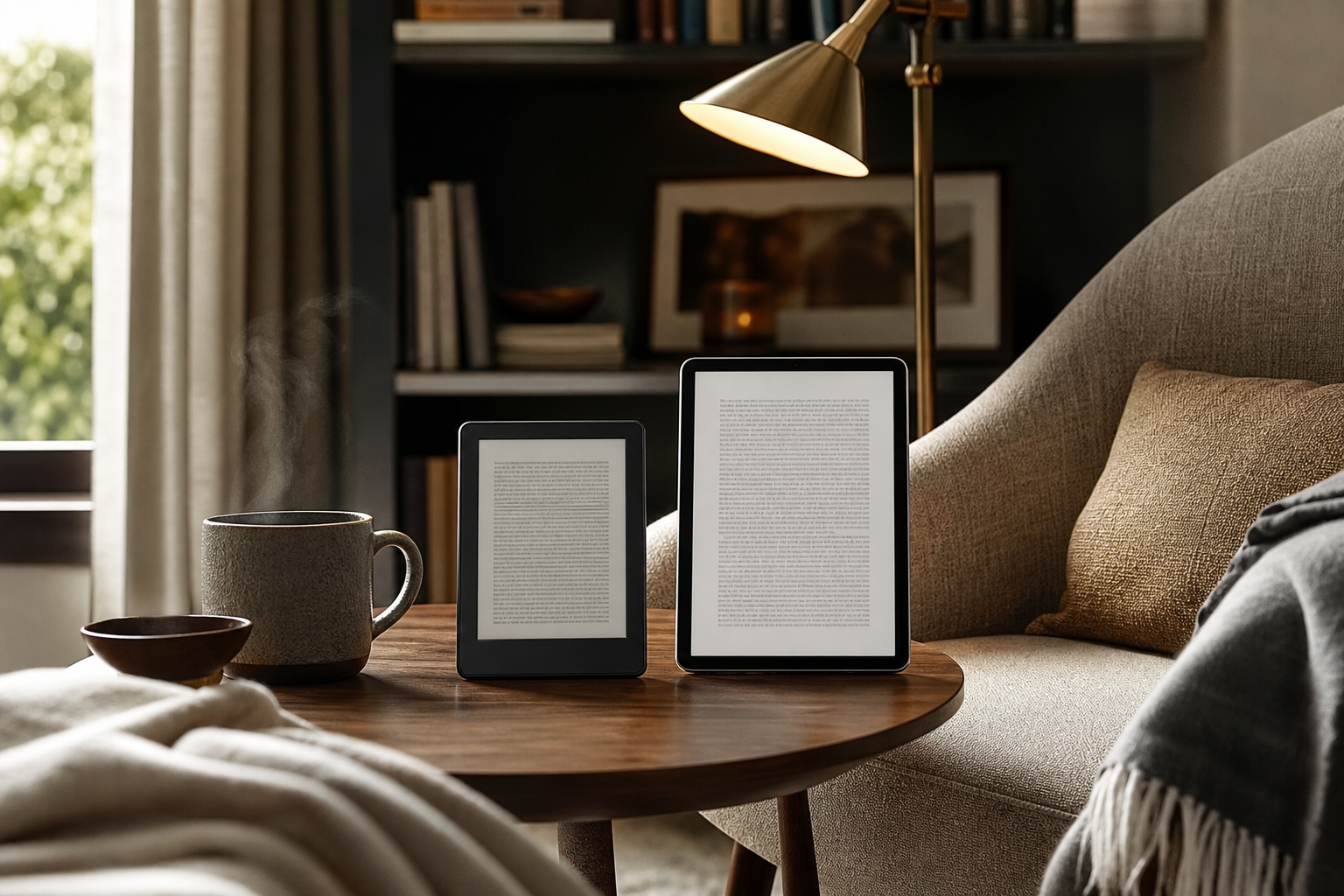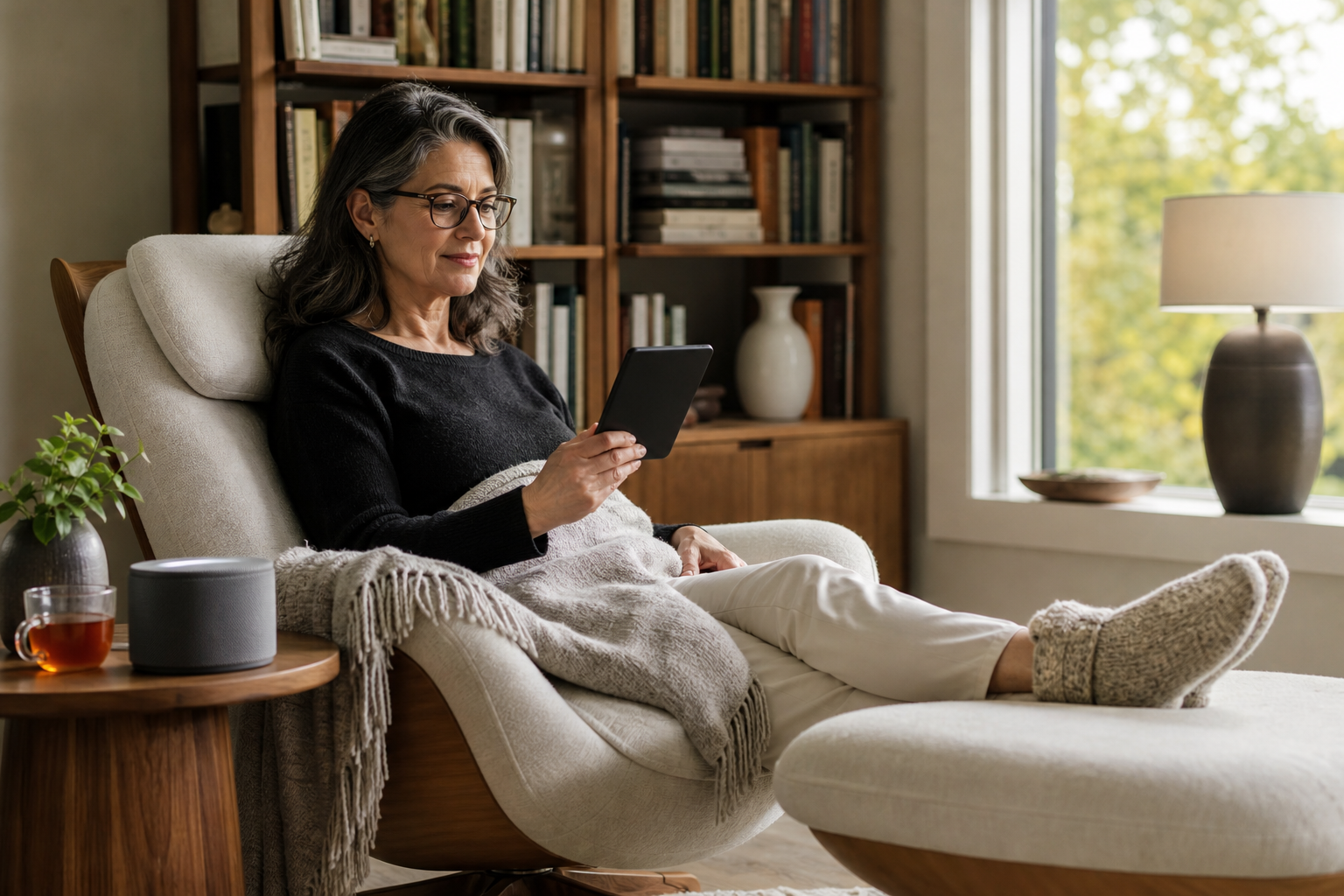
Choose an e-reader if you want to read at your own pace, mark passages, browse a personal library, or settle into a chair with minimal distractions. Choose an audiobook speaker if you want to listen while moving around, resting with your eyes closed, cooking, folding laundry, or sharing the story with someone else. If both habits appeal to you, a basic e-reader plus a separate speaker or headphones may be more flexible than trying to make one device do everything.
What Matters Most
Start with the reading moment you want to create
An e-reader creates a deliberately narrow experience: open a book, adjust the text, and stay with the page. That can be ideal for a quiet evening when you want to read a few chapters without notifications, television, or the temptation to switch between apps. It also gives you direct control over pace, page turns, highlighting, notes, and rereading.
An audiobook speaker creates a more flexible experience. The story can continue while you make tea, stretch, tidy a room, sit with your eyes closed, or move between nearby spaces. That convenience comes with a different kind of attention: you are following a narrator’s timing rather than scanning backward and forward through the page.
For many people, the real choice is not e-reader versus speaker but reading mode versus listening mode. If your relaxed time usually means settling down with a book in hand, start with an e-reader. If it means keeping company with a story while doing something else, start with an audiobook setup.
- Best for an e-reader: focused, private, page-based reading.
- Best for a speaker: hands-free listening and shared-room entertainment.
- Best overall for mixed habits: use each for the job it handles naturally.
Where an e-reader has the advantage
An e-reader is the stronger fit when the act of reading matters as much as finishing the book. You can pause at a sentence, compare earlier passages, search within supported titles, adjust type settings, and make notes without reaching for a phone. Those small interactions are useful for novels, memoirs, essays, book-club selections, and anything you want to read closely.
It is also easier to keep the experience personal. A speaker fills the room, while an e-reader can be used quietly with no sound at all. That makes it a better choice for bedrooms, shared homes, waiting rooms, travel, or any setting where you do not want to disturb people nearby.
There is one important buying detail: audiobook support is not universal across e-readers. Amazon says supported Kindle models can pair with Bluetooth audio devices for audiobooks, while Kobo says only some e-readers support audiobooks through Bluetooth. Check the exact model rather than assuming every e-reader can play audio. ([digprjsurvey.amazon.com](https://digprjsurvey.amazon.com/csad/help/node/TIHMXAou9Wm1q17sg5?utm_source=openai))
- Choose an e-reader when text size, reading speed, notes, and privacy matter most.
- Check storage, lighting, waterproofing, library compatibility, and format support before buying.
- Do not assume audiobook playback is included; verify the model’s official specifications.
Where an audiobook speaker makes more sense
A speaker is the more natural choice when you want the story without holding or looking at a device. It can make relaxed listening feel less like another screen task, especially when you are reclining, preparing dinner, doing light household tasks, or winding down with your eyes closed. A speaker can also work well when two people want to listen together.
Voice control is useful when your hands are occupied. Google’s official guidance, for example, supports commands to start an audiobook, pause, resume, skip forward or backward, change chapters, adjust speed, and change volume. Other platforms may offer similar controls, but the details depend on the speaker, audiobook service, account, and region. ([support.google.com](https://support.google.com/googlehome/answer/7071793?hl=en&utm_source=openai))
The trade-off is that a speaker is less private and can be less precise for close reading. Room noise, other conversations, or an interruption can make you miss a passage. You may be able to rewind, but locating a specific sentence is usually more cumbersome than turning back a page or searching an e-book.
- Choose a speaker when hands-free use is the main reason you listen.
- Prefer a model with clear spoken-word performance and easy volume control.
- Consider Bluetooth or casting support if your preferred audiobook service is not built in.
Compare the practical trade-offs before you buy
Content compatibility should be near the top of the list. An e-reader may be tied closely to one bookstore or ecosystem, while a speaker may depend on a phone, a streaming service, a voice assistant, or a casting connection. Google says audiobooks from other providers can often be started on a computer or mobile device and played remotely on a compatible speaker, but controls may remain in the provider’s app or webpage. ([support.google.com](https://support.google.com/googlehome/answer/7071793?hl=en&utm_source=openai))
Account setup is another difference. A speaker can be convenient once configured, but voice commands may require the right account, linked service, Wi-Fi connection, and recognition settings. Google notes that audiobook access on its speakers can involve the account connected to the device and Voice Match, particularly when more than one person uses the home. ([support.google.com](https://support.google.com/googlehome/answer/7071793?hl=en&utm_source=openai))
Think about the room as well as the device. A smart speaker generally needs a power connection and a reliable network for its connected features. A portable Bluetooth speaker gives you more placement freedom but may require a phone or tablet as the playback source. An e-reader is easier to take away from the home, but its audiobook features may require Bluetooth headphones or a speaker rather than built-in room-filling audio.
- E-reader priority: bookstore and library compatibility, text controls, battery life, and portability.
- Speaker priority: audiobook-service compatibility, spoken-word clarity, voice or physical controls, and connectivity.
- Shared home: check account, privacy, and playback-control arrangements before committing.
Which option fits common relaxed-reading situations?
For a quiet evening in a chair, an e-reader usually wins if you want to read actively and remember the details of the page. It is also the better fit for book-club preparation, passages you want to quote, or books with charts, illustrations, footnotes, or unusual formatting. Listening can work for these genres, but it may not replace having the text in front of you.
For chores, gentle movement, travel around the house, or resting with your eyes closed, an audiobook speaker usually wins. It keeps the narrative moving without asking you to hold a device. A speaker is also the easier shared option when another person wants to hear the book with you, although headphones are better when privacy or room quiet matters.
For bedtime, choose based on whether you want to read a few pages or let a narrator carry the experience. An e-reader provides silent, individual reading; a speaker provides a more ambient experience but may affect someone else’s sleep. If you share a room, headphones or a dedicated personal listening device may be a better compromise than a room speaker.
- Focused reading: e-reader.
- Hands-free listening: audiobook speaker.
- Reading with another person: speaker, soundbar, or shared audio system.
- Private late-night reading: e-reader or headphones.
The best buying decision may be a simple two-device setup
If your budget allows only one purchase, choose the device that supports the habit you already repeat. A speaker will not turn someone who prefers printed words into a regular audiobook listener, and an e-reader will not solve the problem of wanting a story while your hands are busy. Buy for the routine you want to make easier, not for the longest feature list.
If you regularly switch between reading and listening, a combination can be more satisfying: an e-reader for private, text-focused sessions and a speaker or headphones for hands-free audio. Some book ecosystems support switching between an e-book and its professionally narrated audiobook while retaining your place, but availability depends on the title, device, and service. Amazon describes this kind of synchronized reading and listening through supported Kindle titles and audiobooks. ([kdp.amazon.com](https://kdp.amazon.com/en_US/help/topic/G201014330?utm_source=openai))
The short answer is straightforward: choose an e-reader for relaxed reading, and choose an audiobook speaker for relaxed listening. If your idea of leisure includes both, prioritize compatibility with the book service you already use and build from there.
- One purchase, page-first habit: e-reader.
- One purchase, audio-first habit: audiobook speaker.
- Mixed habit: compare ecosystems first, then consider a two-device setup.
Sources & editorial note
This guide is research-based and does not claim hands-on testing unless explicitly stated.
- Amazon Kindle Help — Supports the fact that compatible Kindle e-readers can pair with Bluetooth audio devices for audiobooks.
- Rakuten Kobo Help — Supports the fact that only some Kobo e-readers support audiobook playback through Bluetooth.
- Google Home Help — Supports audiobook playback, voice controls, account requirements, and remote playback from other providers.
- Google Assistant Help — Supports examples of voice controls for starting, pausing, skipping, rewinding, and adjusting audiobook playback.
- Amazon KDP Help — Supports the availability of synchronized reading and listening features for supported Kindle books and audiobooks.