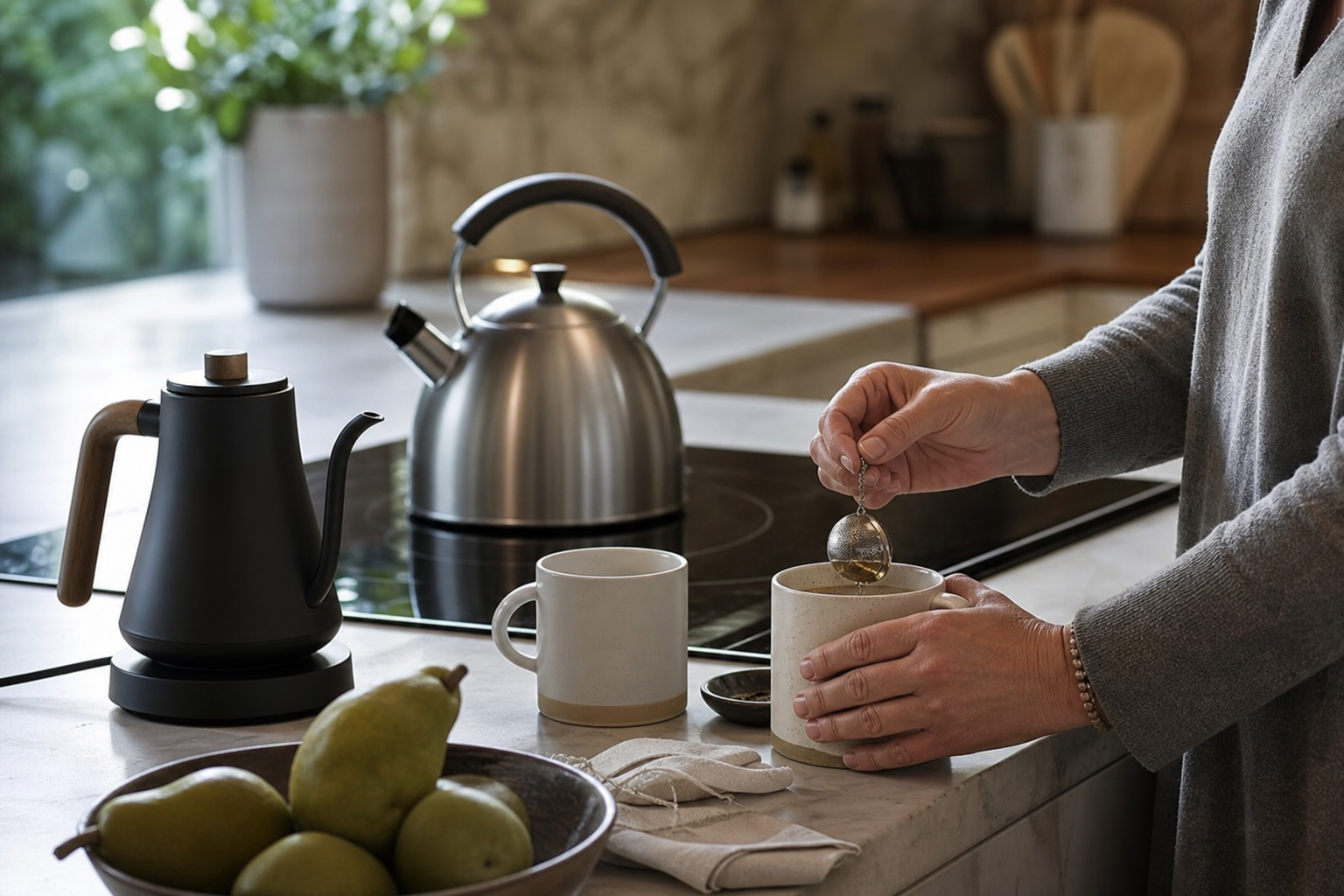
Choose an electric kettle for push-button boiling, automatic shutoff, cordless serving, and frequent cups throughout the day. Choose a stovetop kettle for a low-tech setup, larger visual presence on the range, and fewer electrical parts—but expect to manage the heat and remove the kettle promptly when it whistles.
What Matters Most
The easiest choice for most daily routines
For everyday tea, instant coffee, oatmeal, or hot water for cooking, an electric kettle generally asks less of you. Fill it, place it on its power base, press the switch, and continue with something else while it heats. Many current electric models include automatic shutoff and boil-dry protection, so the kettle can stop when the water reaches a boil or when the water level becomes too low.
That convenience matters most when you make several hot drinks, move between rooms, or do not want another task competing with breakfast or the morning rush. A cordless serving design also lets you lift the kettle from its base and pour at the table without carrying a cord.
The trade-off is that an electric kettle takes a permanent place near an outlet. The base, cord, lid, controls, and heating components also give you more parts to keep clean and eventually replace. If you rarely boil water, that extra appliance may feel unnecessary.
- Best fit: frequent hot drinks, hands-off boiling, and quick everyday routines.
- Main compromise: counter space, electrical dependence, and more components.
When a stovetop kettle is the simpler tool
A stovetop kettle is straightforward: add water, place it on the burner, turn on the heat, and listen for the whistle. There is no power base, temperature display, or separate electrical cord. For someone who prefers familiar controls and a less crowded countertop, that simplicity can be the easier experience.
It can also suit kitchens where counter outlets are limited or where the kettle will be stored between uses. Some stovetop models have generous capacities and wide bases that heat water efficiently on compatible burners. They can remain part of the cooking area rather than becoming another small appliance on the counter.
The hands-on trade-off is greater. You need to select the heat, monitor the kettle, and remove it from the burner after the whistle. Manufacturer instructions commonly warn against allowing a stovetop kettle to boil dry and recommend using a mitt or pot holder because the body and handle may become hot during longer heating.
- Best fit: occasional use, limited counter space, and a low-tech kitchen setup.
- Main compromise: more attention while heating and more heat exposure during pouring.
Speed, control, and the amount of water you actually use
Boiling speed depends on the amount of water, the kettle’s design, the heat source, and the power available. An electric kettle is often convenient because its heating element is designed specifically for water and its operation is simple to repeat. Manufacturer specifications may list wattage, but wattage alone does not guarantee the same real-world result across models.
A stovetop kettle can heat quickly too, particularly on a strong burner with a broad, flat base. On induction, however, the kettle must be compatible with the cooktop and have an appropriate magnetic base. Whirlpool notes that induction cooktops require ferromagnetic cookware; a kettle that is not designed for induction may not heat at all.
Whichever type you choose, boiling only the amount you need is the easiest way to avoid wasted time and energy. A water window on an electric kettle or interior fill markings on a stovetop kettle can make that habit easier. For one mug, filling a large kettle to its maximum line is rarely the most convenient routine.
- Look for clear minimum and maximum fill marks.
- For induction, verify compatibility on the manufacturer’s product page—not just the material name.
- Do not assume the biggest capacity is the easiest option for one or two cups.
Safety and attention: automatic shutoff versus audible reminders
Electric kettles usually have the advantage when you want the appliance to manage the boiling step. Automatic shutoff can reduce the chance of continued heating after the water boils, while boil-dry protection is designed to help prevent scorching if the kettle is switched on with too little water. These features are common, but they are not universal, so confirm them in the specifications and manual.
A stovetop kettle gives you a clear audible signal, but the whistle is a reminder rather than an automatic control. You still need to turn off the burner and move the kettle away from the heat. This is especially important on electric and induction cooktops, which may retain heat or continue transferring heat after the control is changed.
Neither type should be treated as completely unattended. Keep the spout directed away from your hand, use the handle as instructed, and avoid filling above the maximum line. If a kettle is difficult to lift when full, a smaller capacity may be easier and safer to handle than a larger model.
- Choose electric if automatic shutoff is a priority.
- Choose stovetop if you prefer an audible cue and are comfortable managing the burner.
- Check handle shape, lid operation, and full-kettle weight before buying.
Cleanup, storage, and everyday maintenance
Electric kettles are usually easy to wipe on the outside, and some include removable mesh filters that help keep mineral scale from reaching the cup. The interior still needs attention, particularly in areas with hard water. The power base should be kept dry, and the kettle should not be immersed unless the manual specifically allows it.
Stovetop kettles have fewer electrical parts, but many are intended for hand washing. Their exterior can show water spots or burner marks, and the whistle mechanism, lid, and spout may need careful cleaning. OXO’s stovetop kettle instructions advise emptying excess water after use and warn that boiling dry can damage the kettle.
Storage may be the deciding factor. An electric kettle is ready on its base but occupies counter space. A stovetop kettle can move into a cabinet, although a larger metal kettle may be heavier and less convenient to retrieve. If you dislike repeated lifting, choose a size you can comfortably fill and pour rather than the largest available capacity.
- For either type, follow the care instructions for mineral buildup and cleaning.
- A removable filter is useful if your water leaves visible scale.
- Prioritize a comfortable pour over maximum capacity.
Who should buy which kettle?
Buy an electric kettle if your priority is the easiest repeatable routine. It is the better match for frequent tea or coffee drinkers, people who want automatic shutoff, households that need hot water away from the stove, and anyone who values a quick fill-and-press workflow. A variable-temperature model can also be useful if you regularly prepare drinks that do not require a full rolling boil, provided you are willing to pay for and learn the extra controls.
Buy a stovetop kettle if you want a durable-feeling, low-tech tool that can live with your cookware. It is a good fit for occasional use, compact kitchens where counter space is valuable, and households that prefer an audible whistle over electronic controls. It can also be appealing if you already keep a burner free and do not want another appliance plugged in.
If you remain undecided, choose based on the interruption you dislike more. If you dislike waiting beside a burner, buy electric. If you dislike appliances taking up counter space, buy stovetop. For most people asking which is easier day to day, electric wins on convenience; stovetop wins on simplicity.
- Easiest overall: electric kettle.
- Simplest hardware: stovetop kettle.
- Best final check: compare capacity, handle comfort, fill markings, shutoff features, and cooktop compatibility.
Sources & editorial note
This guide is research-based and does not claim hands-on testing unless explicitly stated.
- Hamilton Beach 1.7 Liter Electric Kettle — Supports automatic shutoff, boil-dry protection, cordless serving, water-window, and removable-filter features found on electric kettles.
- Whirlpool: What Cookware Works With Induction Cooktops? — Supports the need for ferromagnetic cookware and specific compatibility checks for induction cooktops.
- Le Creuset Classic Whistling Kettle — Supports typical stovetop kettle features including audible whistle, fill guidance, cooktop compatibility, and hand-wash care.
- OXO Uplift Kettle Use and Care Instructions — Supports stovetop safety and care guidance, including avoiding boil-dry conditions, using a pot holder, and removing the kettle from heat after the whistle.
- U.S. Department of Energy: Take Five—What Is Energy Efficiency? — Supports the general point that energy efficiency compares the useful heating service with the energy consumed, rather than relying on appliance type alone.