Choose a basic electric kettle if you mainly need boiling water for black tea, instant coffee, oatmeal, soup, or cooking. Choose temperature control if you drink green, white, or oolong tea, brew pour-over or French press coffee, want repeatable results, or value a keep-warm function enough to pay for extra controls.
What Matters Most
The main difference: boiling versus targeting
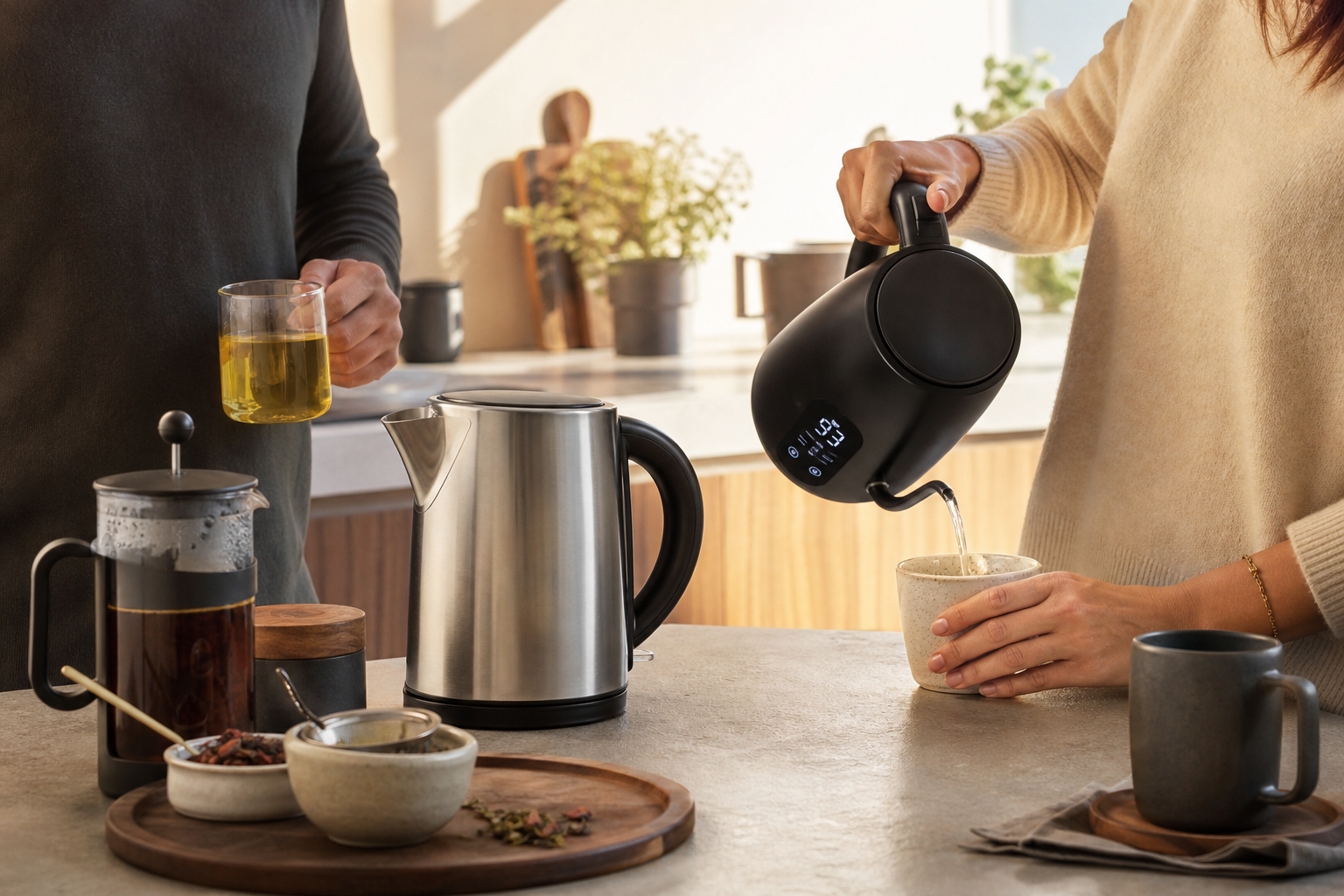
A basic electric kettle is designed around one job: bring water to a boil, then shut off. Many models use a simple switch, an illuminated indicator, a cordless serving base, and automatic shutoff. Some also include boil-dry protection, which turns the kettle off if it is switched on with too little or no water. That combination covers most everyday tasks without asking you to choose a setting.
A temperature-control kettle lets you select a target temperature before heating. Depending on the model, that may mean preset buttons for tea and coffee, a dial with degree-by-degree adjustment, a digital display, or a keep-warm mode. Fellow, for example, lists models with adjustable temperature ranges and optional hold periods, while Breville offers kettles with presets for black, green, white, and oolong tea as well as French press coffee. The key distinction is not that one kettle boils and the other does not; it is that the upgraded model can stop heating before a full boil and repeat that choice more conveniently.
That extra control is useful when water temperature changes the result. It is less useful when your normal routine is simply "fill, boil, pour."
- Basic electric kettle: fastest path to boiling water.
- Temperature-control kettle: more control over heat, timing, and repeatability.
- Both types may offer auto shutoff, cordless serving, water-level markings, and boil-dry protection.
When temperature control makes a real difference
Delicate teas are the clearest use case. Green, white, and some oolong teas are commonly brewed below boiling, and manufacturers such as Breville specifically design presets around different tea varieties. Using cooler water can make it easier to follow the instructions on a particular tea package instead of guessing how long boiling water should cool before pouring.
Coffee is another reason to consider the upgrade. The Specialty Coffee Association lists a brewing-water range around 195 to 205 degrees Fahrenheit for certain coffee-training applications. A temperature-control kettle can make that range easier to reach consistently, especially for pour-over or French press brewing. A gooseneck model can add more control over the pour, although that feature is about water flow rather than temperature.
The benefit is consistency, not guaranteed perfection. Coffee grind size, dose, freshness, steep time, water quality, and pouring technique still matter. Tea recommendations also vary by leaf, blend, and personal taste, so preset buttons are a starting point rather than a universal rule.
- Best fit: people who make several kinds of tea or manually brewed coffee.
- Useful for repeatable recipes where water temperature is part of the instructions.
- Less important if you mostly drink fully boiled water-based beverages.
The everyday convenience trade-off
Temperature-control kettles can reduce small annoyances. A keep-warm function may hold water at or near the selected temperature for a set period, so you do not have to start another heating cycle when you are interrupted. Some models also remember settings, display the current temperature, offer scheduling, or provide a timer for pour-over brewing.
Those conveniences add decisions and components. Instead of pressing one switch, you may need to choose a temperature, activate hold mode, confirm a setting, or interpret a display. For some people, that feels helpful; for others, it turns a straightforward appliance into one more interface to manage. More electronics can also mean more attention to controls, firmware, cleaning instructions, or warranty terms.
A basic kettle is often the calmer choice for a shared kitchen. Anyone can fill it, switch it on, and wait for the shutoff. If several people use the kettle for different purposes, that simplicity may matter more than specialized precision.
- Choose temperature control for repeatability and flexibility.
- Choose basic controls for speed, simplicity, and fewer settings.
- Keep-warm is valuable when you sip slowly or prepare multiple cups in stages.
Capacity, pouring, and cleaning matter more than the feature list
Do not let temperature control overshadow capacity. A compact kettle may suit one or two mugs and heat a smaller volume quickly, while a larger kettle is more practical for multiple servings, pasta water, oatmeal, or a French press. A small precision kettle may also be a poor match for a household that mainly wants a large batch of boiling water.
Pouring style is equally important. Wide spouts are convenient for filling mugs, pots, and cooking containers quickly. Gooseneck spouts release water more slowly and can help with controlled pour-over technique, but they may feel unnecessarily slow for everyday kitchen work. If you mostly make tea in a large mug, a standard spout may be the better all-purpose design.
Look for a removable scale filter if your water leaves mineral deposits, a readable water window, a lid that opens without forcing your hand near steam, and a base that feels stable. Manufacturer instructions commonly warn users to heat water only, avoid immersing the base or cord, and descale when mineral buildup affects performance. Those care requirements apply regardless of whether the kettle has temperature control.
- Prioritize capacity based on your largest normal task.
- Choose a gooseneck spout for controlled brewing, not general-purpose speed.
- Check cleaning, descaling, filter, lid, and water-only instructions before buying.
Who should buy which kettle?
A basic electric kettle makes sense when your routine centers on boiling water. It is a strong match for black tea, instant coffee, hot chocolate, noodles, oatmeal, soup, and cooking tasks. It is also the sensible upgrade from a stovetop kettle when your main goals are quicker heating, automatic shutoff, and less monitoring. You do not need temperature control simply because a kettle has become a daily appliance.
A temperature-control kettle earns its place when you will use the feature repeatedly. Consider one if you switch among tea varieties, brew coffee manually, follow precise beverage recipes, prepare several drinks at different temperatures, or appreciate holding water at a ready-to-use temperature. The upgrade is especially reasonable when convenience and consistency are more important to you than the lowest purchase cost.
For many households, the best answer is not the most advanced kettle but the one whose controls match the routine. If you cannot name at least two or three weekly uses for variable temperature or keep-warm, buy the basic model. If you already find yourself waiting for boiled water to cool, reheating water, or getting inconsistent cups, temperature control is likely worth the upgrade.
- Buy basic: mostly boiling water, larger batches, shared kitchen, minimal fuss.
- Buy temperature control: specialty tea, manual coffee, repeatable recipes, or frequent reheating.
- Buy a precision gooseneck only if controlled pouring is part of your routine.
What to look for before you buy
For a basic kettle, focus on the fundamentals: automatic shutoff, boil-dry protection, a stable base, a clear fill line, a comfortable handle, and a spout that pours without dribbling. Capacity and ease of cleaning should be decided before appearance. A removable filter can be helpful if your water is hard or leaves visible scale.
For a temperature-control model, check how the controls actually work. Presets are convenient if you tend to make the same drinks, while a broad adjustable range is better if you follow different recipes. Confirm whether the keep-warm feature holds the selected temperature, how long it runs, and whether lifting the kettle from the base cancels it. Some models also distinguish between a wide all-purpose spout and a slower precision spout.
Finally, consider whether you need a display, scheduling, or app-connected features. They can be useful, but they should not distract from the essentials: accurate enough temperature selection, comfortable pouring, practical capacity, safe automatic shutoff, and straightforward maintenance. The best upgrade is the one that removes a recurring annoyance rather than adding features you rarely touch.
- Basic-kettle checklist: auto shutoff, boil-dry protection, capacity, handle, spout, filter.
- Temperature-kettle checklist: adjustment range, preset usefulness, hold duration, display, pour style.
- Treat scheduling and connected features as bonuses, not necessities.
Sources & editorial note
This guide is research-based and does not claim hands-on testing unless explicitly stated.
- Breville Temp Select product page — Supports examples of preset temperatures for black, green, white, and oolong tea and French press coffee, plus a keep-warm function.
- Breville electric kettles category — Supports the distinction between variable-temperature kettles and basic boil-only models.
- Fellow Stagg EKG product page — Supports examples of adjustable temperature control, hold settings, scheduling, capacity, and gooseneck pouring.
- Fellow Stagg EKG instructions — Supports how hold mode works and the effect of removing the kettle from its base.
- Hamilton Beach electric kettles — Supports common basic-kettle features including rapid boiling, automatic shutoff, cordless bases, stay-cool handles, and drip-free spouts.
- Specialty Coffee Association training requirements — Supports the commonly used 195 to 205 degree Fahrenheit coffee brewing-water range cited in specialty coffee training.