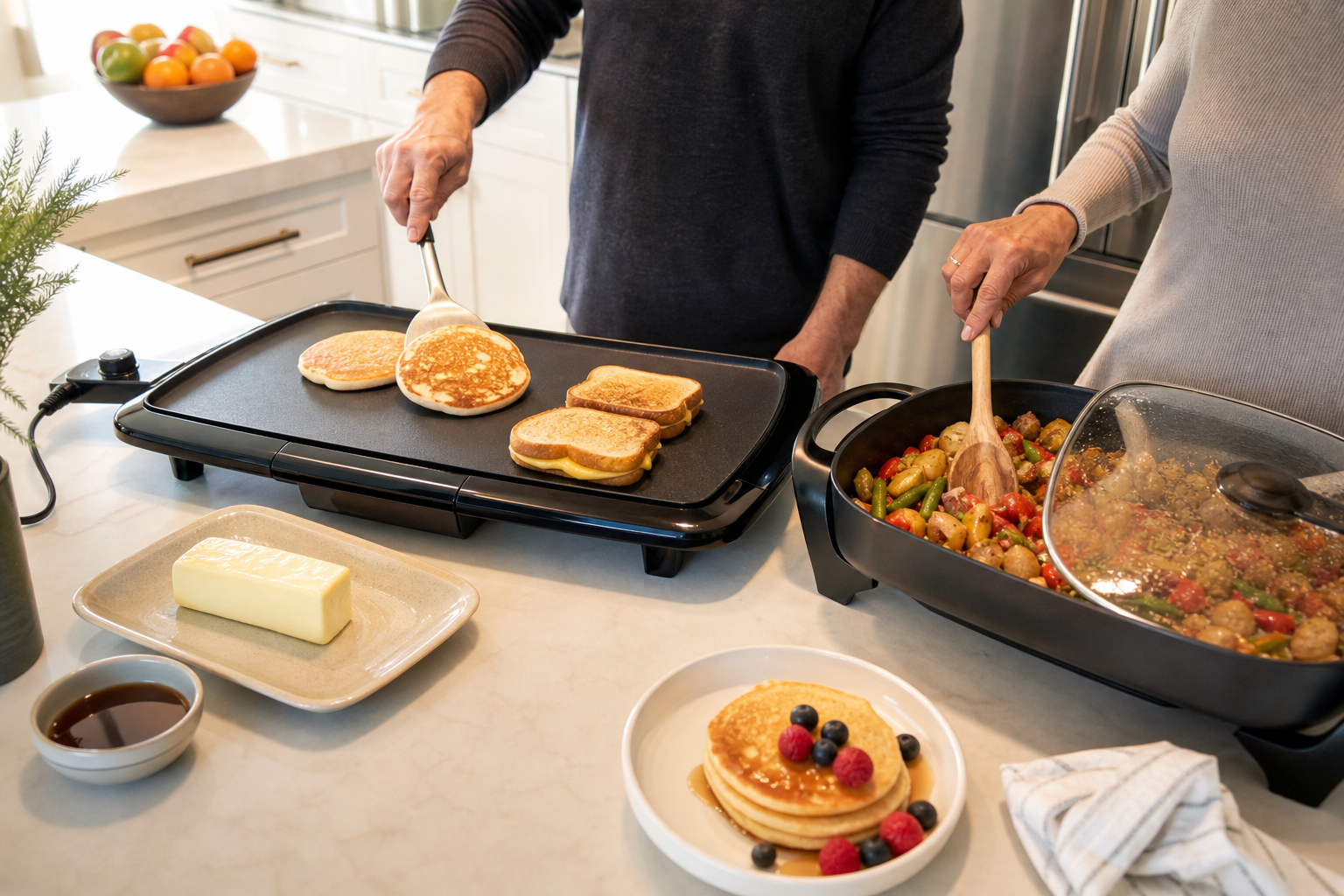
Choose an electric skillet if you want one countertop appliance for sautéing, frying, simmering, braising, reheating, and cooking foods that benefit from a lid. Choose an electric griddle if you mainly want maximum flat cooking space for pancakes, bacon, eggs, burgers, grilled cheese, or several servings at once.
What Matters Most
Explore Options That Fit Your Everyday Routine
Explore products that fit your priorities, compare current options and discover what works best for you.
Check prices, seller details and specifications on Amazon. Featured image is illustrative.
As an Amazon Associate I earn from qualifying purchases.
Start with the job you want the appliance to do
An electric griddle is essentially a large, shallow, heated cooking surface. Its appeal is speed and access: you can spread food across one broad plane, flip it easily, and cook multiple portions without crowding a conventional skillet. That makes it especially useful for pancakes, French toast, bacon, eggs, burgers, quesadillas, grilled cheese, and other foods that are cooked directly on the surface.
An electric skillet is closer to a frying pan or shallow sauté pan that plugs into an outlet. Its raised sides hold ingredients, sauces, cooking liquid, and grease, and many models include a glass lid. That design makes it more capable for meals that move beyond simple browning, including stir-fries, chicken pieces, pork chops, vegetables, hash, casseroles, shallow frying, simmering, and reheating.
The practical distinction is not that one appliance is universally better. It is whether your everyday cooking is mostly flat-surface cooking or contained, pan-style cooking. If you regularly prepare several servings of the same breakfast food, the griddle may feel more useful. If you want to cook a complete dish in one vessel, the skillet usually offers more range.
Where an electric griddle makes more sense
The griddle’s strongest advantage is usable surface area. Current countertop models vary, but manufacturer examples show cooking surfaces around 200 square inches, considerably broader than the cooking area of many electric skillets. A wide surface can let you cook pancakes in batches, brown bacon while preparing eggs, or make several sandwiches without repeatedly clearing space. ([hamiltonbeach.com](https://hamiltonbeach.com/electric-griddle-38515?utm_source=openai))
The open design also makes turning and arranging food straightforward. Pancakes are easy to reach, burgers can be lined up in rows, and grilled sandwiches can be monitored without lifting a lid. A grease channel or removable drip tray can help collect excess fat, which is useful when cooking bacon, sausage, or burgers.
Choose a griddle if your regular routine includes weekend breakfasts, family-style lunches, or cooking for several people at once. It can also be a good fit when you want to keep the cooktop free for another pan. The trade-off is that a griddle is less suited to liquid-heavy dishes: sauces can spread, food is more exposed to splatter, and there is usually no deep wall or lid for simmering.
- Best for pancakes, eggs, bacon, French toast, burgers, quesadillas, and grilled sandwiches
- Often provides more flat cooking space than a skillet
- Usually easier to access while flipping and arranging food
- Less useful for sauces, braises, stews, and foods that need to be covered
Where an electric skillet earns its counter space
The electric skillet is the more adaptable choice for many households because it can perform several jobs normally handled by a stovetop pan. A typical model has adjustable heat, raised sides, and a lid; one Hamilton Beach example lists a 200°F-to-400°F range, a 116-square-inch nonstick cooking surface, and a clear lid. ([hamiltonbeach.com](https://hamiltonbeach.com/nonstick-electric-skillet-38532?utm_source=openai))
The deeper shape is useful when ingredients need to be tossed, stirred, or partially submerged. You can brown meat, add vegetables and sauce, cover the pan, and finish the dish without transferring everything to another pot. That makes it practical for dishes such as chicken and vegetables, sausage with peppers, fried rice, skillet potatoes, shallow-fried foods, and reheated leftovers.
A skillet can also help when you want to serve food directly from the cooking vessel. Low heat settings may be useful for holding food warm, though you should follow the appliance instructions and avoid treating a warm setting as a substitute for safe food handling. FoodSafety.gov advises keeping hot food at 140°F or warmer and using a thermometer to check the safe internal temperature of cooked foods. ([akaprod-www.foodsafety.gov](https://akaprod-www.foodsafety.gov/keep-food-safe/4-steps-to-food-safety?utm_source=openai))
- Best for one-pan meals, sautéing, simmering, braising, shallow frying, and reheating
- Raised sides help contain sauces, grease, and ingredients
- A lid adds control for covered cooking and retaining heat
- Usually offers less uninterrupted flat space for pancakes or sandwiches
Capacity, heat control, and cooking flexibility
Do not compare appliances by exterior dimensions alone. A long griddle may occupy more counter width but provide more usable flat area, while a skillet may have a smaller footprint but hold more food vertically. Think about the foods you cook, not just the advertised size. A griddle’s surface is valuable when every item needs direct contact with the cooking plate; a skillet’s depth is valuable when ingredients are layered or stirred together.
Temperature controls are another area where specifications vary. Manufacturer examples show both appliance types with adjustable settings, but the available range, control style, indicator lights, and heat recovery can differ by model. Some griddles use a removable temperature-control probe, while some skillets use a detachable control cord or built-in dial. These details affect storage and cleaning as much as cooking performance. ([hamiltonbeach.com](https://hamiltonbeach.com/nonstick-electric-skillet-38532?utm_source=openai))
Neither appliance automatically guarantees perfectly even cooking. Large surfaces can develop hotter or cooler zones, and heavily loading either appliance may slow browning. Look for a clear preheat indicator, a controllable thermostat, and instructions that explain whether the cooking surface can be washed or immersed. If you often cook delicate foods, a design with responsive temperature control may matter more than a few extra inches of capacity.
Cleanup, storage, and everyday convenience
Cleanup can decide which appliance actually gets used. Griddles often have a removable grease tray, while skillets may allow the pan and lid to be washed after the electrical control is removed. Hamilton Beach lists dishwasher-safe or immersible components on select griddles and skillets, but this is not universal, so check the exact model rather than assuming every part can go in the dishwasher. ([hamiltonbeach.com](https://hamiltonbeach.com/skillets-and-griddles?utm_source=openai))
The griddle’s shallow profile can make wiping the surface simple, but its width may make it awkward to fit in a sink or cabinet. The skillet is usually easier to carry and store as a single pan, but its depth and lid can take up more vertical space. A detachable cord or temperature probe is helpful for both storage and washing.
Nonstick surfaces are convenient but require care. Follow the manufacturer’s utensil and cleaning instructions; one Hamilton Beach griddle care guide, for example, advises using wooden or plastic utensils to prolong the coating. Avoid stacking heavy cookware on the surface and replace a damaged cooking surface rather than trying to restore it with abrasive cleaners. ([useandcares.hamiltonbeach.com](https://useandcares.hamiltonbeach.com/files/840341300.pdf?utm_source=openai))
- Check whether the cooking surface, lid, drip tray, and control cord are removable
- Measure cabinet and sink space before choosing a wide griddle
- Confirm dishwasher guidance for the exact model
- Use utensils and cleaners recommended for the cooking surface
Which one is more useful day to day?
For a single appliance that can cover the widest range of meals, choose an electric skillet. Its raised sides and lid let it handle ordinary pan cooking plus tasks that a griddle cannot manage comfortably. It is the better everyday option for someone who wants to make dinner, reheat food, cook in a room without a full range, or prepare meals in one vessel.
Choose an electric griddle instead if your main goal is efficient batch cooking on a flat surface. It is particularly compelling for households that make frequent breakfasts, cook several sandwiches or burgers at once, or prefer an appliance that leaves the stovetop available. A griddle may also be the easier choice for people who find a wide, open surface simpler to monitor and turn food on.
If you already own a reliable frying pan or sauté pan, the griddle may add more distinct capability. If you already have a large griddle or flat cooktop, the skillet may add more versatility. The best purchase is the one that fills the gap in your current kitchen rather than duplicating what you already use.
What to look for before buying
For a griddle, prioritize the cooking area, grease management, temperature control, cool-touch handles, and how easily the surface fits into your sink or storage space. A removable drip tray is useful for greasy foods, and a removable or washable cooking plate can reduce cleanup. If you cook for different numbers of people, compare the actual cooking dimensions rather than relying on labels such as family-size or extra-large.
For a skillet, look for a lid that fits securely, a stable base, comfortable handles, a clear temperature range, and a cooking surface large enough for your usual meals. If you plan to brown food at higher heat, check the manufacturer’s stated maximum temperature and care instructions. If easy cleanup is important, confirm exactly which parts are dishwasher safe after the cord or control is removed.
Whichever type you choose, use the appliance on a dry, level, heat-resistant surface and leave room around it for ventilation, following the instruction manual. For meat, poultry, seafood, eggs, and leftovers, use a food thermometer and follow current safe-temperature guidance rather than judging doneness by appearance alone. ([foodsafety.gov](https://www.foodsafety.gov/food-safety-charts/safe-minimum-internal-temperatures?utm_source=openai))
Ready to Find Your Best Match?
Explore products that fit your priorities, compare current options and discover what works best for you.
Check prices, seller details and specifications on Amazon. Featured image is illustrative.
As an Amazon Associate I earn from qualifying purchases.
Sources & editorial note
This guide is research-based and does not claim hands-on testing unless explicitly stated.
- Hamilton Beach: Skillets & Griddles — Supports general feature differences, cooking surfaces, removable parts, drip trays, and adjustable controls across electric griddles and skillets.
- Hamilton Beach: Nonstick Electric Skillet 38532 — Supports skillet features including raised-pan cooking, lid, temperature range, cooking area, handles, and cleaning guidance.
- Hamilton Beach: Electric Griddle 38515 — Supports griddle features including a 200-square-inch surface, grease tray, adjustable heat, and immersible design with the cord removed.
- Hamilton Beach: Proctor Silex Electric Griddle Use & Care Guide — Supports operating, cleaning, utensil, preheating, drip-tray, and safe-use considerations for an electric griddle.
- FoodSafety.gov: Safe Minimum Internal Temperatures — Supports food thermometer use and safe internal temperatures for meat, poultry, seafood, eggs, casseroles, and leftovers.