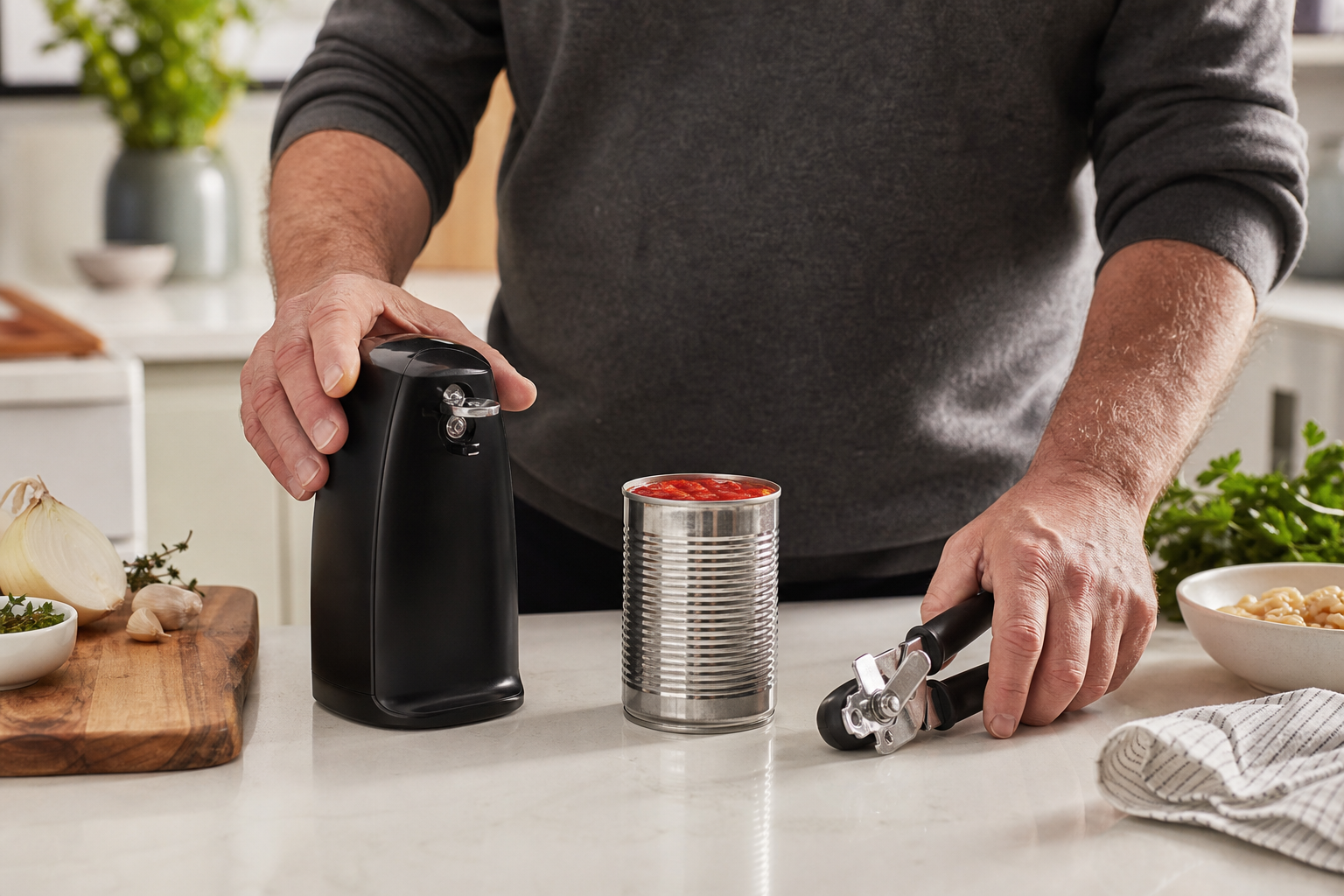
Choose a manual can opener if you want a compact, power-free tool that is easy to store, rinse, and replace. Choose an electric can opener if you regularly open multiple cans, prefer hands-free operation, or want to avoid repeated turning; just allow for a larger footprint, more parts, and either a cord or charging routine.
What Matters Most
The short answer: manual wins on simplicity, electric wins on effort
If your definition of easy is “grab it, use it, rinse it, and put it away,” a manual can opener is usually the better fit. It needs no outlet, batteries, charging cable, or dedicated counter space. A compact model can live in a utensil drawer and be ready whenever you need it.
If your definition of easy is “avoid turning the opener yourself,” an electric model has the advantage. Countertop electric openers are designed to hold the can while the cutting mechanism moves around it, and many stop automatically when the cut is complete. Hamilton Beach, for example, describes automatic shutoff and removable cutting units on several of its current and recent models. ([hamiltonbeach.com](https://hamiltonbeach.com/openstation-can-opener-with-tools-76382?utm_source=openai))
The deciding question is not which technology is universally better. It is whether you would rather manage a little physical effort or a little appliance overhead.
- Best all-around choice for most kitchens: a comfortable manual opener with a locking grip and lid-lifting feature.
- Best choice for frequent use or reduced hand effort: an electric opener with automatic shutoff and a removable cutting unit.
Where a manual can opener is easier to live with
Manual openers are small, straightforward, and independent. They work during a power outage, on a patio, in a vacation rental, or anywhere you do not want another appliance plugged in. There is no motor to store, no charging indicator to monitor, and no question about where the cord should go.
The best current designs are not limited to the old, narrow-handled style. OXO’s Soft-Handled Can Opener uses cushioned handles and an oversized knob, while Zyliss’s Lock & Lift design combines a locking mechanism, a smoother-turn control, and a magnet or release feature for lifting the lid. Those details matter because they reduce the need to squeeze the tool tightly or keep repositioning it as the cut progresses. ([zyliss.com](https://www.zyliss.com/products/zyliss-lock-lift-can-opener-red-e930018u?utm_source=openai))
Manual models also tend to be easier to clean at a glance. You can wipe the handles and cutting wheel immediately, and there is no appliance body with seams, vents, or a base that needs to stay dry. The trade-off is that you still provide the turning motion, and inexpensive or poorly aligned models can slip, require extra force, or leave a rough cut.
- Look for large, non-slip handles and a knob that turns without a tight pinch.
- A locking grip helps the opener stay attached instead of making you hold it in position.
- A lid magnet or lifting lever keeps you from handling the cut lid directly.
Where an electric can opener earns its counter space
Electric models are most useful when opening a can is less about the task itself and more about avoiding repeated hand movement. You position the can, activate the opener, and let the motor do the turning. Many countertop versions are intended for standard cans, while extra-tall designs are made to accommodate a broader range of sizes. ([hamiltonbeach.com](https://hamiltonbeach.com/extra-tall-can-opener-with-removable-cutting-lever-stainless-steel-76700?utm_source=openai))
That convenience becomes more noticeable when you are preparing several cans for soup, beans, tomatoes, pet food, or a large recipe. It can also be useful for anyone who finds a manual knob uncomfortable to turn for long enough to complete a full lid. The practical benefit is not speed alone; it is removing the repeated grip-and-turn motion from the job.
Electric openers vary in how much space and attention they require. A corded countertop unit needs a place near an outlet. A rechargeable or cordless model avoids the cord while introducing charging as another household task. Hamilton Beach’s cordless documentation, for example, specifies charging before use and shows that the unit will not operate while charging. ([useandcares.hamiltonbeach.com](https://useandcares.hamiltonbeach.com/files/840371001.pdf?utm_source=openai))
- Prioritize automatic shutoff so the opener stops without requiring you to watch the entire cut.
- A removable or washable cutting lever makes cleanup more manageable.
- Check the stated can-size range if you regularly buy tall cans or unusually large containers.
Cleanup, lid handling, and everyday safety details
The cutting style may matter more than the power source. Traditional top-cut openers leave a sharp edge on the lid and often on the can rim, so the lid needs careful handling. Some side-cut designs are intended to leave smoother edges and may include a tool for lifting the lid without touching it directly.
OXO’s smooth-edge instructions describe a side-cut mechanism that cuts below the rim and uses lid pliers for removal. Cuisinart has also described side-cut electric models as opening along the side of the lid to minimize sharp edges and contact with food, although individual products and availability change over time. ([cuisinart.com](https://www.cuisinart.com/discontinued-side-cut-can-opener/CCO-75.html?utm_source=openai))
No opener eliminates the need for basic care. Wipe away food residue promptly, keep the cutting area clean, and follow the manufacturer’s instructions about rinsing, hand-washing, or dishwasher use. With electric models, do not immerse the motor housing; look for a detachable cutting unit or lever instead. With manual models, pay attention to rust, dullness, or a wheel that begins to drag.
- For either type, a lid-lifting feature is more useful than a decorative extra.
- Choose side-cut or smooth-edge construction if you want to reduce contact with sharp lid edges.
- Do not assume a removable part is dishwasher-safe unless the manufacturer says so.
Which option fits common kitchen situations?
For occasional can use, a manual opener is usually the more sensible choice. It takes little storage space and does not create another appliance to maintain. Choose one with comfortable handles rather than the cheapest basic model; the design of the grip and turning knob will have more effect on daily satisfaction than the manual label itself.
For frequent batch cooking, an electric opener is easier to justify. It keeps working while you prepare other ingredients and can make repeated opening less tedious. A wide, stable base, automatic shutoff, removable cutting mechanism, and a can-size range that matches your pantry are more important than extra accessories.
For small kitchens, shared kitchens, travel, or emergency preparedness, manual has the edge because it remains useful without electricity and disappears into a drawer. For a household that strongly prefers push-button tools or finds repeated turning unpleasant, electric is the better fit even if it occupies more space.
If more than one person uses the kitchen, consider the person who will use the opener most often. A tool that feels simple to one cook may feel awkward to another. The best choice is the one that can be picked up and used without a workaround.
- Occasional use and limited storage: manual.
- Several cans at once: electric.
- No reliable access to power: manual.
- Preference for one-touch operation: electric.
- Concern about sharp lids: look for a smooth-edge design in either category.
What to look for before you buy
For a manual opener, inspect the points that affect control: wide handles, a non-slip grip, a smooth-turn knob, a locking mechanism, and a way to lift or release the lid. OXO and Zyliss both emphasize these types of features in their current manual designs, which is a useful checklist even if you choose another brand. ([zyliss.com](https://www.zyliss.com/products/zyliss-lock-lift-can-opener-red-e930018u?utm_source=openai))
For an electric opener, check the footprint, cord or charging setup, cutting-unit cleanup, automatic shutoff, and compatibility with the cans you actually buy. A model that looks convenient but stays buried in a cabinet may be less useful than a manual opener that is always within reach.
Also consider failure modes. A manual opener may become stiff or dull but is easy to replace. An electric opener depends on a motor, power source, and sometimes a removable mechanism. That does not make it a poor choice; it simply means convenience comes with more components to store and maintain.
- Do not pay for accessories you will not use.
- Measure your available counter or drawer space before choosing.
- Read the care instructions, especially for washable cutting parts.
- Match the opener’s design to your most common can sizes.
Bottom line
A good manual can opener is easier to live with for most people because it is compact, dependable, power-free, and easy to put away. Choose a comfort-focused model rather than a bare-bones one, and look for a locking grip, large handles, smooth turning, and a lid-lifting feature.
An electric can opener is worth choosing when minimizing hand effort is the main goal, particularly if you open cans often or prefer hands-free preparation. Accept the larger footprint and added cleaning or charging considerations in exchange for push-button operation.
So, which is easier? Manual is easier to own; electric is easier to operate. If you are undecided, buy the best-designed manual model first unless you already know that turning the knob is the part you want to avoid.
Sources & editorial note
This guide is research-based and does not claim hands-on testing unless explicitly stated.
- OXO Soft-Handled Can Opener — Supports features such as cushioned handles, an oversized turning knob, and a stainless steel cutting wheel.
- Zyliss Lock & Lift Can Opener — Supports the locking grip, smoother-turn handle, lid magnet, release lever, and compact manual design.
- Hamilton Beach Extra-Tall Electric Can Opener — Supports automatic shutoff, removable cutting lever, cord storage, and accommodation for different can sizes.
- Hamilton Beach OpenStation Can Opener — Supports hands-free automatic shutoff, can alignment, and a removable washable cutting lever.
- Proctor Silex Cordless Can Opener Use and Care Guide — Supports charging requirements, cordless operation, automatic stopping, and care considerations for an electric model.
- OXO Smooth Edge Can Opener Instructions — Supports side-cut operation, smoother edges, and lid-plier removal.