Choose capacity by combining room size with moisture level. A moderately damp room or small basement often fits a 20- to 30-pint unit; a very damp or larger basement is more likely to need 40 to 50 pints or more. When two sizes seem suitable, the larger unit is generally the safer choice because it can reach the target humidity faster and cycle off sooner. ([energystar.gov](https://www.energystar.gov/products/dehumidifiers?utm_source=openai))
What Matters Most
Explore Options That Fit Your Everyday Routine
Explore products that fit your priorities, compare current options and discover what works best for you.
Check prices, seller details and specifications on Amazon. Featured image is illustrative.
As an Amazon Associate I earn from qualifying purchases.
Start with the job: one room, a basement, or the whole home?
A dehumidifier works best when its assignment is clear. A portable unit is designed to control moisture in a room or defined area, such as a bedroom, laundry room, bathroom-adjacent space, or basement. If doors stay open and air moves freely, one unit may cover adjoining rooms, but walls, closed doors, stairwells, and uneven temperatures can limit how evenly moisture is removed.
For a single room, match the unit to that room rather than to the total square footage of the house. For a basement, measure the entire basement, including unfinished storage areas, and consider how damp the foundation, floor, and walls feel. If you want consistent humidity throughout several floors, a whole-home dehumidifier connected to the HVAC system may be a better fit than moving a portable appliance from room to room. ENERGY STAR describes whole-home systems as an option for homes with central air conditioning and humidity that remains above about 55% throughout the house. ([energystar.gov](https://www.energystar.gov/products/dehumidifiers?utm_source=openai))
- One bedroom or office: portable unit sized for that room.
- Open basement: portable unit sized for the full basement, with a hose option if possible.
- Several floors or recurring whole-house humidity: consider a professionally sized whole-home system.
Use square footage as a starting point—not the whole decision
Dehumidifier capacity is usually listed in pints per 24 hours. That number describes how much water the unit can remove under specified test conditions, not how large a room it can automatically control in every situation. A cool, slightly damp bedroom and a warm, wet basement of the same size can require very different capacities. ([energystar.gov](https://www.energystar.gov/products/dehumidifiers?utm_source=openai))
As a practical shopping framework, look first at 20 to 30 pints for a smaller or moderately damp area, 30 to 50 pints for a larger or consistently damp space, and 50 pints or more when the area is wet, has seepage, or contains a high moisture source such as regularly drying laundry. These are capacity ranges rather than universal room-size rules; manufacturers may publish different charts, so use the product documentation when your space falls between categories.
- 20–30 pints: slightly to moderately damp rooms or smaller spaces.
- 30–50 pints: larger rooms, basements, or spaces that stay noticeably damp.
- 50+ pints: wet areas, seepage, heavy laundry-related moisture, or unusually high moisture loads.
A useful size guide for common home situations
For a bedroom, office, or living area that feels a little damp and has an occasional musty odor, a 20- to 30-pint unit is often the sensible range. If the room is larger, poorly ventilated, or connected to other open spaces, move toward the upper end rather than choosing the smallest model.
For a basement that feels consistently damp, start around 30 to 50 pints depending on its size and condition. If you see damp spots, condensation, sweating walls or floors, or signs of seepage, shop above that range and address the water source as well. A dehumidifier can remove airborne moisture, but it is not a substitute for repairing leaks, improving drainage, or drying water-damaged materials.
Manufacturer charts illustrate why condition matters. Frigidaire’s guide pairs a 30-pint model with a 300-square-foot space that is slightly or moderately damp, while larger or wetter examples move to 50-, 70-, or 90-plus-pint capacities. Treat that chart as a brand-specific example, not a universal industry formula. ([owner.frigidaire.com](https://owner.frigidaire.com/support-articles/article/1927758-dehumidifier-sizing-guide?utm_source=openai))
- Small, slightly damp room: approximately 20–30 pints.
- Medium room or modest basement: approximately 30–40 pints.
- Large or consistently damp basement: approximately 40–50 pints.
- Wet basement, seepage, or heavy moisture load: 50 pints or more, plus moisture-source repairs.
Basement sizing requires extra attention
Basements are often cooler than the rest of the home, and that changes how a compressor-based dehumidifier performs. ENERGY STAR notes that frost can form on the coils when the surrounding air is below about 65°F, which can reduce moisture removal or cause the unit to cycle for defrosting. If your basement regularly runs cool, look for a model specified for lower-temperature operation or one with an anti-frost feature. ([energystar.gov](https://www.energystar.gov/products/dehumidifiers?utm_source=openai))
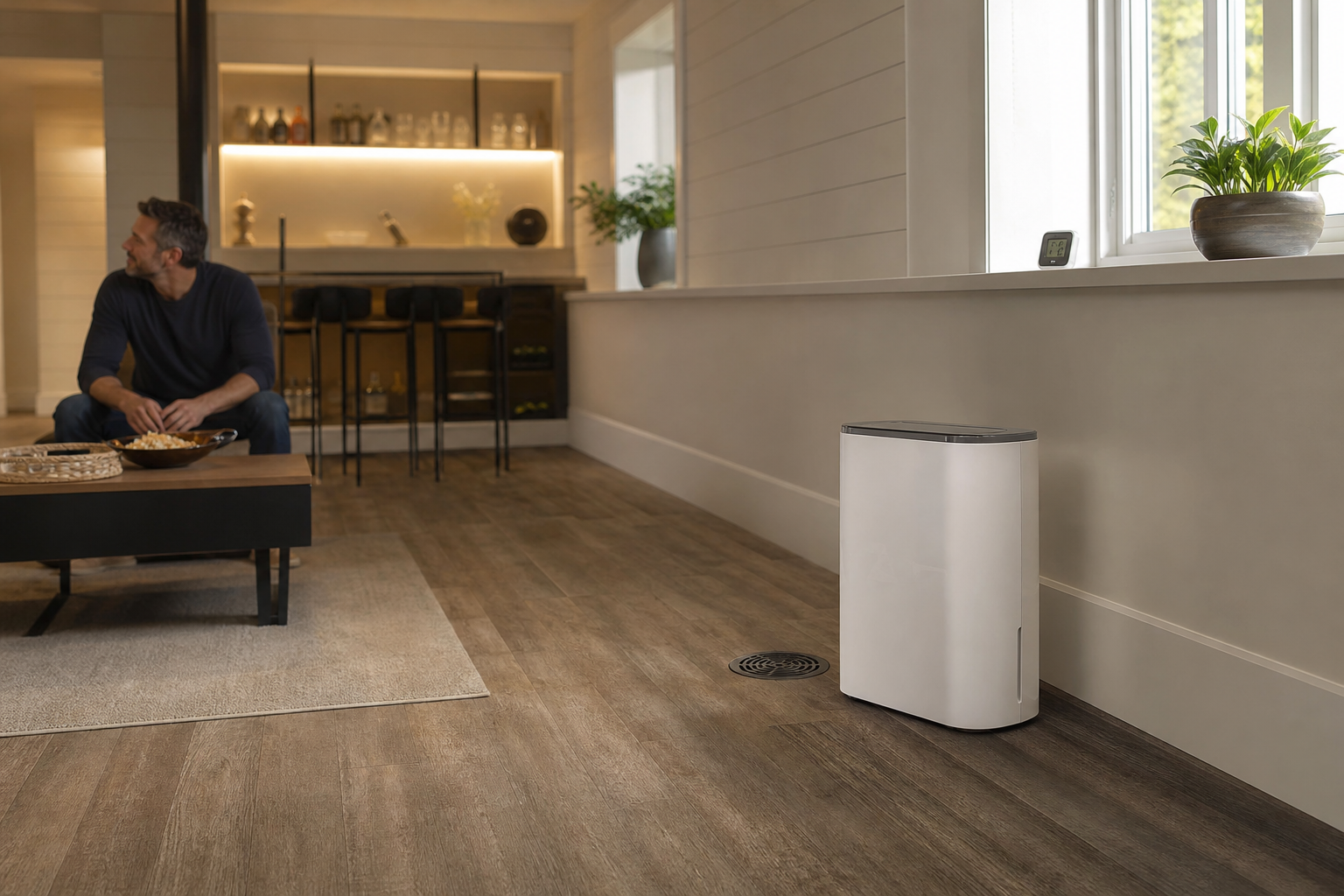
Drainage may matter as much as capacity. A large bucket can still fill frequently in a damp basement, and an automatic shutoff will stop the unit when it is full. A continuous-drain connection routed to a floor drain or condensate pump lets the unit operate with less attention, provided the hose can maintain the required slope and the installation follows the manufacturer’s instructions.
If the basement has visible mold, standing water, recent flooding, or wet building materials, deal with the water problem and cleanup separately. EPA guidance recommends keeping indoor relative humidity below 60%, ideally between 30% and 50%, and drying wet materials promptly. ([epa.gov](https://www.epa.gov/emergencies-iaq/text-version-flooded-home?utm_source=openai))
- Cool basement: prioritize low-temperature operation or anti-frost protection.
- Frequently unattended basement: prioritize continuous drainage.
- Water intrusion or wet materials: repair and dry the source instead of relying only on the appliance.
When a larger unit is the better buy
If you are between sizes, choose the larger capacity when the price, footprint, and electrical requirements are acceptable. ENERGY STAR specifically advises that it is better to oversize than undersize. A larger unit may lower humidity more quickly and spend more time cycling off once the target is reached, while an undersized unit may run continuously without keeping up. ([energystar.gov](https://www.energystar.gov/products/dehumidifiers?utm_source=openai))
Oversizing does not mean choosing the biggest appliance available for every room. A very large unit can be heavier, noisier, harder to place, and more expensive to buy. The goal is enough capacity for the space and its moisture load, not maximum capacity without regard to drainage, clearance, sound, or portability.
Also compare current capacity ratings carefully. DOE testing changes introduced around 2020 used cooler, more realistic conditions, so newer units may show lower pint numbers than older models that appear similar. ENERGY STAR provides approximate comparisons, but the manufacturer’s current specification is the best reference when replacing an older appliance. ([energystar.gov](https://www.energystar.gov/products/dehumidifier_testing_and_capacity?utm_source=openai))
- Choose larger when the space is wetter, cooler, open to other areas, or hard to monitor.
- Do not compare old and new pint ratings as if the test conditions were identical.
- Check noise, dimensions, drain setup, and outlet requirements before buying.
Features that matter after capacity
A built-in humidistat is one of the most useful features because it allows the dehumidifier to maintain a chosen relative-humidity setting rather than simply running on a timer. ENERGY STAR says certified dehumidifiers include a humidistat and cycle on and off as the room reaches the selected level. A separate hygrometer can help you check whether the unit’s reading matches conditions elsewhere in the room. ([energystar.gov](https://www.energystar.gov/products/dehumidifiers?utm_source=openai))
Look for automatic shutoff, a washable filter, an accessible water bucket, and a continuous-drain option. Wheels and handles are helpful if you will move the unit seasonally. In a living area or bedroom, noise and the direction of the air discharge may matter more than a few extra pints of capacity.
Efficiency is worth comparing when the unit will run for long periods. ENERGY STAR measures dehumidifier efficiency using integrated energy factor, expressed as liters of water removed per kilowatt-hour; in general, a higher value indicates better efficiency. ([energystar.gov](https://www.energystar.gov/products/dehumidifiers?utm_source=openai))
- Best all-around feature set: humidistat, auto shutoff, washable filter, wheels, and hose connection.
- For a basement: low-temperature operation and continuous drainage deserve priority.
- For a bedroom or office: compare noise, airflow direction, and compactness.
Ready to Find Your Best Match?
Explore products that fit your priorities, compare current options and discover what works best for you.
Check prices, seller details and specifications on Amazon. Featured image is illustrative.
As an Amazon Associate I earn from qualifying purchases.
Sources & editorial note
This guide is research-based and does not claim hands-on testing unless explicitly stated.
- ENERGY STAR: Dehumidifiers — Supports pint-per-day capacity guidance, dampness-based sizing ranges, oversizing advice, humidity targets, low-temperature considerations, drainage, humidistats, and whole-home applications.
- ENERGY STAR: Dehumidifier Testing and Capacity — Explains current capacity testing and why newer pint ratings may be lower than older ratings.
- U.S. Environmental Protection Agency: The Inside Story — Supports maintaining basement and indoor relative humidity between 30% and 50% when possible.
- U.S. Environmental Protection Agency: A Brief Guide to Mold, Moisture and Your Home — Supports moisture-source repair, prompt drying, and keeping indoor humidity below 60%, ideally 30% to 50%.
- Frigidaire: Dehumidifier Sizing Guide — Provides a manufacturer-specific example linking room area and dampness to 30-, 50-, 70-, and 90-plus-pint capacities.