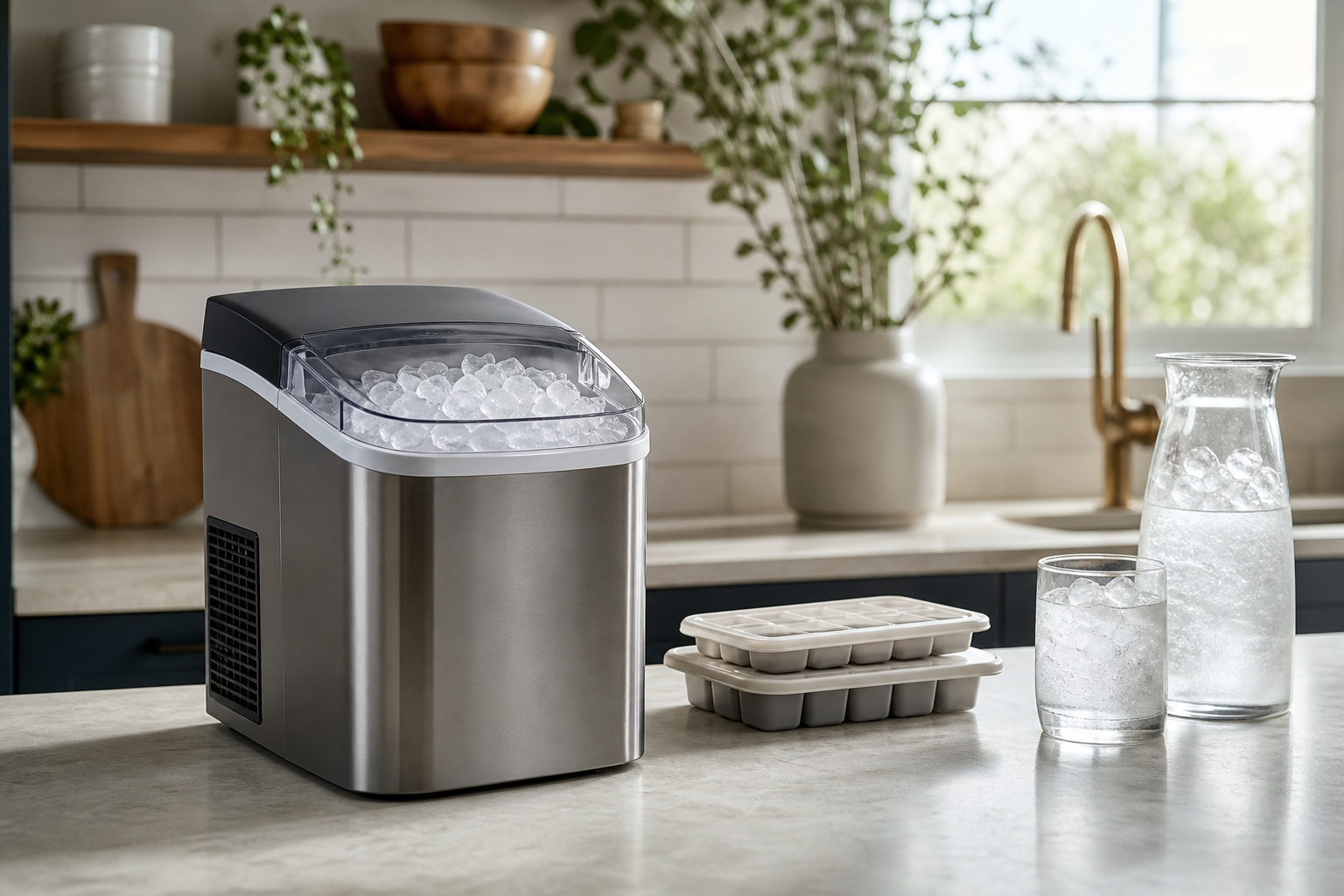
Choose reusable ice trays if you mainly need a few drinks at a time, already have freezer space, and want the lowest-maintenance option. Choose a countertop ice maker if you regularly run short on freezer ice, prefer nugget-style ice, host often, or want fresh batches without waiting for trays to freeze.
What Matters Most
Start with the everyday job: keeping drinks cold without creating another chore
For most households, the job is straightforward: have enough clean, usable ice for water, coffee drinks, iced tea, cocktails, smoothies, or a cooler. Ice trays handle that job quietly. Fill them, place them in the freezer, wait, and transfer the cubes to a container when they are ready. There is no motor, reservoir, filter, cord, or dedicated counter space to manage.
A countertop ice maker is designed for a different rhythm. It produces ice in repeated batches, stores a limited amount in an internal bin, and commonly recirculates meltwater back into the reservoir. A current GE Profile Opal specification, for example, lists production of up to 24 pounds per day, a three-pound ice capacity, and first ice in about 15 minutes under stated test conditions. Actual output varies with water and room temperature. ([products.geappliances.com](https://products.geappliances.com/appliance/gea-support-search-content?contentId=35279&utm_source=openai))
That sounds like a clear win for the machine, but production capacity is not the same as frozen storage. A countertop unit is not usually a substitute for a freezer. Ice that sits in the bin can melt and be remade, so the practical benefit is ongoing access rather than a permanent stockpile.
- Best fit for trays: occasional or predictable ice use.
- Best fit for a machine: frequent use, quick refills, or gatherings.
Ice supply and timing: trays reward planning, machines reward convenience
Ice trays work well when your household follows a routine. Fill them after grocery shopping, before bed, or while cleaning the kitchen, and you will have ice ready later. Multiple trays can build a respectable supply, but they occupy freezer real estate and require you to remember to refill them. If a tray is empty when guests arrive, there is no shortcut.
A countertop ice maker is more useful when demand is irregular. You can start a batch before dinner, add ice during a weekend gathering, or keep a beverage station supplied without opening the freezer repeatedly. Some models advertise roughly one to one-and-a-half pounds of production per hour, although performance depends on the model and operating conditions. GE lists one pound per hour for one Opal specification and 1.5 pounds per hour for its newer Mini model. ([products.geappliances.com](https://products.geappliances.com/appliance/gea-support-search-content?contentId=35279&utm_source=openai))
The trade-off is attention. You still need to add potable water, empty or use the bin, and keep the machine available on a stable, ventilated counter. If your ice use is light, the machine may spend more time occupying your kitchen than solving a meaningful problem.
- Choose trays when you can plan ahead.
- Choose a machine when waiting for the freezer is the real inconvenience.
Ice style, drink experience, and storage
Reusable trays generally make hard cubes or rounded cubes, depending on the design. They are versatile for everyday water, iced coffee, cooking, chilling a punch bowl, or placing a few cubes in a glass. Covered trays can also reduce the chance of freezer odors affecting the ice. OXO’s No-Spill Ice Cube Tray, for example, uses a silicone lid for sealed storage, stacking, and angled carrying, and is listed as top-rack dishwasher safe. ([oxo.com](https://www.oxo.com/oxo-gg-no-spill-ice-cube-tray-2-pk.html?utm_source=openai))
Many countertop machines are purchased specifically for a different texture. Nugget or pellet ice is made from compacted ice flakes rather than a traditional solid cube. GE describes its Opal ice as chewable nuggets produced by scraping ice flakes from a chilled cylinder and compacting them. That texture can be appealing in soft drinks, iced tea, and casual entertaining, but it is not automatically better for every drink. ([products.geappliances.com](https://products.geappliances.com/appliance/gea-support-search-content?contentId=35279&utm_source=openai))
Think about the drinks you actually make. Solid cubes tend to suit a slow-sipping drink where you want less exposed surface area. Nugget ice is often chosen for texture and easy scooping. If you want one appliance to make large, slow-melting cocktail cubes or clear ice, a typical countertop nugget machine is the wrong category; it makes a specific style of ice rather than every style of ice.
- Trays offer more freedom to choose cube size and shape.
- Machines are attractive when nugget-style ice is the main reason for buying.
Space, sound, electricity, and upkeep
Ice trays take freezer space but little else. They can be stacked, stored inside a lidded bin, or kept in a drawer if the design allows. Their main upkeep is washing and drying them, plus occasionally cleaning the container used to hold finished ice. A covered tray can make filling and stacking easier, especially in a crowded freezer.
A countertop ice maker uses counter space and electrical power. It may also need clearance around the sides or rear for ventilation; GE’s Opal specifications call for three inches at the rear and sides. Larger models can be heavy, so choose a location you will not need to move often. ([products.geappliances.com](https://products.geappliances.com/appliance/gea-support-search-content?contentId=35279&utm_source=openai))
Cleaning is the bigger difference. Manufacturers commonly recommend routine reservoir cleaning and descaling because water minerals can accumulate. GE’s Opal cleaning guidance recommends weekly reservoir sanitizing for one model family and notes that mineral deposits can build up in the drip tray. Follow the instructions for the exact machine rather than assuming a generic cleaner or schedule is suitable. ([products.geappliances.com](https://products.geappliances.com/appliance/gea-support-search-content?contentId=000060634&utm_source=openai))
- Trays are nearly silent and have no operating cost beyond water and freezer energy already in use.
- Machines add noise, counter clutter, and a recurring cleaning routine.
- Look for removable, washable parts and clear manufacturer cleaning instructions.
Clean ice and the decision that makes sense for your home
Neither option is maintenance-free. With trays, the cleanest routine is to wash them regularly, let them dry, and use a covered container for finished ice. Avoid handling ice with utensils or hands that have just touched food. The USDA emphasizes cleaning surfaces and utensils before sanitizing and preventing cross-contamination in the kitchen. ([fsis.usda.gov](https://www.fsis.usda.gov/food-safety/safe-food-handling-and-preparation/food-safety-basics/washing-food-does-it-promote-food?utm_source=openai))
With a machine, water quality and cleaning habits matter more because the appliance has a reservoir, internal water paths, a bin, and damp surfaces. Use only the water type specified by the manufacturer, empty the unit when it will sit unused, and follow the stated cleaning and descaling schedule. Features such as filters or automated cleaning cycles can reduce friction, but they do not remove the need for routine care. GE describes filtration and cleaning programs as features on selected Opal models, not as a substitute for maintenance. ([geappliances.com](https://www.geappliances.com/appliance/GE-Profile-Opal-2-0-Nugget-Ice-Maker-with-Side-Tank-XPIO13SCSS?bvstate=pg%3A23%2Fct%3Ar&gclsrc=aw.ds&utm_source=openai))
For everyday use, ice trays remain the sensible default when you want simplicity, low clutter, and predictable small quantities. A countertop ice maker earns its place when fast availability, higher demand, or a preferred ice texture matters enough to justify the footprint and upkeep. If you are undecided, start by tracking how often you run out of ice and how often you wish you had a different texture. Those two answers usually make the choice clear.
- Buy reusable trays for the simplest, quietest, most space-efficient setup overall.
- Buy a countertop ice maker for convenience, entertaining, or nugget-ice preference.
- Before buying a machine, measure the counter, check ventilation requirements, and confirm where melted water and cleaning supplies will go.
Sources & editorial note
This guide is research-based and does not claim hands-on testing unless explicitly stated.
- GE Appliances: Opal Ice Maker Product Specifications — Supports production rate, ice capacity, first-ice timing, nugget-ice design, operating temperature, and clearance details.
- GE Appliances: Opal Nugget Ice Makers — Supports current model examples, dimensions, production claims, and Mini model specifications.
- GE Appliances: Opal 2.0 Nugget Ice Maker — Supports examples of hourly production, bin capacity, recirculation, filtration, and cleaning features.
- GE Appliances: Opal Cleaning and Descaling — Supports routine reservoir cleaning, mineral buildup, potable-water guidance, and cleaning instructions.
- OXO Good Grips No-Spill Ice Cube Tray — Supports covered-tray features, stacking, odor reduction, rounded cubes, and dishwasher-safe construction.
- USDA Food Safety and Inspection Service: Washing Food — Supports cleaning, sanitizing, and cross-contamination guidance for food-contact surfaces and utensils.