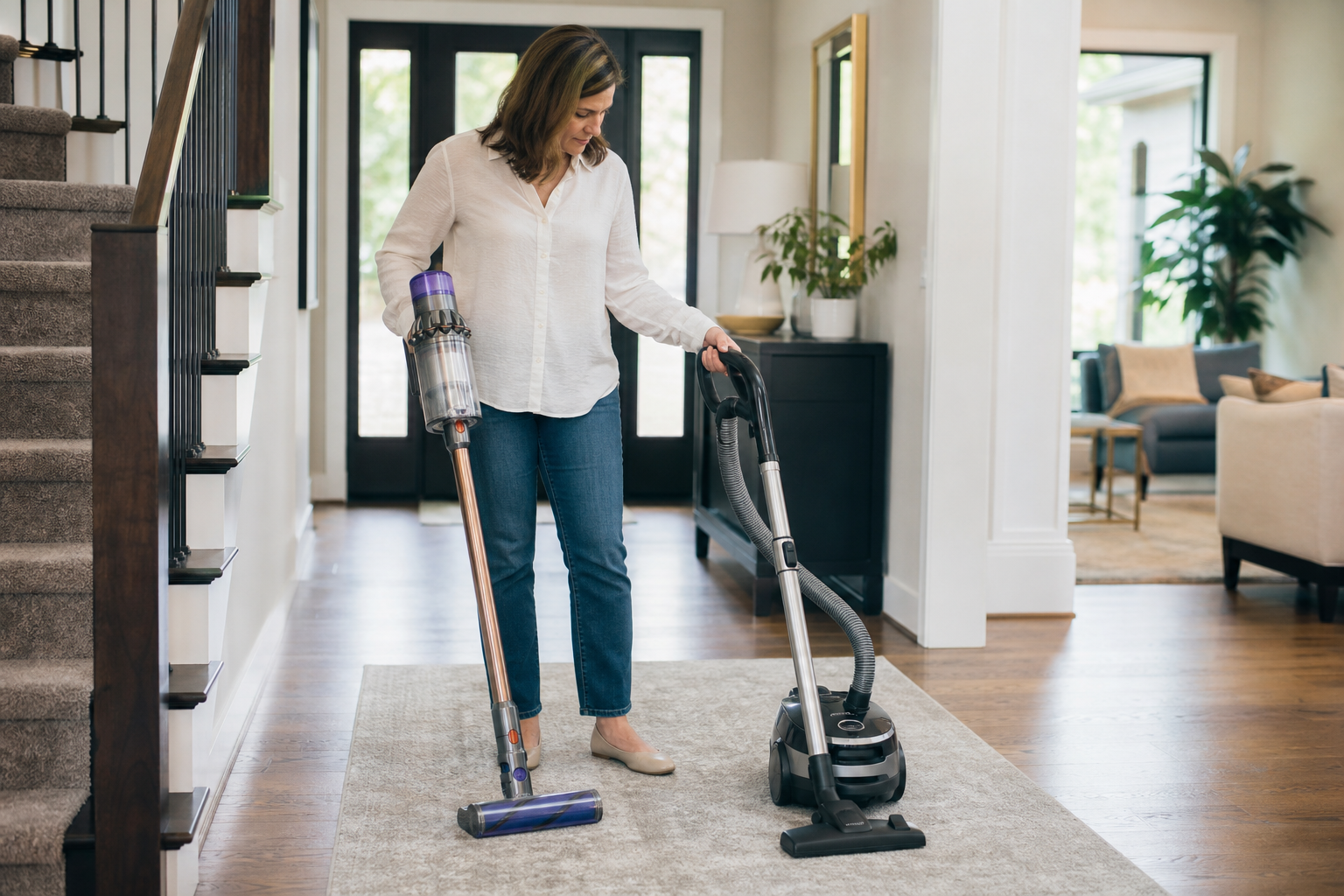
Choose a cordless stick vacuum if you want something lightweight, easy to store, and ready for frequent spot cleaning. Choose a canister vacuum if you regularly clean larger areas, need longer uninterrupted sessions, have multiple floor surfaces, or prefer a bagged system with more capacity. For many homes, the deciding factor is not which design is universally better, but which one removes the biggest annoyance from your routine.
What Matters Most
Start with the cleaning job, not the vacuum shape
Think about your most common cleaning session. If you sweep up crumbs after meals, collect pet hair from one room, or make several short passes during the week, a cordless stick vacuum can make those jobs feel less involved. Its compact format is generally easier to pull from a closet, carry upstairs, and return to a wall dock or charging stand.
If your routine is a weekly whole-home clean, the calculation changes. A canister vacuum keeps drawing power from the outlet instead of asking you to manage battery charge, and its separate body, hose, wand, and floorhead can be useful when you move between floors, furniture, stairs, and hard-to-reach areas. Miele describes canister models as a fit for consistent performance and larger dust capacity, while cordless models are positioned around portability and convenience. ([mieleusa.com](https://www.mieleusa.com/c/a-miele-guide-to-different-vacuum-cleaner-models-7559.htm?utm_source=openai))
- Best first question: What cleaning task do you postpone because the vacuum feels inconvenient?
- For frequent small jobs, convenience may matter more than maximum capacity.
- For longer sessions, uninterrupted operation and attachments may matter more than compact storage.
Cordless stick vacuum: where it makes sense
A cordless stick is usually the more natural choice for quick, frequent cleaning. There is no cord to unwind or outlet to find, and many models convert to a handheld format for furniture, shelves, car interiors, or small spills. The upright, narrow design can also be easier to store in a small utility closet or apartment.
The main trade-off is that cordless performance is tied to the battery, cleaning mode, and tool being used. Manufacturer specifications often describe runtime as an upper limit rather than a guaranteed whole-home figure. Dyson, for example, notes that higher-power modes reduce runtime and recommends using boost or max settings for shorter intensive bursts. Some models can accept an additional battery, but that feature is not universal. ([dyson.com](https://www.dyson.com/support/vacuum-cleaners/cordless/battery-care?utm_source=openai))
You will also need a charging habit. A cordless vacuum may be ready whenever it is docked, but a battery that is empty before a larger cleaning session can interrupt the job. Battery capacity gradually declines over time, so check whether replacement batteries are available, whether they can be changed without service, and what the warranty covers before buying. ([dyson.com](https://www.dyson.com/support/vacuum-cleaners/cordless/battery-care?utm_source=openai))
- A strong fit for: apartments, frequent spot cleaning, stairs, kitchens, and homes where storage space is limited.
- Check carefully: advertised runtime, max-mode runtime, charging time, battery replacement, bin capacity, and floorhead design.
- Do not assume lightweight means effortless for every user; the motor and dust bin may sit near the handle, which can affect wrist and arm comfort.
Canister vacuum: where it makes sense
A canister vacuum is often better suited to deliberate, longer cleaning sessions. The motor and dust container stay on the floor while you guide a lighter wand and hose, which can be convenient when cleaning under furniture, along baseboards, on stairs, or across several rooms. Many models also support specialized floorheads for hard floors, rugs, and carpeting.
Because a corded canister draws power from the outlet while it runs, you do not have the same battery-runtime limitation. The practical limit is usually the cord and operating radius. As one example, Miele lists a Complete C3 model with a 36-foot operating radius, a 24-foot cord, and a 4.8-quart filter-bag volume; specifications vary substantially by model, so compare the actual figures rather than relying on the category name. ([mieleusa.com](https://www.mieleusa.com/product/10014520/canister-vacuum-cleaners-complete-c3-cat-and-dog-powerline-sgee0-lotus-white?utm_source=openai))
The trade-off is setup and storage. You have to carry or roll the canister, manage the cord, connect tools, and find room for the hose and wand. A canister is not necessarily difficult to use, but it can feel like more equipment for a five-minute crumb pickup.
- A strong fit for: larger homes, mixed flooring, carpeted rooms, detailed cleaning, and uninterrupted sessions.
- Check carefully: operating radius, hose reach, floorhead options, wheel behavior, bag or bin size, and accessory storage.
- A bagged canister can be appealing if you prefer less frequent emptying and a closed dust-disposal process.
Capacity, filtration, and cleanup maintenance
Cordless sticks usually use a compact dust bin, which helps keep the machine slim but may mean more frequent emptying, especially in homes with shedding pets, children, or ongoing renovation dust. Emptying a bin can also release dust into the room, depending on the design and how close you hold it to the trash container.
Canister vacuums may use either bags or bagless containers. With a bagged design, the bag holds more debris and can be removed as a sealed unit. Miele’s documentation explains that full or clogged bags and filters can reduce suction, and that bags and filters need to be replaced according to the model’s instructions. ([mieleusa.com](https://www.mieleusa.com/support/customer-assistance/canister_vacuum_cleaner-1326/all/cleaning_performance_reduced_with_filterbag-92265764619?utm_source=openai))
Filtration claims deserve careful reading. Look for the exact filter type, whether it is included or optional, and whether replacement filters are readily available. Some Miele canister models specify AirClean or HEPA AirClean filters, but filtration performance is model-specific rather than guaranteed by the word canister alone. ([mieleusa.com](https://www.mieleusa.com/category/1016468/canister-vacuum-cleaners?utm_source=openai))
- Choose a smaller bin if you value a compact body and do not mind frequent emptying.
- Choose a larger bag or container if you want fewer interruptions during whole-home cleaning.
- Budget for replacement bags, filters, or batteries as part of ownership rather than treating them as optional extras.
Flooring, stairs, furniture, and everyday maneuvering
For mostly hard floors and low-pile rugs, either category can work well if the floorhead is appropriate. Look for a head that can switch between surfaces or offers a soft roller for delicate hard floors and a brushroll for rugs. A cordless stick is often convenient for crumbs and visible debris, while a canister’s hose and attachments may make detailed edge, upholstery, and stair cleaning easier.
Stairs are a useful stress test. A cordless stick avoids dragging a cord up and down, and a detachable handheld can be practical for individual steps. A canister can also clean stairs effectively, but you will want a long hose, secure parking position, and a tool that does not require you to balance the machine on a step.
Furniture and low spaces favor flexibility more than category. Compare the wand’s reach, the hose’s flexibility, the cleaning head’s height, and whether the machine can lie flat. Pay attention to the controls: a trigger that must be held continuously can feel different from a power button, particularly during longer sessions.
- For stairs: prioritize weight in hand, hose or wand reach, and secure handling.
- For mixed floors: prioritize adjustable suction or a floorhead designed for multiple surfaces.
- For upholstery and edges: prioritize included tools and how quickly they can be attached.
How to choose without overbuying
Choose a cordless stick when your priority is reducing friction: quick access, easy carrying, compact storage, and frequent small cleanups. It is especially sensible when most sessions are short and your floors do not demand a large set of specialized tools. Before buying, confirm the real runtime in the mode you expect to use, charging time, replacement-battery policy, and bin-emptying design.
Choose a canister when your priority is cleaning range: longer sessions, larger capacity, dependable outlet power, mixed flooring, and detailed work with a hose and attachments. It is a better match when you would rather roll equipment behind you than stop to recharge or empty a small bin. Confirm the operating radius, bag availability, filter costs, floorhead assortment, and storage footprint.
If your needs split evenly, consider the role of the vacuum in your home. A cordless stick can serve as the everyday maintenance tool, while a canister can handle deeper or more detailed cleaning. If you are buying only one, select the design that fits your most frequent and most frustrating job—not the one with the longest feature list.
- Pick cordless stick: short sessions, small spaces, stairs, quick pickups, minimal setup.
- Pick canister: whole-home cleaning, mixed floors, larger debris loads, detailed attachments, continuous power.
- Before checkout: measure storage space, check replacement-part availability, and read the manual for runtime, maintenance, and filter instructions.
Sources & editorial note
This guide is research-based and does not claim hands-on testing unless explicitly stated.
- ENERGY STAR Vacuum Cleaner Scoping Report — Supports the distinction between cordless and mains-powered vacuum designs and explains the role of cleaning heads and filters.
- Miele Guide to Different Vacuum Cleaner Models — Supports the comparison between portable cordless models and canisters designed around consistent performance and larger capacity.
- Miele Complete C3 Cat & Dog Product Specifications — Supports the example of canister operating radius, cord length, bag volume, and floor-care features.
- Dyson Vacuum Battery Care — Supports the discussion of runtime differences by power mode, battery aging, charging habits, and replacement batteries.
- Miele Canister Vacuum Maintenance Guidance — Supports the explanation that full bags or clogged filters can reduce cleaning performance and require scheduled replacement.
- Miele Canister Vacuum Category — Supports the discussion of bagged canisters, AirClean and HEPA AirClean filter options, accessories, and mixed-surface cleaning.