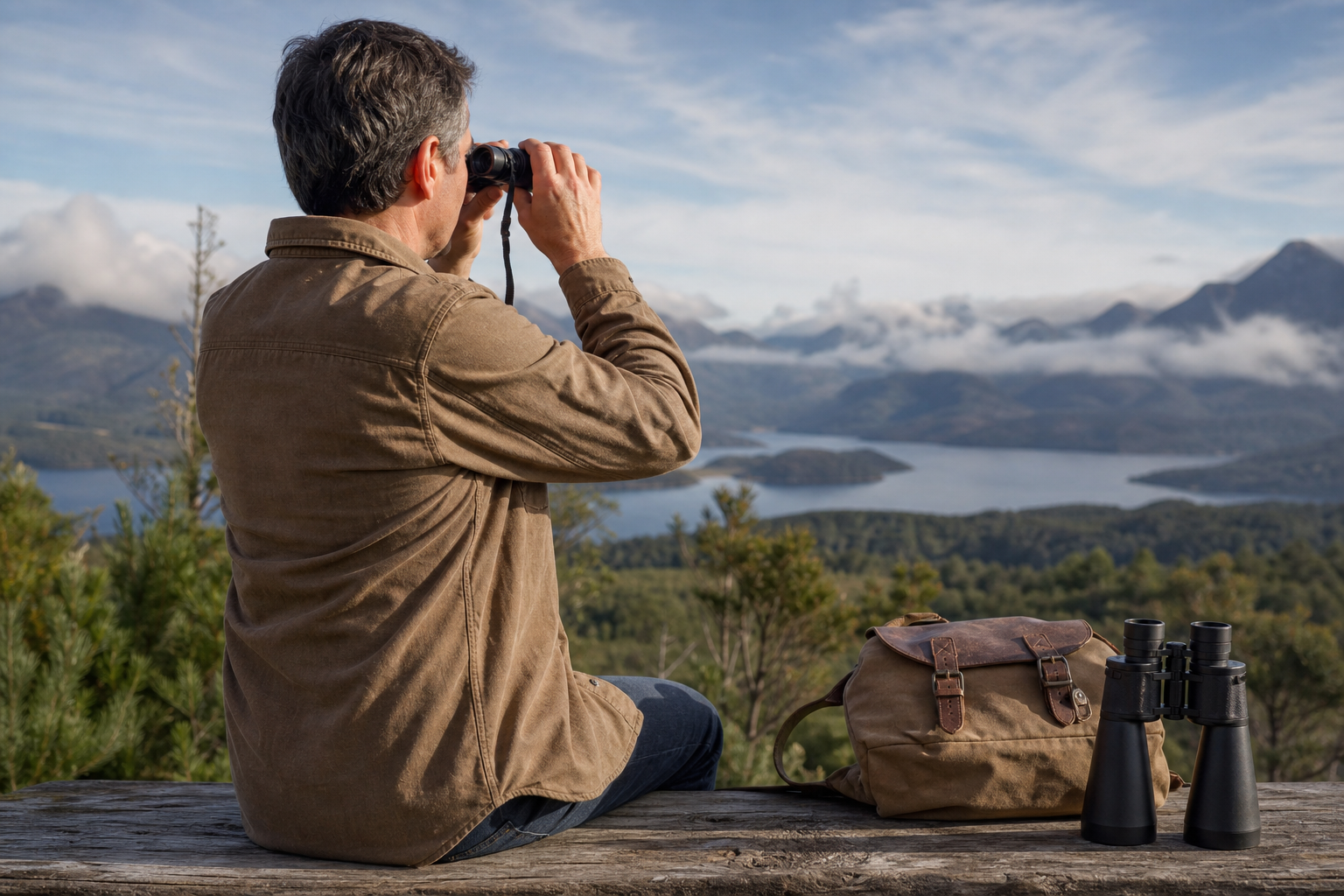
Compact binoculars are lighter, shorter, and easier to tuck into a day bag, making them the better fit for travel and casual use. Full-size binoculars are bulkier, but their larger objective lenses can deliver a brighter image, roomier handling, and a more comfortable view during extended sessions, especially in lower light.
What Matters Most
Start with the job: carrying convenience or viewing comfort?
The simplest answer is that compact binoculars are easier to carry, while full-size binoculars are often easier to use for long, detailed viewing. Compact models generally use objective lenses around 30 to 32 millimeters, while full-size models are commonly built around 40 to 45 millimeters. In a specification such as 8x30 or 8x42, the first number is magnification and the second is objective-lens diameter. ([allaboutbirds.org](https://www.allaboutbirds.org/news/how-to-choose-binoculars-full-size-compact-pocket/?utm_source=openai))
That size difference affects more than the space binoculars occupy in a bag. Larger objective lenses can gather more light and support a larger exit pupil, which may make the image feel more relaxed in dim conditions. Smaller models reduce weight and bulk, but their image can feel less forgiving if you are viewing in deep shade or near sunset. ([allaboutbirds.org](https://www.allaboutbirds.org/news/how-to-choose-binoculars-full-size-compact-pocket/?utm_source=openai))
For many people, the best compromise is an 8x32 compact or midsize design. It is small enough for travel but still substantial enough to provide a comfortable view. A good pair that you actually bring along is more useful than a larger pair that stays at home.
- Choose compact if your priority is portability, day trips, museums, travel, and casual wildlife viewing.
- Choose full-size if your priority is birding, extended observation, low-light viewing, or the largest, easiest-to-see image.
- Consider 8x32 if you want a middle ground rather than the smallest or largest format.
Which type is easier to carry?
Compact binoculars have the clear advantage when you are walking through airports, carrying a daypack, sightseeing in a city, or managing other gear. They take up less room and place less weight on your neck or shoulders. That difference becomes more noticeable after several hours rather than during a quick look.
As a real-world illustration, Nikon lists its MONARCH M7 8x30 at 16.4 ounces and 4.7 inches long, while its MONARCH M5 8x42 is listed at 22.2 ounces and 5.7 inches long. The exact difference varies by brand and construction, but the pattern is typical: full-size models tend to be heavier and longer. ([nikonusa.com](https://www.nikonusa.com/p/monarch-m5-8x42/16767/overview?utm_source=openai))
Compact binoculars also fit more easily into a coat pocket, personal item, or small travel pouch. However, the smallest models can become fiddly. Very compact housings may leave less room for your fingers, a smaller focus wheel, and less physical separation between the eyepieces. Easy to carry does not always mean easiest to adjust.
- Best for travel: compact 8x30 or 8x32.
- Best for all-day carrying with extra viewing comfort: a lightweight 8x42.
- If weight is your concern, compare actual manufacturer weights rather than relying on labels such as lightweight.
Which type is easier to use for longer sessions?
Full-size binoculars often feel easier to use once they are at your eyes. The larger body can provide a steadier grip, a roomier bridge, and a larger focus wheel. Their eyecups may also feel more substantial, which can help you settle your eyes into the viewing position without constant readjustment.
The larger lenses can make the image feel brighter and more forgiving, particularly in woodland shade, overcast weather, or the hours around sunrise and sunset. This does not mean every full-size pair will outperform every compact pair; optical quality, lens coatings, design, and focusing precision matter too. Still, a 42-millimeter objective gives manufacturers more light-gathering capacity to work with than a 30- or 32-millimeter objective. ([allaboutbirds.org](https://www.allaboutbirds.org/news/how-to-choose-binoculars-full-size-compact-pocket/?utm_source=openai))
Compact models can be just as comfortable for short sessions and are often easier for people with smaller hands or a preference for a less substantial grip. Their lower weight may also make them easier to hold up repeatedly. Try to separate two kinds of comfort: comfort while carrying the binoculars and comfort while looking through them.
- For extended viewing, check the focus-wheel position, grip width, eyecup shape, and balance.
- A heavier binocular is not automatically harder to use; some people find extra mass steadies the view.
- If full-size binoculars feel tiring around your neck, a padded strap or binocular harness can improve the experience.
Brightness, field of view, and the numbers that matter
Many shoppers focus first on magnification, but higher magnification is not automatically easier to use. Eight-power binoculars are commonly considered a practical starting point because they provide useful enlargement while remaining easier to hold steady and often offering a wider field of view than comparable 10-power models. Higher magnification also magnifies hand movement and can make it harder to find a moving subject. ([audubon.org](https://www.audubon.org/magazine/how-choose-your-binoculars?utm_source=openai))
Field of view is especially important for reading and leisure uses that involve finding a bird, watching a moving animal, following a parade, or scanning a landscape. A wider field gives you more room to locate and keep track of a subject. It can also make the view feel less tunnel-like. Nikon lists a 435-foot field of view at 1,000 yards for its MONARCH M7 8x30, compared with 335 feet for the MONARCH M5 8x42; this shows why size alone does not determine field of view. ([nikonusa.com](https://www.nikonusa.com/p/monarch-m5-8x42/16767/overview?utm_source=openai))
If you wear glasses, pay close attention to eye relief and adjustable eyecups. Longer eye relief can make it easier to see the full image without pressing the binoculars against your lenses. Audubon recommends checking whether you can see the entire field while wearing your glasses, because fit varies from face to face. ([audubon.org](https://www.audubon.org/magazine/how-choose-your-binoculars?utm_source=openai))
- Look for 8x magnification if you want an easier, steadier general-purpose view.
- Compare field of view directly; compact does not always mean wider, and full-size does not always mean narrower.
- For eyeglass wearers, prioritize usable eye relief over a compact body.
Where compact binoculars make the most sense
Compact binoculars are a strong fit for travel, sightseeing, theater and concert venues where permitted, museums with large spaces, scenic overlooks, cruises, and casual wildlife viewing. They are also practical when binoculars are one of several items competing for room in your bag.
They work particularly well when most viewing happens in daylight. A compact pair can be quick to grab, easy to pass to another person, and less tiring to carry between stops. For a traveler who might use binoculars only a few times each day, that convenience can outweigh the advantages of a larger objective lens.
The trade-off is that compact models can be less comfortable in low light and may feel cramped if you have larger hands or prefer a substantial grip. Look for a focus wheel that is easy to reach, hinge movement that feels controlled, and eyecups that adjust positively rather than sliding loosely.
- Best fit: travel, sightseeing, daytime walks, casual birding, and shared family use.
- Look for: 8x30 or 8x32, comfortable eye relief, a wide field of view, and a firm central focus wheel.
- Avoid choosing solely by folded size; the binoculars still need to fit your face and hands.
Where full-size binoculars are worth the extra bulk
Full-size binoculars make more sense when you plan to watch for long stretches or want the most comfortable image in changing light. Birdwatching, wildlife observation, outdoor events, scenic viewing from a fixed location, and stargazing can all benefit from the larger, brighter presentation of a 40- to 45-millimeter objective.
They are also a sensible choice if you want one general-purpose pair and do not mind carrying a case or strap. Full-size models are often easier to find at entry-level price points because the larger lenses can help deliver a useful image even when the optical design is not especially advanced. Cornell’s binocular guidance describes full-size models as a workhorse option, while noting that they take more room and weigh more than compact designs. ([allaboutbirds.org](https://www.allaboutbirds.org/news/how-to-choose-binoculars-full-size-compact-pocket/?utm_source=openai))
The downside is not just weight. A longer, wider body may be less convenient in crowded places, and a pair that feels fine for ten minutes may feel burdensome after a full day. If you choose full-size, compare the actual weight, strap, balance, and grip rather than assuming every 8x42 will feel the same.
- Best fit: serious birding, wildlife watching, low-light use, and long stationary sessions.
- Look for: 8x42 as a versatile starting point, generous eye relief, a smooth focus wheel, and good balance.
- Consider a harness or padded strap if you expect to carry them for hours.
Sources & editorial note
This guide is research-based and does not claim hands-on testing unless explicitly stated.
- Cornell Lab of Ornithology, All About Birds — Supports the definitions of full-size, compact, and pocket binoculars, along with trade-offs involving brightness, weight, field of view, and handling.
- Cornell Lab of Ornithology, All About Birds — Supports guidance on magnification, field of view, balance, weight, eyecups, eye relief, and trying binoculars in person.
- National Audubon Society — Supports the relationship between objective-lens size, brightness, magnification, field of view, weight, and eyeglass use.
- Nikon USA, MONARCH M7 8x30 — Provides an example of compact binocular dimensions, weight, field of view, close focus, and eye relief.
- Nikon USA, MONARCH M5 8x42 — Provides an example of full-size binocular dimensions, weight, field of view, close focus, and eye relief.