Choose a carry-on spinner if you want effortless rolling, easy access to a neatly organized suitcase, and a stable bag for business or longer trips. Choose a travel backpack if you value hands-free movement, flexible storage, and the ability to keep your bag close through stairs, shuttle rides, older terminals, and uneven sidewalks.
What Matters Most
Start with the airport job you want the bag to do
If your priority is covering distance with the least effort, a carry-on spinner has a clear advantage. Four wheels let you roll the bag beside you or push it in front of you, which can feel easier than carrying a loaded backpack from the parking garage to the gate. A spinner also stands upright when you pause to check a boarding pass, refill a water bottle, or wait in line.
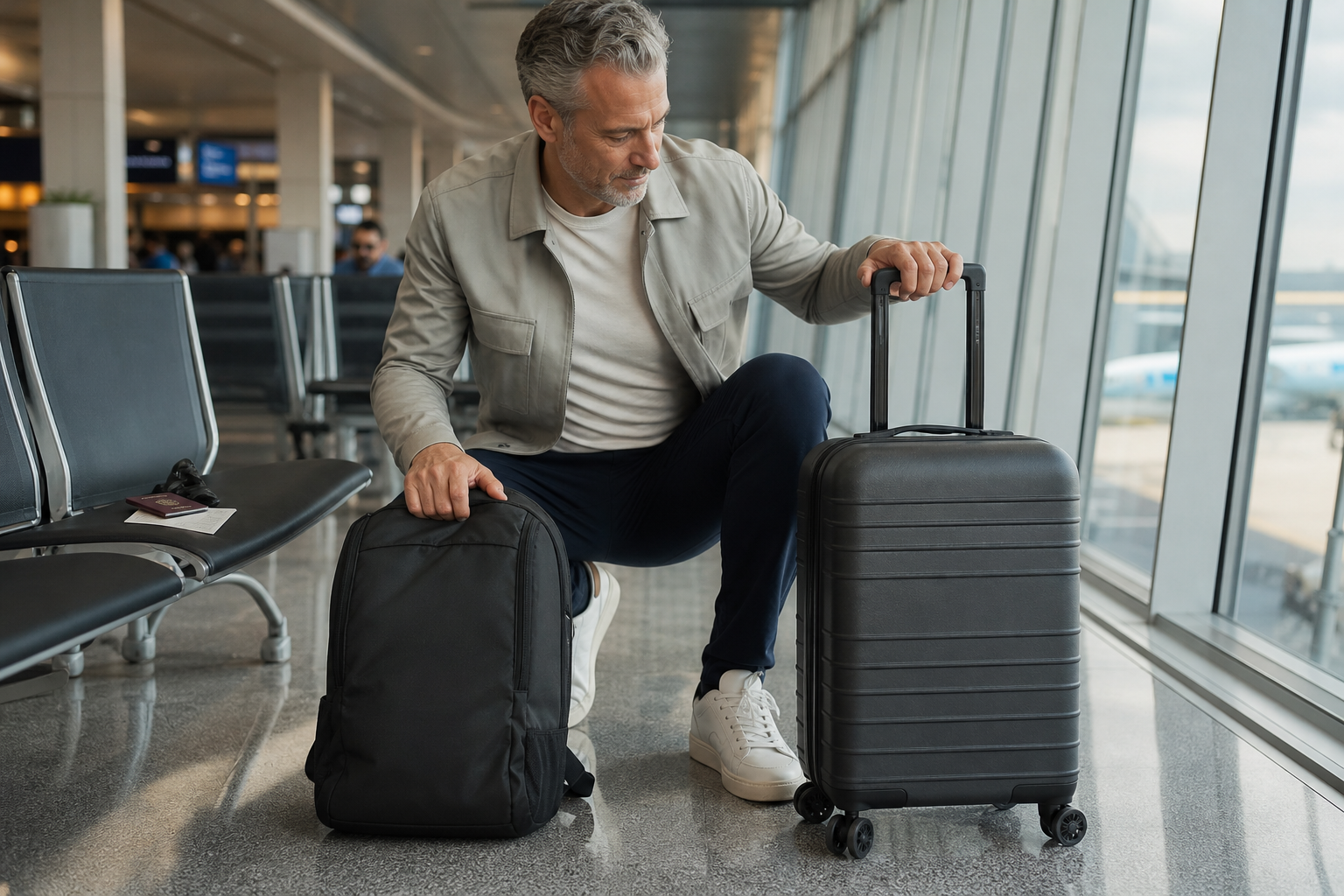
If your priority is staying mobile in unpredictable spaces, a travel backpack often feels simpler. It leaves both hands free for a phone, coffee, jacket, or handrail, and it does not need a clear lane beside you. That matters in crowded boarding areas, narrow aircraft aisles, shuttle buses, and terminals with stairs or broken pavement.
Neither style eliminates airport friction. A spinner can become awkward when you must lift it, while a backpack can become tiring when it is heavily packed. The right choice depends on how often you roll, lift, carry, open, and repack your bag during a typical trip.
- Best for smooth, predictable movement: carry-on spinner
- Best for hands-free movement and mixed terrain: travel backpack
Where a carry-on spinner makes airports easier
A spinner is the more comfortable choice for travelers who want to avoid carrying a substantial load on their back. On a long terminal walk, rolling can conserve energy, especially when the bag is packed with shoes, toiletries, a laptop, or several days of clothing. The upright design also makes it easier to see what you have packed without emptying the whole bag.
The rigid or semi-rigid structure gives clothing a defined home. Packing cubes fit neatly, folded garments are less likely to collapse into a soft pile, and delicate items may have more protection from being squeezed. Many spinners also open like a suitcase, which can be more convenient in a hotel room than digging through a top-loading backpack.
The trade-off is that four-wheel spinners need space to roll. They can catch on carpet edges, floor transitions, escalator grooves, and rough sidewalks. You may also need to pull the bag behind you or lift it over curbs, into a car trunk, onto a train, or into an overhead bin. Wheels and a telescoping handle add moving parts and reduce some interior capacity compared with a similarly sized soft bag.
- Choose a spinner for longer airport walks, structured packing, formal clothing, or a laptop-heavy load.
- Look for a handle that feels stable at different heights, wheels that roll smoothly, and a compact exterior that includes wheels and handles in its measurements.
Where a travel backpack makes airports easier
A travel backpack earns its advantage when the route is not perfectly smooth. You can carry it up stairs, across a hotel courtyard, through a crowded security queue, or onto public transportation without steering around other travelers. A backpack also keeps your hands available, which is useful when you are managing documents, a coat, a phone, or a companion’s belongings.
Soft-sided construction can make a backpack more forgiving when the overhead bin is tight. It may compress slightly, fit into irregular spaces, or accommodate an extra layer that would not fit inside a rigid case. Exterior pockets can also provide quick access to a passport, charging cable, water bottle, or reading glasses.
The main drawback is load transfer. A backpack that feels fine when empty can become uncomfortable when fully packed, especially if the shoulder straps are narrow, the back panel lacks structure, or the weight sits away from your body. Overstuffing can also turn the bag into a difficult security item: items may be hard to remove, and the bag may not fit under a seat even if it is marketed as a personal item.
- Choose a backpack for stairs, transit connections, uneven ground, hands-free travel, or shorter trips with lighter packing.
- Look for padded shoulder straps, a sternum strap, a supportive back panel, lockable zippers, and a wide opening that lets you pack it like a suitcase.
Airline size rules can change the better choice
The bag style matters less than whether the finished, packed bag fits your airline’s limits. American Airlines lists a maximum carry-on size of 22 by 14 by 9 inches, including wheels and handles. Delta lists the same maximum dimensions and notes that gate staff may restrict carry-ons when storage is limited. Southwest lists a larger carry-on limit of 24 by 16 by 10 inches, but partner-airline rules can differ.
That variation is important for both categories. A large spinner may technically be sold as a carry-on but exceed a particular airline’s sizer once the wheels, handle, and outer pockets are included. A soft backpack may compress, but a packed bag that bulges beyond its stated dimensions can still be refused or gate-checked.
Aircraft also matter. Regional planes and smaller aircraft may have less overhead space, and some flights may require larger carry-ons to be tagged at the gate. Before buying, check the airline operating each flight—not only the airline shown on your booking—and measure the bag as packed.
- For a conservative U.S. carry-on target, start by comparing bags against 22 by 14 by 9 inches.
- For a backpack intended as a personal item, verify the airline’s under-seat dimensions separately; a carry-on backpack and a personal-item backpack are not the same size.
Security, access, and gate-check trade-offs
At TSA screening, organization matters more than whether the bag has wheels. TSA advises travelers to keep carry-ons uncluttered and place the 3-1-1 liquids bag where it is easy to remove. A spinner’s suitcase-style opening can make this straightforward, while a backpack can work just as well if liquids, electronics, and layers are packed in accessible compartments.
A backpack may be easier to keep close when overhead bins are full, but only if it fits under the seat or meets the airline’s personal-item rules. A full-size travel backpack is still an overhead carry-on. A spinner can also be gate-checked when bins fill, so keep valuables, fragile items, spare batteries, and important documents in a smaller personal item.
For either bag, separate items you may need during the flight before boarding. A compact personal item can hold your passport, medication or other essential personal items, laptop, headphones, charger, and a change of clothes. This makes a gate check less disruptive and keeps you from reopening the main bag in the boarding line.
- Pack liquids and electronics near an opening or pocket you can reach quickly.
- Do not assume a soft bag will avoid gate-checking if it is too large or the overhead compartments are full.
Which one fits your travel pattern?
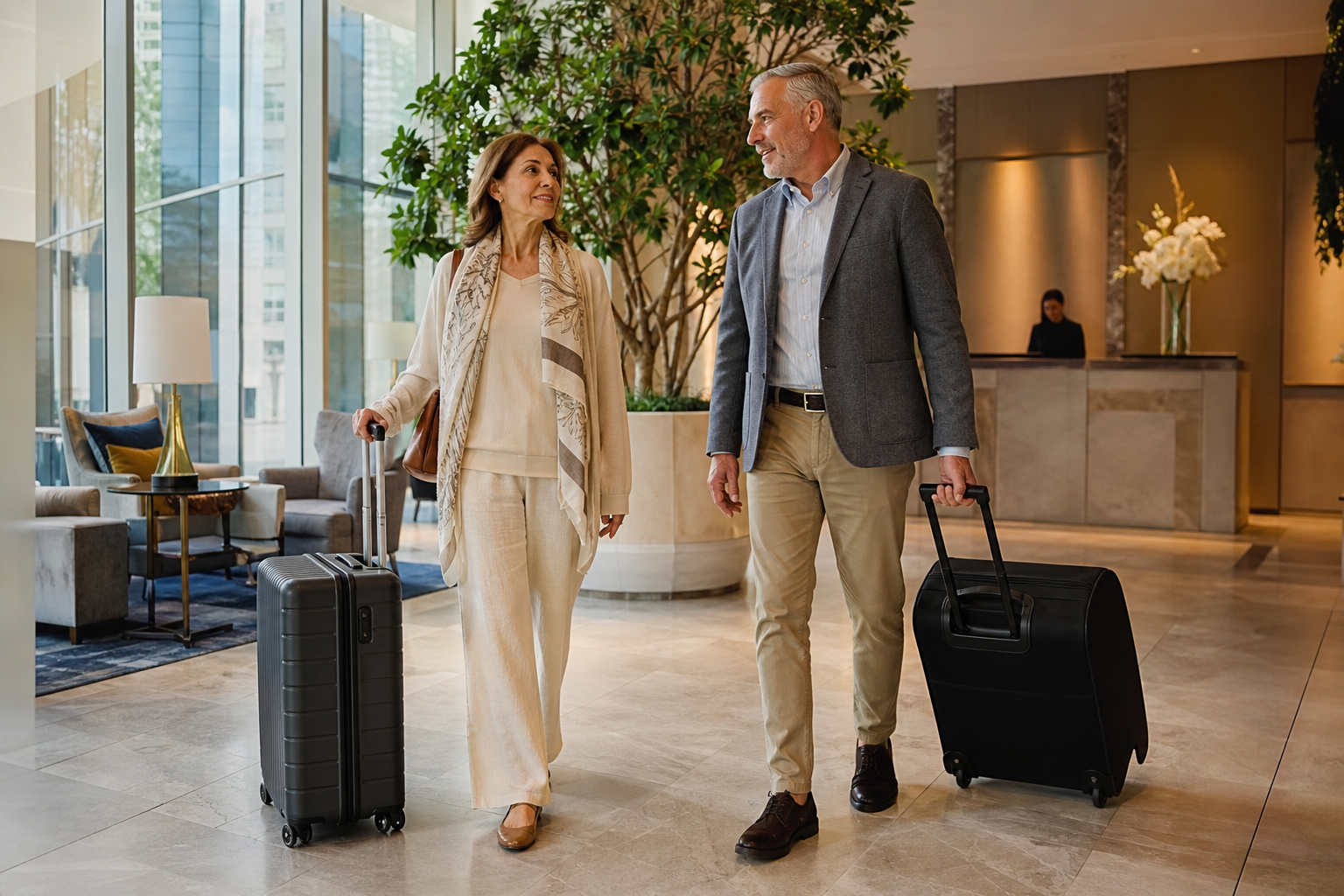
A carry-on spinner is the stronger fit for business trips, four- to seven-day stays, formal clothing, heavier packing, or itineraries built around airports, taxis, and paved hotel entrances. It is also a sensible choice if you strongly prefer not to carry weight on your shoulders. A two-wheel roller may be worth considering if you frequently cross uneven ground, since it can be pulled over surfaces that make small spinner wheels struggle.
A travel backpack is the better fit for minimalist packers, train-and-bus itineraries, city breaks, older buildings without elevators, and trips where you expect to change direction often. It is particularly useful when your route includes stairs, cobblestones, crowded public transit, or long periods standing with your bag.
If you move between both types of travel, consider a hybrid approach: a compact travel backpack as your personal item paired with a spinner when you need more capacity, or a backpack-style carry-on with tuck-away straps for occasional hands-free carrying. The goal is not to find one universal winner. It is to avoid paying for features you will not use while making the most tiring parts of your trip easier.
- Pick the spinner when rolling distance and packing structure matter most.
- Pick the backpack when terrain, stairs, flexibility, and hands-free movement matter most.
- Choose a hybrid only if you will actually use both carrying modes; extra hardware can add weight and bulk.
Buying checklist: test the bag before the trip
Measure the exterior, not just the main compartment. Include wheels, handles, compression panels, protruding pockets, and anything that expands. Then compare those dimensions with the strictest airline on your usual routes. If you fly several carriers, choosing a bag that fits the smallest allowance gives you more flexibility.
For a spinner, check whether the handle wobbles, whether the wheels roll smoothly in multiple directions, and whether the case remains stable when lightly packed. Open it on a bed or floor and see whether the layout suits your clothing, shoes, toiletries, and electronics. A structured interior is useful only if it matches how you pack.
For a backpack, load it with the weight you would actually carry and walk around for several minutes. Adjust the straps, check whether the bag pulls backward, and see whether the laptop sleeve or main compartment remains accessible when the bag is full. In either style, prioritize a comfortable personal item because it becomes your backup if the main bag is gate-checked.
- Measure the packed bag at home before the first flight.
- Leave room for expansion only if the expanded dimensions still comply with your airline.
- Keep a small personal item ready for documents, electronics, valuables, and in-flight essentials.
Sources & editorial note
This guide is research-based and does not claim hands-on testing unless explicitly stated.
- American Airlines carry-on baggage — Supports American Airlines carry-on and personal-item dimensions, including wheels and handles, plus possible restrictions on regional aircraft.
- Delta Air Lines baggage FAQs — Supports Delta's 22 by 14 by 9 inch carry-on limit, one carry-on plus one personal item, and possible limits when overhead storage is constrained.
- Southwest Airlines carry-on baggage policy — Supports Southwest's listed 24 by 16 by 10 inch carry-on size limit and the reminder that partner-airline rules may differ.
- Transportation Security Administration travel tips — Supports the 3-1-1 liquids rule, organizing carry-on bags for screening, and guidance on medication and prohibited items.
- Transportation Security Administration travel checklist — Supports packing liquids and large electronics where they are accessible during security screening.