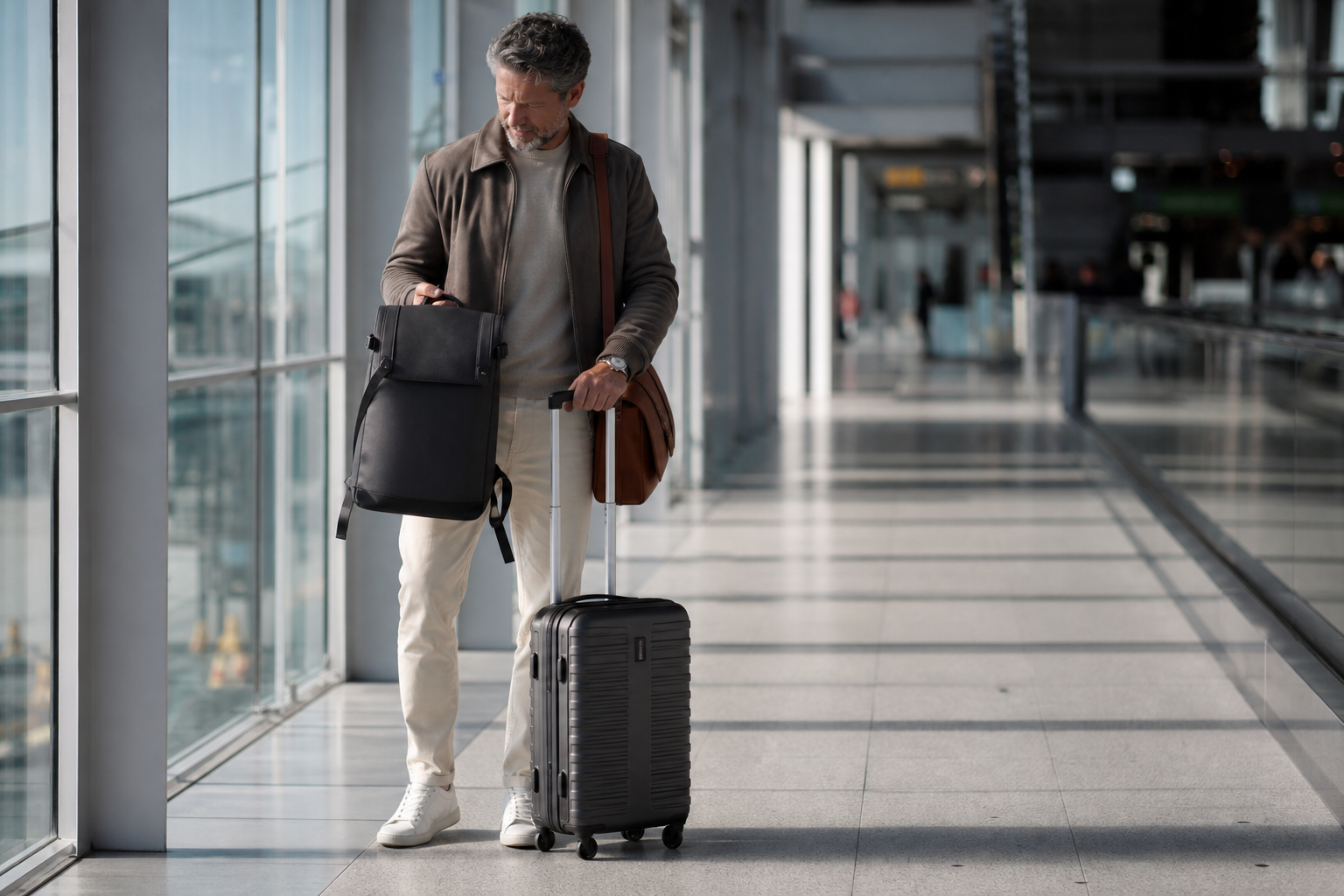
Choose a carry-on backpack if your trip involves stairs, public transportation, uneven pavement, frequent hotel changes, or keeping your hands free. Choose a rolling carry-on if you will walk mostly on smooth surfaces, pack heavier clothing or structured items, or prefer not to carry the bag on your shoulders. Either style can work as an airline carry-on, but dimensions include wheels and handles, and airline rules can vary.
What Matters Most
Start With the Job Your Carry-On Needs to Do
Before comparing pockets, wheels, or laptop sleeves, map the movement your bag will handle. A direct airport-to-hotel trip on elevators and smooth sidewalks favors a rolling carry-on. A multi-stop itinerary with train platforms, staircases, narrow aisles, or long walks between lodging and transit favors a backpack because you can keep moving without dragging a bag behind you.
The decision also depends on what “easy” means to you. A backpack is easier when maneuverability and hands-free movement matter most. A roller is easier when reducing shoulder and hand strain matters most. Neither option eliminates effort: a backpack transfers the load to your body, while a roller requires lifting it into an overhead bin, over curbs, and sometimes up stairs.
For many travelers, the best answer is not the lightest empty bag but the bag that stays manageable when fully packed. A lightweight backpack can become uncomfortable if it lacks a supportive frame or if dense items sit far from your back. A lightweight roller can feel awkward if its wheels, handle, or base are flimsy. Look at the loaded experience, not just the advertised empty weight.
- Best for a backpack: movement, stairs, crowded spaces, and hands-free travel.
- Best for a roller: smooth routes, heavier loads, structured packing, and minimizing shoulder carry.
- Key test: imagine carrying or pulling the bag for 20 minutes, not just lifting it from a car.
Where a Carry-On Backpack Is Easier
A carry-on backpack is usually the more adaptable choice when the route includes uneven ground or frequent transitions. You can carry it over cobblestones, gravel, grass, curbs, and staircases without stopping to maneuver wheels. It also keeps both hands available for a phone, passport, coffee, railings, or a smaller personal item.
Backpacks are useful when you expect to change locations often. Moving from an airport to a train, then from a station to a rental apartment, is less dependent on smooth flooring. A backpack can also be easier in tight hotel corridors, older buildings without elevators, and crowded public transportation where a rolling bag takes up floor space or catches on people and furniture.
The trade-off is that the weight stays on your body. Shoulder straps, a sternum strap, a padded back panel, and a hip belt can improve comfort, but they do not make a heavy load disappear. A backpack also tends to be less convenient when you need to remove a sweater, shoes, or electronics quickly unless it opens broadly like a suitcase.
- Look for a wide-opening main compartment if you dislike digging through top-loading bags.
- Check whether the shoulder straps can be stowed so they do not snag during transit.
- A firm back panel can improve organization but may add bulk and empty weight.
- Avoid overpacking simply because the backpack still has unused space.
Where a Rolling Carry-On Is Easier
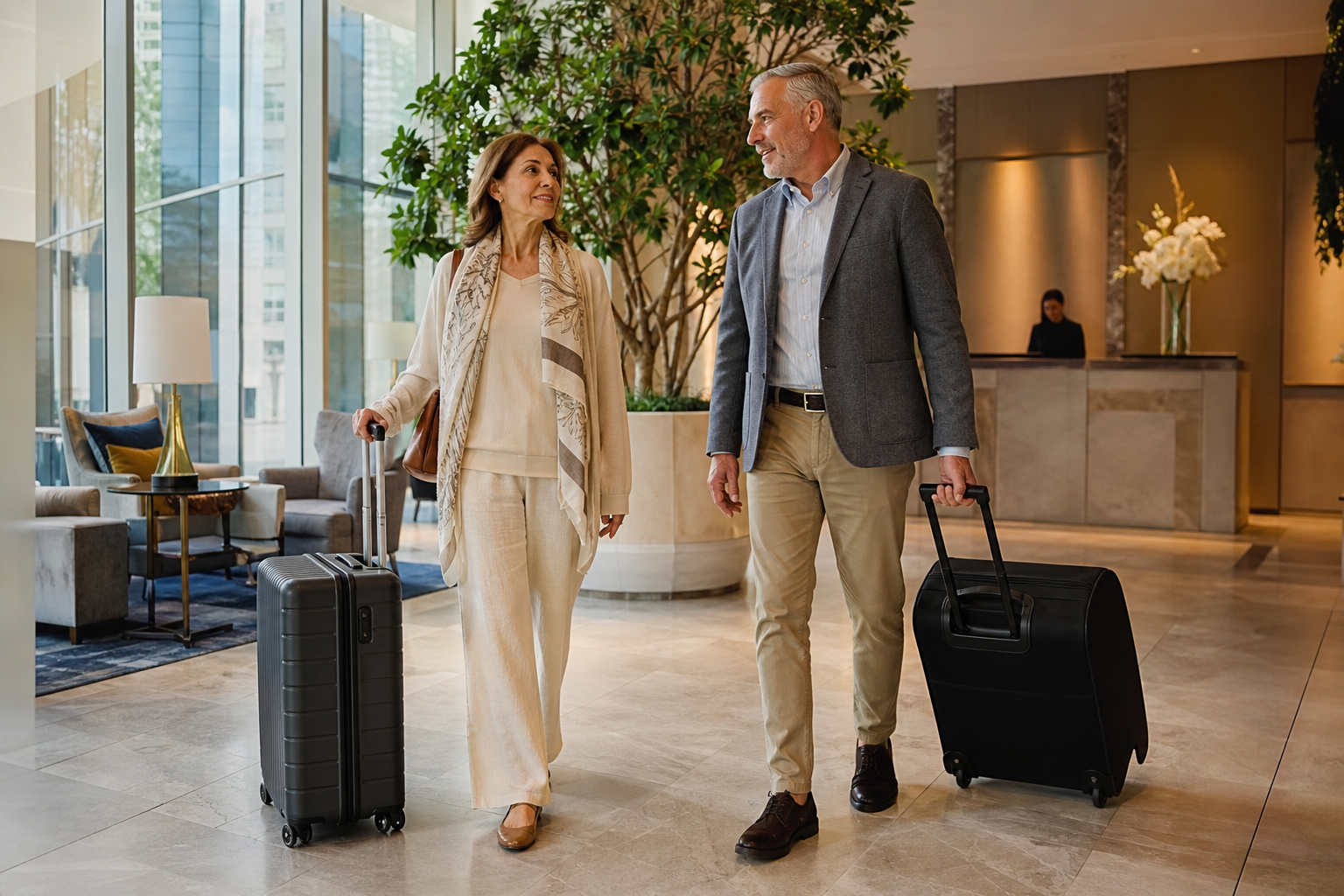
A rolling carry-on is often the more comfortable choice for a dense or structured load. Clothes, shoes, toiletries, books, and work equipment can be arranged in compartments or packing cubes without placing the entire weight on your shoulders. On smooth airport floors, a good roller can be moved with relatively little physical effort.
The suitcase format also makes packing and unpacking more predictable. A clamshell opening gives you two distinct sides, while compression panels or tie-down straps can keep clothing contained. That structure is useful if you want to separate clean clothes from shoes, keep a jacket accessible, or unpack into a hotel drawer without emptying the entire bag.
The disadvantages appear when the route stops being smooth. Wheels can be awkward on broken sidewalks, stairs, soft ground, and narrow passages. You will also need to lift the bag at curbs, onto trains, into vehicle trunks, and into the aircraft’s overhead bin. A roller may be easier to pull for 15 minutes but harder to lift repeatedly.
- Two-wheel rollers can be easier on some uneven surfaces but require more tilted pulling space.
- Four-wheel spinners maneuver well in airports but may roll away on slopes and can be less stable on rough ground.
- Check handle height and grip comfort; a short or wobbly handle changes the pulling experience.
- A protective frame and wheels can reduce usable interior space and increase empty weight.
Airline Fit: The Bag’s Shape Matters More Than Its Label
Airlines generally care about the bag’s exterior dimensions, not whether it is called a backpack or a suitcase. For example, Delta and American list a maximum carry-on size of 22 by 14 by 9 inches, including wheels and handles. The exact allowance can differ by airline, aircraft, fare, route, or operating carrier, so check the policy for the specific flight before buying or packing. ([delta.com](https://www.delta.com/us/en/baggage/carry-on-baggage?utm_source=openai))
A soft backpack may compress into a sizer when it is not full, but that is not a reason to exceed the stated dimensions. A fully packed backpack can become wider or deeper than expected, especially when front pockets are filled. A roller has more obvious fixed dimensions, but its wheels and telescoping handle count toward the outside measurement. ([delta.com](https://www.delta.com/us/en/baggage/carry-on-baggage?utm_source=openai))
Also distinguish between a carry-on and a personal item. A personal item must fit under the seat, and the permitted dimensions may be considerably smaller than the overhead-bin allowance. American, for example, lists 18 by 14 by 8 inches for a personal item. Some smaller aircraft or regional flights may have limited overhead space and may require larger bags to be gate-checked. ([delta.com](https://www.delta.com/us/en/baggage/carry-on-baggage?utm_source=openai))
Security access is another practical consideration. TSA advises organizing carry-on contents so screening is easier and placing the quart-size liquids bag where it can be reached. A backpack with a crowded front panel can be frustrating if liquids or electronics are buried; a clamshell roller can be easier to open and repack, though both styles work when organized. ([tsa.gov](https://www.tsa.gov/news/press/factsheets/tsa-travel-tips?utm_source=openai))
- Measure the packed bag, including wheels, handles, bulging pockets, and compression.
- Check both the operating airline and the aircraft if your itinerary includes a connection.
- Do not assume a soft-sided bag is automatically acceptable if it exceeds the published size.
- Keep liquids and frequently screened electronics easy to reach.
Packing Capacity, Access, and Everyday Convenience
Backpacks make it easy to use every inch of flexible space, but that flexibility can make packing less orderly. A wide-opening travel backpack with compression straps can provide suitcase-style access while retaining backpack mobility. A top-loading hiking-style pack may carry comfortably, but it is slower to unpack and less convenient when you need one item near the bottom.
Rolling carry-ons usually make it easier to separate categories and protect items that should not be crushed. They are a good fit for travelers who pack shoes, folded garments, business clothing, cameras, or other items that benefit from a stable interior. The structure can also make the bag stand upright and easier to live out of during a hotel stay.
External pockets are useful in either format, but they add a temptation to fill the bag beyond its comfortable or airline-compliant shape. Use them for flat, lightweight items such as documents or a jacket rather than dense objects that pull a backpack backward or make a roller front-heavy. A simple packing cube system can improve either style without requiring a particular bag design.
- Backpack priority: supportive harness, broad opening, compression, and breathable contact points.
- Roller priority: smooth wheels, stable handle, durable corners, and usable interior dimensions.
- For either style, confirm that a laptop sleeve fits your device and does not steal too much main-compartment space.
The Practical Verdict: Match the Bag to the Trip
Choose a carry-on backpack when the itinerary is mobile and the ground is unpredictable. It is the better fit for city-hopping, rail travel, older buildings, outdoor transitions, and travelers who value free hands more than a fully structured interior. Keep the packed weight realistic, because the convenience disappears if the bag becomes uncomfortable after a short walk.
Choose a rolling carry-on when most movement happens on smooth floors and you prefer to avoid carrying weight on your back. It is especially sensible for airport-heavy trips, longer stays in one hotel, organized packing, and loads that include shoes, work equipment, or clothing that benefits from structure. Be prepared to lift it more often than you expect.
If you are still undecided, picture the most difficult 10 minutes of the trip rather than the easiest 10 minutes at the airport. If those 10 minutes involve stairs, rough pavement, or crowded transit, select the backpack. If they involve a heavier load and repeated lifting would be the bigger problem, select the roller. The easier bag is the one that solves the trip’s hardest movement problem.
- Backpack verdict: easier for mobility and varied terrain.
- Rolling carry-on verdict: easier for heavier, more structured loads on smooth routes.
- Hybrid option: a backpack with a trolley sleeve can work with a separate roller, but it may add cost, weight, and complexity.
Sources & editorial note
This guide is research-based and does not claim hands-on testing unless explicitly stated.
- Delta Air Lines — Carry-On Baggage — Supports the example 22 x 14 x 9 inch carry-on dimensions, inclusion of wheels and handles, personal-item allowance, and possible restrictions on smaller regional aircraft.
- American Airlines — Carry-On Bags and Size Limits — Supports the example carry-on and personal-item dimensions and the requirement that bags fit the overhead bin, under-seat space, or airport sizer.
- Transportation Security Administration — Travel Tips — Supports the TSA 3-1-1 liquids rule and general carry-on screening guidance.
- Transportation Security Administration — Travel Checklist — Supports advice to keep liquids and large electronics accessible and organize carry-on contents for screening.