Choose a book light if you read in bed, share the room, travel often, or want to keep light off the walls and away from a sleeping partner. Choose a bedside lamp if you read for long stretches, switch between books and other tasks, want wider illumination, or prefer a light you can use without attaching anything to the book. For many readers, the most flexible setup is a warm, dimmable bedside lamp paired with a small book light for particularly quiet nights.
What Matters Most
Start with the job: illuminate the page or the whole reading space?
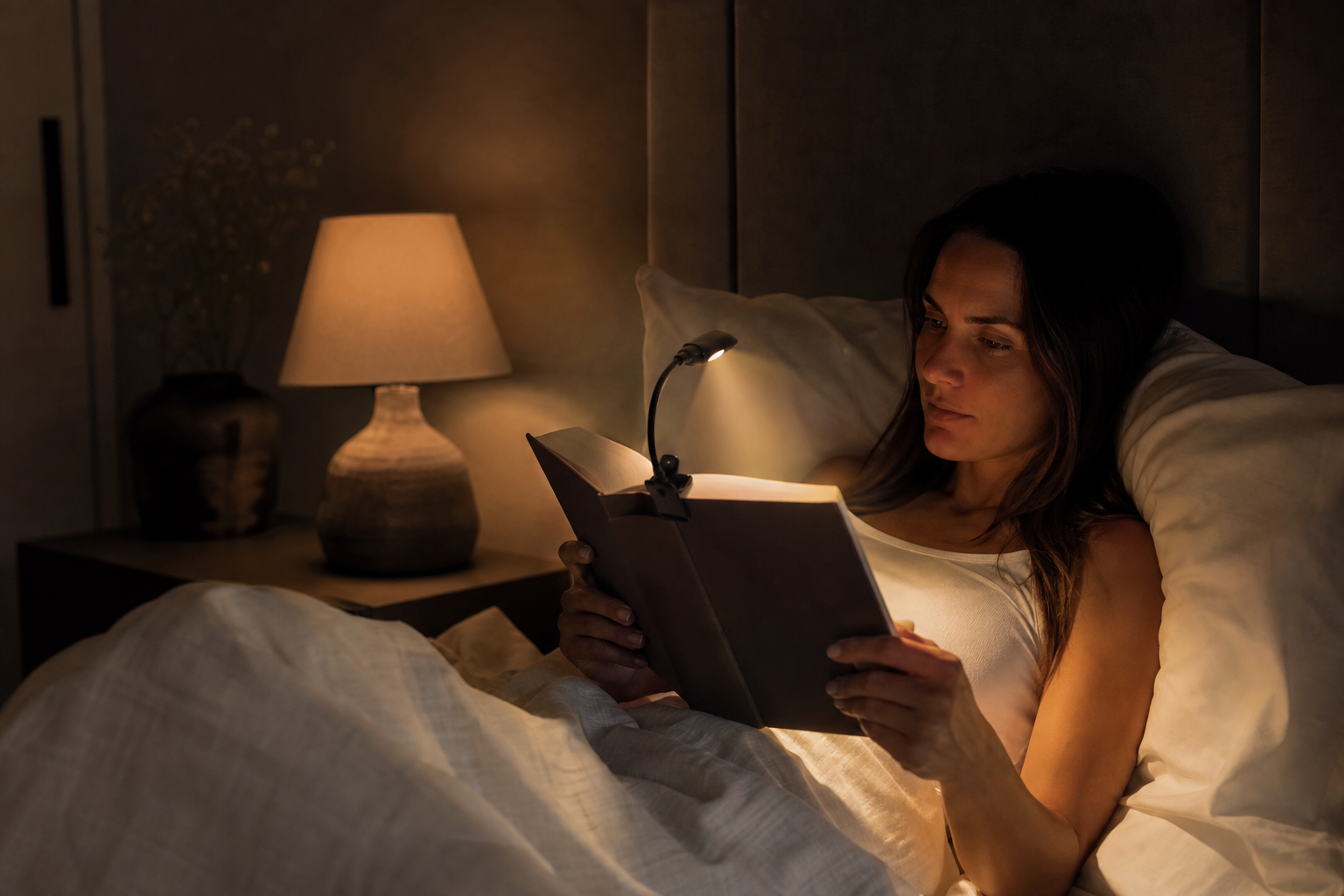
A book light is designed to create a compact, personal beam. Clip-on models attach to a cover or e-reader, while neck lights sit around your shoulders and aim light downward. The main advantage is control: you can direct the light toward the page without lighting the entire bedroom. Many current book lights also offer several brightness levels, multiple color settings, and rechargeable operation, although features vary by model. ([glocusent.com](https://glocusent.com/products/glocusent-upgraded-bookmark-style-reading-light?utm_source=openai))
A bedside lamp does a broader job. It can provide reading light, help you find a glass of water, illuminate a nightstand, and make the room easier to navigate. A directional reading lamp can still put useful light on the page, but its beam usually spreads farther than a book light. That wider coverage is helpful when you read large-format books or dislike the feeling of reading inside a narrow spotlight.
The direct answer is simple: a book light is better for private, low-disruption reading; a bedside lamp is better for an all-purpose reading environment. The right choice depends less on which product is technically brighter and more on how much of the room you want illuminated.
- Book light: focused, portable, discreet, and usually better for shared bedrooms.
- Bedside lamp: wider, easier to use, more decorative, and more useful beyond reading.
Book light advantages: quiet, portable, and easy to aim
The strongest reason to buy a book light is that it keeps your reading light personal. A well-aimed clip light can illuminate one or both pages while limiting spill onto the headboard, ceiling, or the other side of the bed. That makes it a practical option when two people have different sleep schedules or when you want to read without turning the bedroom into a bright space.
Portability is another clear advantage. A rechargeable book light can move from the bed to a travel bag, sofa, reading chair, or airplane seat. Some models are small enough to keep inside a book or nightstand drawer. Neck-style lights can also make sense when you read awkwardly positioned books, use a tablet, knit, follow a recipe, or need both hands free.
The trade-off is that a small light has less margin for error. If the clip slips, the flexible arm droops, or the beam is too narrow, you may spend more time repositioning it. A clip can also feel awkward on a thin paperback, a thick hardcover, or a protective e-reader case. Look for a secure grip, stable arm, simple controls, and enough beam width to cover your usual page size.
- Best for: shared bedrooms, travel, occasional reading, and readers who want minimal room light.
- Check before buying: clip strength, arm stability, charging method, battery information, and page coverage.
Bedside lamp advantages: comfort, coverage, and everyday usefulness
A bedside lamp is often the more comfortable choice for long reading sessions because it does not add weight to the book or require a clip to stay in place. A lamp with an adjustable head or shade can direct light toward the page, while a diffuser or fabric shade can soften the overall effect. Some reading lamps are wall-mounted or floor-standing, which can free up space on a small nightstand.
A lamp also gives you more flexibility with brightness. Light output is measured in lumens rather than watts, so compare lumen information when you can instead of relying on wattage alone. ENERGY STAR lists 800 lumens as a typical minimum comparison for an old 60-watt incandescent bulb, but a night-reading setup may use much less depending on shade design, distance, page size, and personal preference. ([energystar.gov](https://www.energystar.gov/products/learn-about-brightness?utm_source=openai))
The main drawback is spill light. Even a well-shaded lamp can brighten the room more than a book light, and a bare bulb or poorly aimed lamp may create glare on glossy pages. A bedside lamp also needs a stable surface, a nearby outlet or cable, and enough clearance from bedding. It is less convenient if you regularly read away from home.
- Best for: long reading sessions, large books, reading chairs, and people who want one light for several bedside tasks.
- Look for: a dimmer, adjustable direction, a shade that controls glare, and a switch you can reach easily.
Warm light, brightness, and glare matter more than the category
For night reading, a warm setting is a common starting point because lower color-temperature light appears more yellow and less blue-white. ENERGY STAR describes approximately 2700K to 3000K as warmer light, while higher Kelvin values look progressively cooler or bluer. A 2700K lamp or book light can create a relaxed bedroom atmosphere; a neutral setting around 3500K to 4000K may look crisper if you prefer stronger page contrast. ([energystar.gov](https://www.energystar.gov/products/light_fixtures?utm_source=openai))
There is no single best setting for every reader or every book. Warm light may feel more inviting for novels and bedtime reading, while a clearer neutral-white setting can be useful for small print, reference books, magazines, or note-taking. If you are unsure, adjustable color temperature gives you more room to experiment than a fixed-color light.
Dimming is just as important as color. Start with the lowest level that makes the words clear, then increase gradually. Avoid placing a bright reading light in an otherwise completely dark room if that contrast feels uncomfortable; a low-level ambient source can make the overall space feel more balanced. IKEA recommends combining general, task, and mood lighting, while Philips Hue similarly describes layered lighting as a way to reduce harsh contrast around a reading area. ([ikea.com](https://www.ikea.com/us/en/rooms/bedroom/how-to/bedroom-lighting-ideas-how-to-set-any-mood-pxmed03e700a3a511eca0f0b9d3c4aa5e1f/?utm_source=openai))
- Warm option: roughly 2700K to 3000K for a softer, yellow-toned appearance.
- More flexible option: adjustable color temperature and dimming, especially if you read different kinds of material.
Which one fits your routine?
Choose a book light if your priority is keeping the room dark, you share a bed, you travel, or you read in several locations. It is also the easier choice when you do not have room for a lamp or when your nightstand is already crowded. A rechargeable model can simplify placement, but check how it charges and whether the controls are easy to operate by feel in a dark room.
Choose a bedside lamp if you want a more permanent reading setup, prefer to keep both hands free, or move between a paperback, a large hardcover, and an e-reader. A directional, dimmable lamp is particularly useful beside a reading chair or bed. If the lamp will also function as general bedroom lighting, choose a shade and brightness range that work for more than just the page.
Consider a combination if your needs change. A warm, dimmable bedside lamp can provide comfortable ambient and task light on ordinary nights, while a small book light can handle late reading when someone else is sleeping. That approach costs more and adds another device, but it separates the jobs instead of asking one light to do everything.
- Pick a book light for privacy and portability.
- Pick a bedside lamp for comfort and versatility.
- Pick both if your reading habits change between ordinary evenings and shared-room nights.
What to check before you buy
For a book light, prioritize the physical design before chasing the highest brightness number. The clip should hold your typical book without damaging the cover, the arm should stay where you place it, and the light should spread evenly enough to cover the page. Adjustable brightness is usually more useful than a very bright single setting, especially in a dark bedroom.
For a bedside lamp, confirm whether dimming requires a compatible bulb, an included control, or a separate dimmer. Some lamps accept replaceable bulbs, while others use an integrated LED. Replaceable bulbs make it easier to change brightness or color temperature later; integrated LEDs can simplify the design but may give you fewer upgrade options. IKEA, for example, identifies whether particular reading lamps require dimmable bulbs and whether the light head can be directed. ([ikea.com](https://www.ikea.com/us/en/p/nymane-wall-reading-lamp-white-20356990/?utm_source=openai))
Finally, think about controls and placement. A hard-to-reach switch, a touch control that activates accidentally, or a lamp that throws light directly into your eyes can make a promising setup frustrating. The best reading light is the one you can position quickly, dim easily, and leave ready for the next chapter.
- Book light checklist: secure clip, stable arm, even beam, adjustable brightness, practical charging.
- Bedside lamp checklist: dimmable setup, directed shade or head, warm bulb option, reachable switch, stable base.
Sources & editorial note
This guide is research-based and does not claim hands-on testing unless explicitly stated.
- ENERGY STAR — Learn About Brightness — Supports the distinction between lumens and watts and provides common lumen comparisons.
- ENERGY STAR — Light Fixtures — Supports explanations of Kelvin color temperature and warmer versus cooler light.
- IKEA — Bedroom Lighting Ideas — Supports layered bedroom lighting and the role of focused reading lamps.
- IKEA — NYMÅNE Wall/Reading Lamp — Supports examples of adjustable, directed, dimmable bedside reading lamps and bulb compatibility.
- Glocusent — Upgraded Bookmark Style Reading Light — Supports category examples of clip-style book lights with adjustable brightness, color temperature, and rechargeable operation.
- Philips Hue — Best Light for Reading — Supports the use of layered lighting, warm settings, and positioning light toward the page.