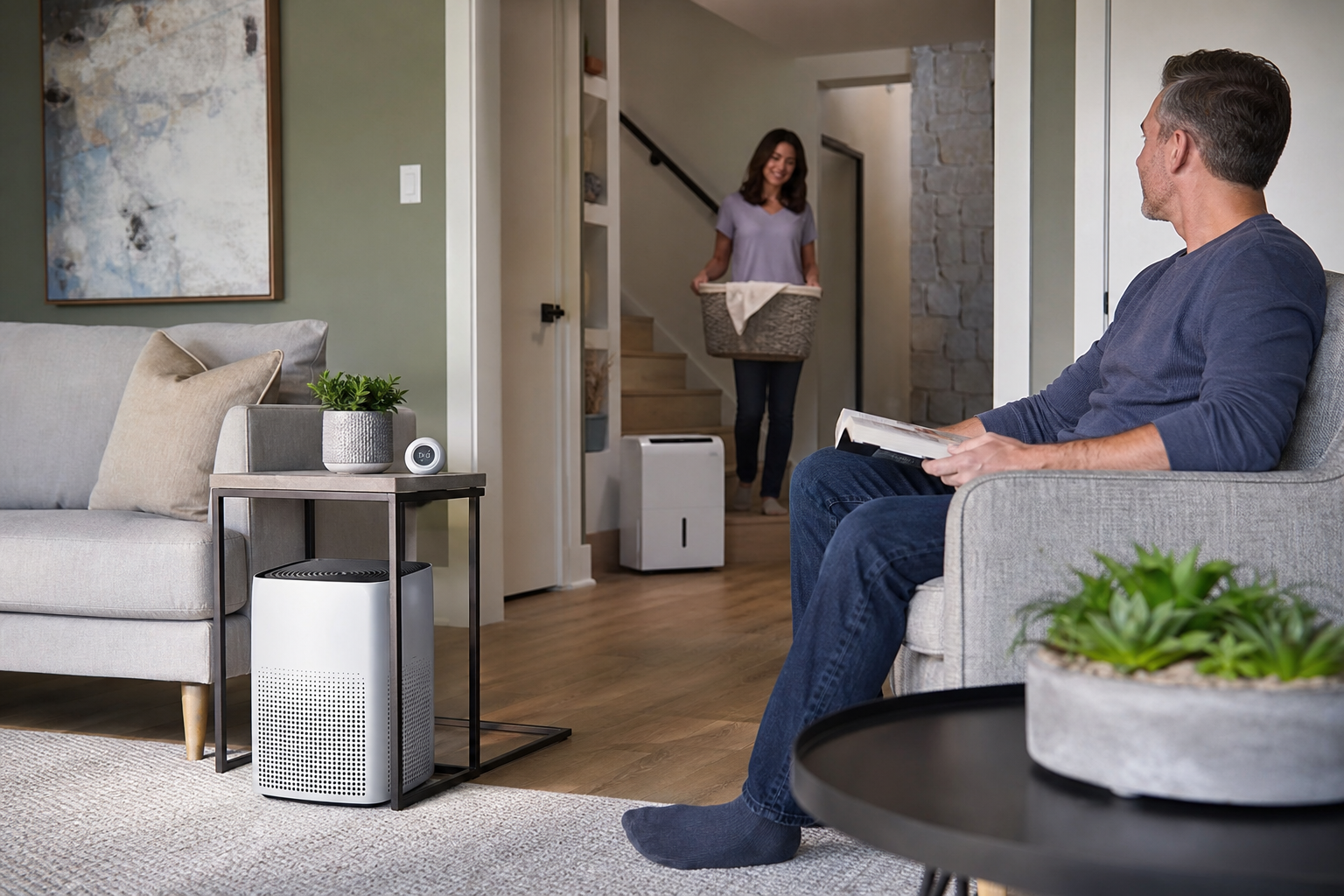
Choose an air purifier for dust, pollen, smoke, and other airborne particles. Choose a dehumidifier for damp rooms, condensation, musty odors linked to moisture, and indoor humidity that stays too high; if you have both problems, using both appliances may make sense.
What Matters Most
Start with the problem, not the appliance
The simplest distinction is this: an air purifier changes what is suspended in the air, while a dehumidifier changes how much water vapor is in the air. Neither is a universal fix for every indoor-comfort complaint.
An air purifier pulls room air through a filter or other cleaning technology. Depending on the design, it can reduce airborne particles such as dust, pollen, smoke, and fine particulate matter. Portable models are generally intended for one room or defined area, not automatic whole-home coverage.
A dehumidifier draws in humid air, condenses some of its moisture, and collects or drains the resulting water. It can make a sticky room feel more comfortable and help reduce condensation and damp conditions, but it does not remove dust or smoke from the air.
- Air purifier: targets airborne particles and, in some models, selected odors or gases.
- Dehumidifier: targets excess moisture and high relative humidity.
- Neither appliance replaces fixing leaks, improving ventilation, or removing a pollution source.
When an air purifier is the better fit
An air purifier makes more sense when your complaint is about what you can see or smell in the air rather than how the room feels. Common examples include recurring dust, seasonal pollen, cooking particles, wildfire smoke, or a bedroom that seems dusty even after cleaning.
For particle removal, look beyond a large square-footage claim. The U.S. Environmental Protection Agency recommends considering a unit’s clean air delivery rate, or CADR, and matching the appliance to the room. EPA guidance for wildfire smoke suggests choosing a portable air cleaner with a smoke CADR of at least two-thirds of the room’s area in square feet. That is a useful starting point, although manufacturer guidance and room layout also matter.
A filter-based model is usually the straightforward choice for particles. If odors are a major concern, check whether the product includes a meaningful activated-carbon stage; a particle filter alone is not designed to remove every gaseous pollutant. Also be cautious with devices that intentionally generate ozone. EPA advises against using ozone generators in occupied spaces.
- Best for: dust, pollen, smoke, fine particles, and some airborne debris.
- Look for: room-appropriate CADR, replacement-filter availability, reasonable noise levels, and clear filter specifications.
- Remember: air cleaning is supplemental; source control and ventilation remain important.
When a dehumidifier is the better fit
Choose a dehumidifier when a room feels clammy, towels stay damp, windows collect condensation, or you notice a persistent musty quality associated with moisture. Basements, laundry areas, bathrooms, storage rooms, and humid summer spaces are common use cases.
A small humidity meter can make the decision less subjective. EPA recommends keeping indoor relative humidity below 60%, ideally between 30% and 50% when possible. A dehumidifier is most useful when readings remain high rather than briefly rising after a shower or cooking.
Sizing is based on more than floor area. ENERGY STAR says capacity depends on the size of the space and how damp it is, with capacity expressed in pints of water removed per 24 hours. A unit that is too small may run constantly without catching up. A model with a continuous-drain option can be more convenient in a basement or other location where emptying a bucket is difficult.
- Best for: dampness, condensation, high humidity, and moisture-related mustiness.
- Look for: a built-in humidistat, suitable pint-per-day capacity, automatic shutoff, and a drain-hose option.
- Cold spaces need extra attention because some units perform poorly when temperatures fall below about 65°F.
The symptoms can overlap—but the remedy does not
Musty odor is where the comparison gets confusing. A dehumidifier may help when the odor is being driven by damp air or moisture in a room. An air purifier may help capture some airborne particles associated with the space, but it will not dry wet materials, stop a leak, or remove mold growth from a wall or carpet.
Likewise, humidity can make a room feel stale, but a dehumidifier does not filter smoke, pollen, or dust. If a room is both damp and dusty, one appliance may improve comfort while leaving the other complaint untouched.
Look for the source before buying. Condensation may point to high humidity or a cold surface. A musty smell may indicate damp materials, a plumbing issue, or water intrusion. EPA emphasizes moisture control as the key to preventing and controlling mold, so an appliance should support—not replace—repairs and drying.
- Damp walls, leaks, or wet carpet require source correction first.
- Visible mold or recurring water intrusion is not an air-purifier problem.
- If symptoms persist after humidity is controlled, reassess the source rather than simply buying a larger appliance.
Can you use both?
Yes. An air purifier and a dehumidifier can complement each other when a space has both airborne-particle concerns and excess moisture. For example, a basement may need dehumidification to control dampness while a nearby living area benefits from filtration for dust or smoke.
Placement matters. A purifier generally works best in the room where people spend time or where the particle source is strongest. A dehumidifier should be placed where moisture is concentrated, with enough clearance for air intake and exhaust. Avoid blocking either appliance with furniture or curtains.
Running both can increase noise, maintenance, and electricity use. It is worth checking whether your central HVAC system already provides filtration or whether air conditioning is lowering humidity. A whole-home dehumidifier may be more appropriate than several portable units when humidity is consistently high throughout a well-sealed home with ducted HVAC.
- Use both when the problems are genuinely separate: particles plus high humidity.
- Do not expect one appliance to perform the other’s job.
- Keep filters, coils, buckets, and drain lines clean according to the manufacturer’s instructions.
A practical buying checklist
For an air purifier, start with the room size and the type of pollution you want to address. Compare CADR where available, verify that replacement filters are easy to obtain, and consider the noise level at the speed you are likely to use. A unit that is quiet enough to run consistently may be more useful than a powerful model that stays switched off.
For a dehumidifier, confirm the pint-per-day capacity, intended operating temperature, energy-efficiency information, and water-removal setup. ENERGY STAR-certified models are designed to meet efficiency requirements, and current ENERGY STAR guidance identifies integrated energy factor as the relevant efficiency metric.
If you are unsure, measure before you buy. A humidity meter can tell you whether moisture is actually the issue, while observing when dust, odors, or smoke appear can help identify whether filtration is the more direct solution. In many homes, the best answer is not the biggest appliance—it is the one matched to the specific room and problem.
- Pick an air purifier for airborne particles.
- Pick a dehumidifier for excess moisture.
- Pick both only when measurements and symptoms point to both problems.
- Treat leaks, damp materials, and strong pollution sources at their origin.
Sources & editorial note
This guide is research-based and does not claim hands-on testing unless explicitly stated.
- U.S. Environmental Protection Agency: Air Cleaners and Air Filters in the Home — Supports the distinction between portable air cleaners and HVAC filtration, plus the role of source control and ventilation.
- U.S. Environmental Protection Agency: Indoor Air Filtration — Supports guidance on CADR, room sizing, mechanical filtration, and avoiding intentional ozone generation.
- U.S. Environmental Protection Agency: A Brief Guide to Mold, Moisture and Your Home — Supports the recommended indoor humidity range and the importance of moisture control.
- ENERGY STAR: Dehumidifiers — Supports dehumidifier capacity, humidistats, continuous drainage, operating-temperature considerations, and whole-home options.
- ENERGY STAR: Dehumidifier Testing and Capacity — Supports the definitions of capacity and integrated energy factor.