For a typical 120- to 200-square-foot bedroom, look for a portable air purifier with a smoke CADR of roughly 80 to 135 cfm and a published low-speed noise rating you can tolerate overnight. A HEPA filter is a sensible choice for airborne particles, but CADR tells you how quickly the unit can move filtered air through the room; a large filter with a weak fan may not clean a bedroom as quickly as a smaller-looking unit with a higher CADR. ([epa.gov](https://www.epa.gov/indoor-air-quality-iaq/guide-air-cleaners-home?utm_source=openai))
What Matters Most
Explore Options That Fit Your Everyday Routine
Explore products that fit your priorities, compare current options and discover what works best for you.
Check prices, seller details and specifications on Amazon. Featured image is illustrative.
As an Amazon Associate I earn from qualifying purchases.
Start with the bedroom’s actual size
Measure the room’s length and width, then multiply the numbers to get square footage. A 10-by-12-foot bedroom is 120 square feet; a 12-by-15-foot room is 180 square feet. If the purifier will serve a connected dressing area, sitting area, or open doorway to another space, count that additional area rather than sizing only for the section closest to the bed. The U.S. Environmental Protection Agency recommends considering the entire space the air cleaner is expected to serve. ([epa.gov](https://www.epa.gov/indoor-air-quality-iaq/guide-air-cleaners-home?utm_source=openai))
Ceiling height matters because most room-size estimates assume an 8-foot ceiling. A bedroom with 10- or 12-foot ceilings contains more air than its floor area suggests, so a larger CADR gives you a useful margin. An open bedroom with a permanently open door is also harder to size than a closed room because air moves beyond the area the purifier is rated for. ([epa.gov](https://www.epa.gov/indoor-air-quality-iaq/guide-air-cleaners-home?utm_source=openai))
For a closed, standard-height bedroom, the room-size label can be a convenient starting point. Treat it as a maximum recommendation, though. If a unit is rated for 200 square feet and your bedroom is exactly 200 square feet, it may need a higher fan setting to deliver that performance than a model rated for 300 square feet.
- Small bedroom: up to about 150 square feet
- Average bedroom: about 150 to 250 square feet
- Large bedroom or open suite: about 250 to 400 square feet
- Very large or connected space: consider a larger purifier or more than one unit
Use smoke CADR to compare purifier size
CADR means clean air delivery rate. It combines how effectively a purifier removes particles with how much air it processes, so a higher CADR generally means faster particle removal and a larger suitable room. EPA’s sizing chart estimates a minimum CADR of 65 cfm for 100 square feet, 130 cfm for 200 square feet, 195 cfm for 300 square feet, and 260 cfm for 400 square feet. ([epa.gov](https://www.epa.gov/indoor-air-quality-iaq/guide-air-cleaners-home?utm_source=openai))
When a purifier lists separate CADR figures for smoke, dust, and pollen, use the smoke CADR as the conservative comparison for small airborne particles. AHAM and EPA describe the two-thirds rule: choose a smoke CADR at least two-thirds of the room’s area in square feet. That translates to approximately 80 cfm for a 120-square-foot bedroom, 100 cfm for 150 square feet, 133 cfm for 200 square feet, and 200 cfm for 300 square feet. ([epa.gov](https://www.epa.gov/indoor-air-quality-iaq/air-cleaners-hvac-filters-and-respiratory-viruses?utm_source=openai))
The two-thirds rule is a useful baseline, not a promise that every room will behave identically. For wildfire smoke or another unusually heavy particle load, AHAM and EPA point toward a smoke CADR closer to the room’s full square footage. A larger unit also lets you run the fan at a lower setting while retaining more cleaning capacity than a barely adequate model. ([epa.gov](https://www.epa.gov/wildfires/indoor-air-filtration?utm_source=openai))
- 120-square-foot bedroom: smoke CADR of about 80 cfm or more
- 150-square-foot bedroom: smoke CADR of about 100 cfm or more
- 200-square-foot bedroom: smoke CADR of about 135 cfm or more
- 300-square-foot bedroom: smoke CADR of about 200 cfm or more
Small, medium, or large: which option fits?
A small bedroom purifier makes sense for a compact, closed room such as a guest room, office-bedroom, or bedroom under about 150 square feet. It usually takes up less floor space and may cost less to operate, but its lower CADR can mean running at a higher—and potentially more noticeable—fan speed. It is a reasonable fit when the room is genuinely small and overnight quiet is not compromised.
A medium purifier is the practical choice for many standard bedrooms in the 150- to 250-square-foot range. Look for a smoke CADR around 100 to 170 cfm, then compare the low- and medium-speed noise information. This size often offers a better balance: enough capacity for routine particle filtration without requiring the footprint or power use of a large-room model.
A large purifier is worth considering for a primary bedroom, high-ceiling room, bedroom with an open doorway, or any space where you prefer low-speed operation. It can also make sense when outdoor smoke, dust, or other particle events are a recurring concern. The trade-off is a larger footprint, potentially higher filter-replacement cost, and more energy use if operated continuously. ENERGY STAR notes that larger models generally use more energy, so sizing up should be purposeful rather than automatic. ([energystar.gov](https://www.energystar.gov/products/holiday/air_purifiers?utm_source=openai))
- Choose small when the room is compact and the unit will not need to work at its highest setting.
- Choose medium for most ordinary bedrooms and the best balance of capacity, footprint, and cost.
- Choose large when the room is spacious, tall, open to another area, or exposed to heavier particle loads.
HEPA matters, but it does not replace CADR
HEPA describes the particle-filtering media; CADR describes the amount of clean filtered air the appliance delivers. A purifier can have a HEPA filter and still be undersized for the bedroom. Conversely, a high CADR is not a reason to ignore the filter type or replacement requirements. For a bedroom-focused particle purifier, look for a clearly identified HEPA or high-efficiency particle filter and a published smoke CADR.
If odors are part of the reason you are shopping, check for an activated-carbon stage as well. EPA notes that CADR ratings apply to particles, not gases, and that carbon performance depends in part on how much carbon is used. A thin carbon sheet may provide less odor capacity than a purifier with a deeper carbon bed, so avoid assuming that every “carbon filter” will perform the same way. ([epa.gov](https://www.epa.gov/indoor-air-quality-iaq/guide-air-cleaners-home?utm_source=openai))
Plan for filter maintenance before buying. EPA says overloaded or dirty filters do not work as well, and all filters need periodic replacement. Check whether replacement filters are readily available, how often the manufacturer recommends changing them, and whether the purifier provides a filter-change indicator. ([epa.gov](https://www.epa.gov/indoor-air-quality-iaq/guide-air-cleaners-home?utm_source=openai))
- Particle filtration: compare HEPA or high-efficiency filter details and smoke CADR.
- Odor filtration: look for activated carbon and assess the amount of carbon, not just the label.
- Long-term ownership: verify replacement-filter availability and maintenance instructions.
Bedroom noise and placement can change the best choice
The quietest purifier is the one you can leave running. CADR is commonly measured at the highest fan speed, while sleep mode may deliver much less airflow. EPA notes that higher fan speeds and longer run times increase the amount of air filtered, and suggests checking published noise ratings when sound could prevent regular use. For reference, EPA describes about 50 decibels as roughly comparable to a modern refrigerator, though perceived noise also depends on pitch, airflow, and bedroom acoustics. ([epa.gov](https://www.epa.gov/indoor-air-quality-iaq/guide-air-cleaners-home?utm_source=openai))
This is why a slightly oversized purifier can be a smart bedroom choice. If a 200-square-foot room is served by a unit rated for 200 square feet, it may need medium or high speed during particle events. A model with more capacity may clean the same room at low or medium speed, but compare its actual low-speed specifications rather than relying on the word “quiet.”
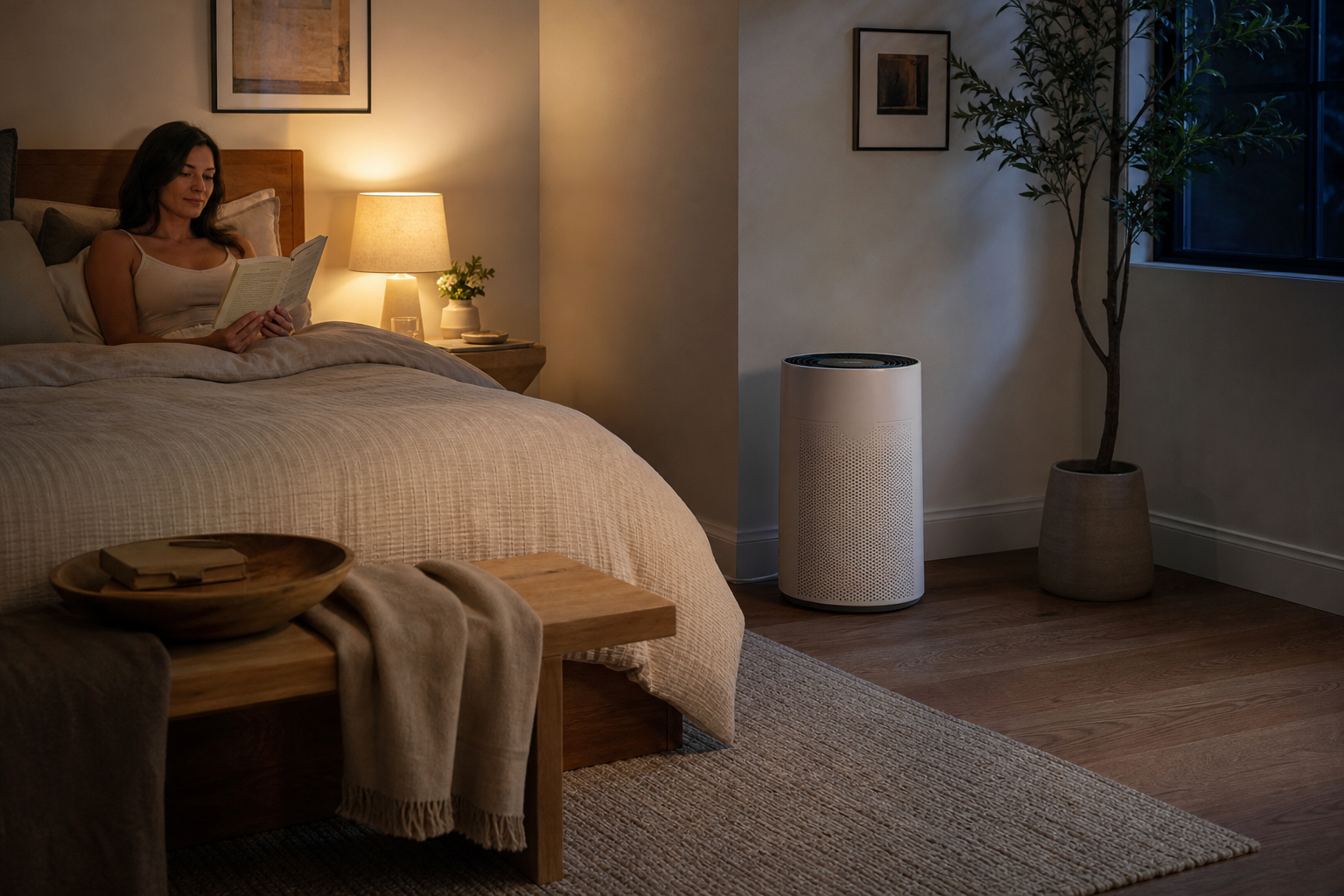
Place the purifier where air can enter and leave freely, usually on the floor or another location specified by the manufacturer. Keep it away from curtains, bedding, furniture, and other obstructions. It can sit near the bed if the airflow is comfortable, but it does not need to blow directly at your face. Avoid units that intentionally generate ozone; EPA advises against ozone-generating air cleaners in occupied spaces. ([epa.gov](https://www.epa.gov/indoor-air-quality-iaq/air-cleaners-hvac-filters-and-respiratory-viruses?utm_source=openai))
- Compare low-speed and sleep-mode noise, not only the loudest setting.
- Leave clearance around the intake and outlet.
- Use the purifier in the bedroom with the door closed if that is the space you want to clean.
- Avoid ozone-generating modes and devices.
Ready to Find Your Best Match?
Explore products that fit your priorities, compare current options and discover what works best for you.
Check prices, seller details and specifications on Amazon. Featured image is illustrative.
As an Amazon Associate I earn from qualifying purchases.
Sources & editorial note
This guide is research-based and does not claim hands-on testing unless explicitly stated.
- U.S. Environmental Protection Agency: Guide to Air Cleaners in the Home — Supports CADR-based sizing, the EPA room-size chart, ceiling-height considerations, noise, placement, filter replacement, and carbon-filter guidance.
- U.S. Environmental Protection Agency: Air Cleaners, HVAC Filters, and Respiratory Viruses — Supports choosing the correct room size, using smoke CADR or HEPA as comparison points, and avoiding intentionally ozone-generating air cleaners.
- U.S. Environmental Protection Agency: Indoor Air Filtration — Supports the two-thirds smoke-CADR rule, higher CADR guidance for smoke events, and selecting low-noise models.
- Association of Home Appliance Manufacturers: Tips for Choosing the Ideal Portable Room Air Cleaner — Supports the two-thirds rule and the use of smoke CADR when comparing portable room air cleaners.
- ENERGY STAR: Room Air Cleaners Key Product Criteria — Supports comparing reported smoke, dust, and pollen CADR and considering energy-efficiency information.