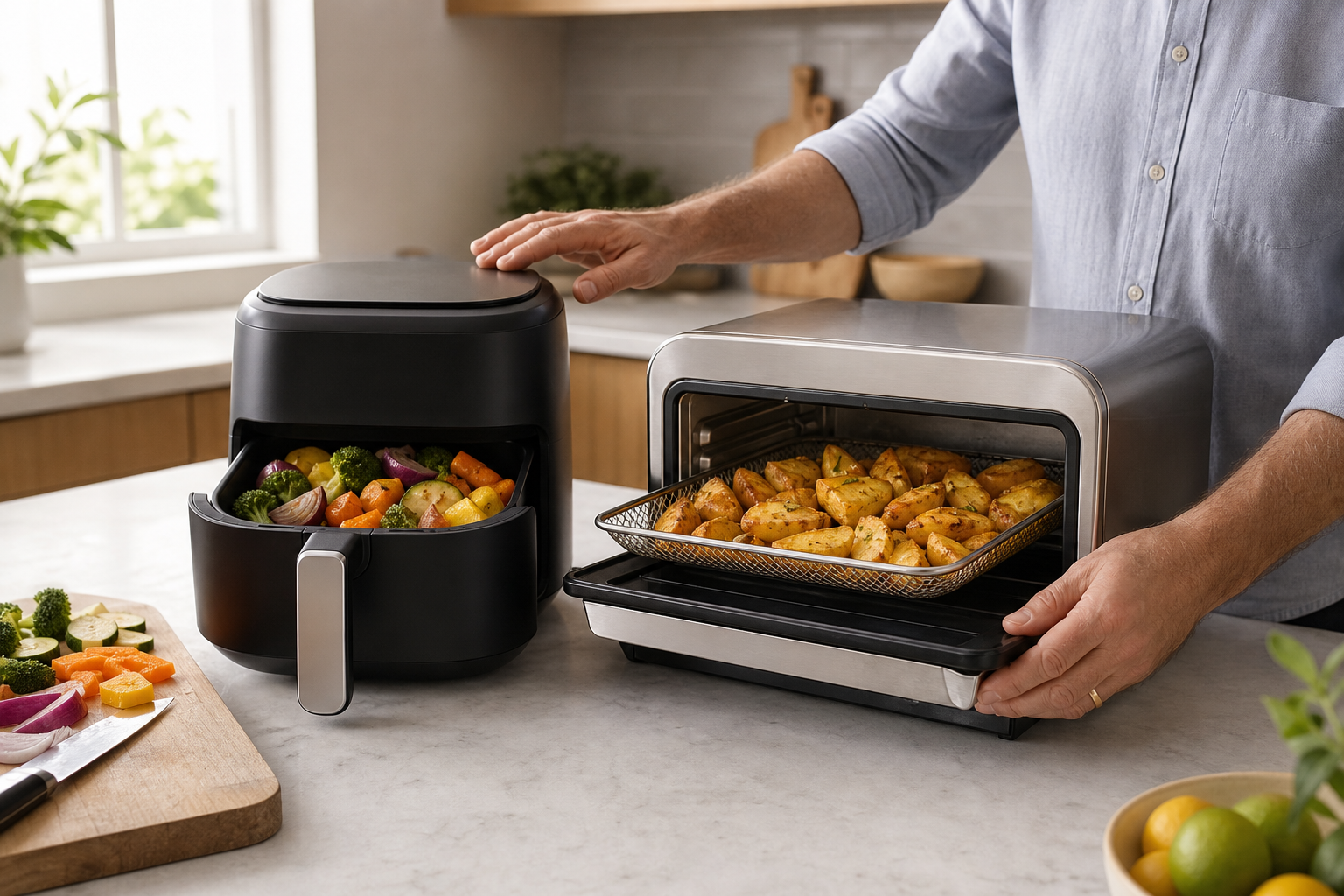
Choose a basket air fryer if your main goal is quickly cooking crisp portions of fries, vegetables, wings, fish, or reheated leftovers with minimal setup. Choose an oven-style air fryer if you want one appliance that can also toast, bake, broil, roast, reheat, or accommodate flatter foods and multiple racks. Neither format is automatically better: the right choice depends on whether you value focused air frying or greater cooking flexibility.
What Matters Most
Start with the job to be done
Before comparing capacities and presets, identify what you want the appliance to do on a typical weeknight. If the job is “make a portion of crisp food with little fuss,” a basket air fryer is usually the more direct fit. Its drawer-and-basket layout is designed around tossing food into a relatively compact cooking chamber, setting a temperature and time, and shaking or turning the food as needed.
If the job is broader—toast breakfast, roast vegetables, reheat pizza, bake a small dish, broil, or air fry a tray of food—an oven-style model makes more sense. These appliances resemble compact countertop ovens, often using racks, pans, and a mesh air-fry basket. For example, Breville’s Smart Oven Air Fryer Compact lists air fry alongside toast, bagel, pizza, broil, and bake-and-roast functions, while its larger Air Fryer Pro includes 13 cooking functions. ([breville.com](https://www.breville.com/en-us/product/BOV680?utm_source=openai))
The key distinction is not simply “small versus large.” It is focused air frying versus a more general countertop cooking system. A larger basket model may hold plenty of food but still be less useful for toast or a 9-by-13-inch dish; an oven-style model may do more but take longer to load, clean, and store.
Basket air fryer: best for focused, everyday cooking
Basket air fryers are at their best when the food benefits from concentrated hot-air circulation and a relatively shallow layer. Fries, chicken wings, breaded foods, roasted vegetables, fish portions, and reheated leftovers are natural use cases. The basket can usually be pulled out to shake or turn food, which helps expose more surfaces to the moving air.
The compact cooking chamber can also make a basket model feel quick and approachable. The U.S. Department of Agriculture describes air fryers as countertop convection ovens and notes that their smaller interiors can cook quickly while using less energy than a full-size oven. It also cautions that overcrowding restricts air circulation, so the advertised capacity is not always the same as the amount that will crisp well in one layer. ([fsis.usda.gov](https://www.fsis.usda.gov/food-safety/safe-food-handling-and-preparation/food-safety-basics/air-fryers-and-food-safety?utm_source=openai))
There are trade-offs. A round or squarish basket may make it harder to arrange flat foods, long cuts, sandwiches, or foods that need a baking pan. Many single-basket models also require batches when you want both a main dish and a side. Dual-basket designs address that limitation by letting you cook two foods independently; Ninja, for example, describes its dual-zone model as two separate cooking zones that can finish together or share settings. ([ninjakitchen.com](https://www.ninjakitchen.com/products/ninja-foodi-dz090c-5-in-1%2C-6-qt.-2-basket-air-fryer-with-dualzone-technology-zidDZ090C?SharedId=discoup.com&afsrc=1&bvstate=pg%3A3%2Fct%3Ar&clickid=Q5WwD10%3AixycW%3Aa19cxNAycYUksRQ2UhMxZAXA0&irgwc=1&utm_source=openai))
- Fits: crisp portions, frozen foods, vegetables, wings, fish, and reheating.
- Strengths: simple controls, easy food access, compact cooking path, strong everyday convenience.
- Watch-outs: batch cooking, limited flat surface, and capacity claims that may exceed the best crisping load.
Oven-style air fryer: best for versatility and flatter foods
An oven-style air fryer uses a front door, shelves, trays, or racks instead of a pull-out drawer. That layout can be more practical for toast, pizza, open-faced sandwiches, baked dishes, cookies, casseroles, and foods that need to lie flat. It may also let you cook on more than one level, although results can vary by rack position and recipe.
The broader format is useful when you want to replace or supplement a toaster oven. Breville’s larger Smart Oven Air Fryer Pro, for example, is specified to fit a 13-inch pizza, most 9-by-13-inch pans, a 12-cup muffin tray, and up to four dehydrating trays. Those specifications illustrate the kind of flexibility an oven-style design can offer, but they also show why dimensions matter: a model with a larger interior usually occupies more countertop space. ([breville.com](https://www.breville.com/en-us/product/bov900?bvstate=pg%3A24%2Fct%3Ar&sku=BOV900BSSUSC%29zu&utm_source=openai))
The trade-off is that air frying may be less grab-and-go. You may need to slide out a rack, use a tray, turn food with tongs, and wipe the interior after cooking. A mesh basket can give good airflow, but a tray beneath it may collect grease and crumbs. Oven-style units also require clearance around the door and ventilation areas, so measure the usable footprint rather than relying only on the listed width.
- Fits: toast, pizza, baking, roasting, broiling, reheating, and larger or flatter foods.
- Strengths: versatile accessories, shelf positions, and potential to replace a toaster oven.
- Watch-outs: larger footprint, more accessories to wash, and more attention to rack placement.
Capacity is about food shape, not just quarts
Capacity labels can be misleading because a basket’s volume and an oven’s usable surface area solve different problems. A deep basket may hold a substantial amount of food, but piling food too high can reduce crisping. Philips advises that its air-fryer basket generally performs best when fries are not filled to the maximum line, and recommends distributing meat in a single layer when possible. ([dev.usa.philips.com](https://dev.usa.philips.com/c-f/XC000003730/how-much-food-can-i-prepare-in-my-philips-airfryer?utm_source=openai))
For a single person or a couple, a compact basket may be enough for a main portion or side dish. For a household that regularly cooks different foods at the same time, a dual-basket model can be more convenient than one large basket because each compartment can have its own temperature and timing. The limitation is width: two narrow zones may not accommodate a broad casserole, whole pizza, or large flat cut.
An oven-style model is often better when the shape of the food matters more than maximum basket volume. A pizza, sheet-pan vegetables, toast, or a baking dish needs usable width and length. If you entertain or prepare several components at once, look for the manufacturer’s actual tray dimensions, rack positions, and recommended food loads—not just the headline capacity.
Counter space, cleanup, and daily friction
A basket model may have a smaller cooking footprint, but its height can be significant, especially with dual baskets. An oven-style model is often wider and deeper and needs room for the door to open. Before buying, measure the counter area from the wall outward, then check whether cabinets, outlets, and nearby appliances leave adequate clearance.
Cleanup depends more on the specific model than on the category name. Some basket air fryers have dishwasher-safe baskets or crisper plates. Instant’s Vortex 6-quart product page, for example, identifies its basket as top-rack dishwasher-safe, while Ninja’s dual-basket model lists dishwasher-safe crisper plates. ([instantpot.com](https://instantpot.com/products/instant-pot-vortex-6qt-air-fryer?utm_source=openai))
Oven-style units commonly include more pieces: racks, sheet pans, crumb trays, and mesh baskets. Some parts may be dishwasher-safe while others are hand-wash only. A Ninja Foodi oven guide, for example, says the air-fry basket and wire racks can go in the dishwasher but recommends hand washing several other accessories and the crumb tray. Always check the manual for the exact model, especially if easy cleanup is a deciding factor. ([support.ninjakitchen.com](https://support.ninjakitchen.com/hc/en-us/article_attachments/5061879996316?utm_source=openai))
Which one should you buy?
Choose a basket air fryer when you want the simplest path to crisp food and expect to use the appliance several times a week. It is a strong match for cooks who prepare modest portions, reheat leftovers often, prefer a pull-out basket, or do not need toast and baking functions. If you choose a single-basket model, make sure its usable cooking area matches the portions you actually make; if you often need a main and side at once, consider a dual-basket design.
Choose an oven-style air fryer when you want to consolidate appliances or cook foods that need a flat surface. It is the better fit for someone who wants toast, pizza, baking, roasting, broiling, or multiple rack positions in addition to air frying. It can also be more convenient for foods that are awkward to shake in a drawer, although cleaning and preheating may involve more steps.
Whichever style you buy, treat capacity claims as a starting point rather than a promise of one-batch crispness. Follow the manufacturer’s loading guidance, avoid overcrowding, and use a food thermometer for meat and poultry. USDA guidance says poultry should reach 165°F, ground meats 160°F, and fish 145°F, regardless of whether the food is cooked in a basket or oven-style appliance. ([fsis.usda.gov](https://www.fsis.usda.gov/food-safety/safe-food-handling-and-preparation/food-safety-basics/air-fryers-and-food-safety?utm_source=openai))
A practical buying checklist
For a basket model, compare the shape of the cooking surface, not only the stated quart capacity. Look for a basket that can hold the portions you cook without forcing you to stack food deeply. Check whether the basket and crisper plate are dishwasher-safe, whether the drawer feels manageable when full, and whether the controls make it easy to pause and shake.
For an oven-style model, check the interior dimensions and included accessories. Confirm whether it fits the pan, pizza size, or baking dish you already use. Look at the number of rack positions, the placement of the air-fry basket above a drip tray, the cleaning instructions, and the space required when the door is open.
Finally, decide where the appliance will live. If it will remain on the counter, choose the format whose footprint you can tolerate every day. If it must be stored, favor the lighter and easier-to-handle option. A technically more versatile appliance is not the better buy if its size or cleanup keeps you from using it.
Sources & editorial note
This guide is research-based and does not claim hands-on testing unless explicitly stated.
- USDA Food Safety and Inspection Service: Air Fryers and Food Safety — Supports how air fryers circulate hot air, the effect of overcrowding, and safe cooking guidance.
- Breville Smart Oven Air Fryer Compact — Supports oven-style functions, accessories, and example countertop capacity.
- Breville Smart Oven Air Fryer Pro — Supports oven-style interior dimensions, rack and tray flexibility, and cooking functions.
- Philips: How much food can I prepare in my Airfryer? — Supports the distinction between maximum basket capacity and recommended loading for airflow.
- Instant Pot Vortex 6QT Air Fryer — Supports an example of top-rack dishwasher-safe basket construction.
- Ninja Foodi XL Pro Air Oven Owner’s Guide — Supports the more involved accessory and cleaning considerations of an oven-style model.